
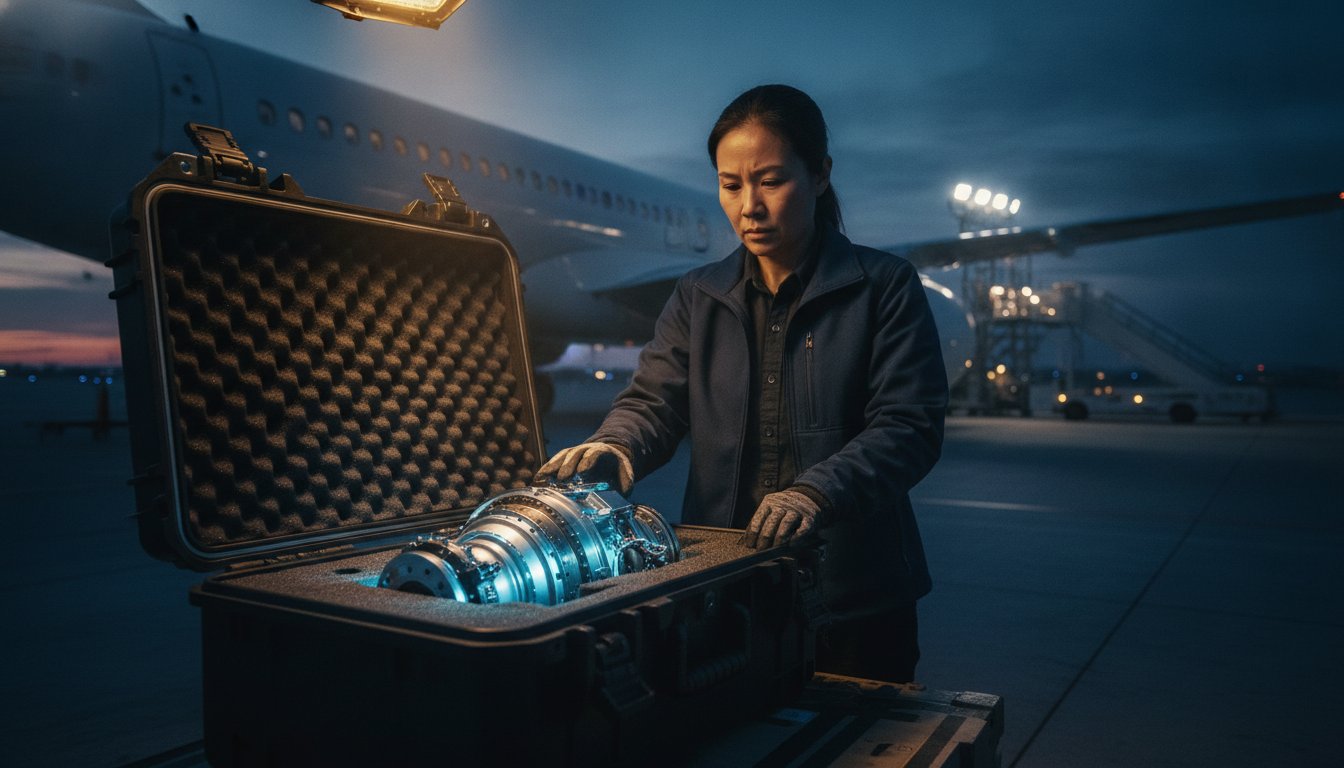
An Aircraft on Ground event can bleed between $10,000 and $150,000 every single hour the engines remain cold. When a commercial narrow-body jet is stranded, the financial hemorrhage isn’t just a line item; it’s an operational crisis that demands immediate, flawless execution. You understand that standard freight is never an option when revenue evaporates by the minute and flight schedules collapse. Implementing specialized AOG shipping solutions is the only way to bypass the bottlenecks and customs delays that typically paralyze global aerospace supply chains.
The pressure to restore operations is immense, and the margin for error is non-existent when managing high-value components or ITAR-regulated parts. This article will show you how to eliminate operational friction and slash aircraft-on-ground costs through specialized aerospace logistics and expedited customs protocols. We’ll examine the mechanics of zero-delay delivery, the necessity of full cargo visibility, and the rigorous trade compliance strategies required to navigate a volatile regulatory environment. You’ll discover how a methodical, precision-based approach to logistics transforms a high-pressure grounding into a controlled, successful recovery.
Key Takeaways
- Quantify the massive financial impact of downtime and learn to prioritize logistics based on hourly revenue loss.
- Discover how specialized AOG shipping solutions protect sensitive avionics and manage the complexities of oversized aerospace freight.
- Evaluate the speed and reliability of Next Flight Out (NFO) and dedicated air charters for time-sensitive component recovery.
- Master the intricacies of ITAR and EAR compliance to eliminate the regulatory delays that frequently stall high-value shipments.
- Learn how to leverage a strategic logistics partnership to maintain 24/7/365 operational readiness for any grounding event.
The High Stakes of Aircraft on Ground (AOG) Situations
A technical grounding is more than a delay. It’s a financial emergency. An Aircraft on Ground (AOG) status occurs when a mechanical issue prevents flight, instantly halting revenue generation. For a commercial narrow-body jet, the cost of downtime ranges from $10,000 to $150,000 per hour. These aren’t just theoretical numbers. They represent lost ticket sales, missed cargo deadlines, and the massive expense of re-routing passengers. On a global scale, flight disruptions cost the airline industry approximately $60 billion annually, which is roughly 8% of total revenue. Standard freight protocols simply can’t handle this level of pressure.
Routine logistics prioritize cost-efficiency and consolidated routes. Specialized AOG shipping solutions, however, prioritize the clock. When a plane is stuck on the tarmac, the ripple effect moves fast. One grounded aircraft can disrupt an entire global flight network, causing a cascade of delays that affect supply chains and passenger connections thousands of miles away. This mismatch between routine logistics and AOG urgency is where most operations fail. You need a partner who understands that every minute represents a tangible loss of capital.
The Anatomy of an AOG Emergency
Emergencies rarely happen on a schedule. Common triggers include sudden mechanical failures, bird strikes, or scheduled maintenance that uncovers unexpected, critical wear. This creates a “Line Down” mentality. In this high-stakes environment, every stakeholder, from Maintenance (MRO) teams to Operations and Procurement officers, must move in perfect synchronization. There’s no time for departmental silos. The objective is singular: get the part to the hangar and the aircraft back in the sky.
AOG Logistics vs. Routine Aerospace Shipping
Routine shipping involves predictable schedules and standard processing queues. AOG logistics demands priority status that bypasses these traditional bottlenecks. Successful recovery requires 24/7/365 operational control towers that provide constant oversight and immediate intervention. It isn’t enough to track a package; you must command its movement through every customs checkpoint and transit hub. AOG logistics is the elite tier of expedited freight, functioning as a mission-critical recovery operation rather than a simple transport service.
Effective expedited shipping ground and air solutions ensure that high-value components move without friction. In the aerospace industry, precision is the only currency that matters. When the stakes are this high, composure and technical excellence are the only tools that prevent a crisis from becoming a catastrophe.
Technical Requirements for Aerospace Component Transport
Speed is a liability without precision. In the context of AOG shipping solutions, delivering a part fast but damaged is effectively a double failure. High-value avionics and sensitive flight controls require rigorous protection against vibration, Electrostatic Discharge (ESD), and environmental fluctuations. These aren’t standard parcels; they’re mission-critical assets that demand specialized environmental controls and secure handling protocols from the moment they leave the shelf.
Managing oversized aerospace cargo like engines, landing gear, or wing sections introduces massive operational complexity. These components often require oversize freight handling capabilities that go beyond standard equipment. If an engine’s center of gravity is miscalculated or a landing gear assembly isn’t properly braced, the structural integrity of the part is compromised before it even reaches the hangar. Precision crating isn’t an optional add-on; it’s a fundamental requirement for maintaining the airworthiness of the asset.
Protecting High-Value Avionics and Engines
Precision components require active monitoring. We utilize shock-watch and tilt-meter sensors to provide a verifiable record of handling throughout the transit. This data is essential for Non-Destructive Testing (NDT) equipment, where even a minor drop can render the calibration useless. Utilizing expert packaging and crating services is the primary defense against secondary delays caused by transit damage. Custom-engineered crates ensure that every component, from a turbine blade to a cockpit display, remains immobilized and protected against the physical stresses of expedited transport.
Chain of Custody and Visibility
Visibility must be absolute. Milestone updates are insufficient when an aircraft is grounded and costs are mounting. We provide real-time GPS tracking to ensure you know the exact location of your cargo at any given second. This oversight extends to documentation verification. A single discrepancy on a packing list or a missing FAA/EASA certification can ground a shipment at a customs terminal for days. Our team verifies all paperwork against the physical cargo before departure to ensure total alignment with regulatory standards. Technical handling is the only way to ensure a part is “flight-ready” upon delivery. If you’re managing a sensitive recovery and need to guarantee integrity, you can consult with a technical logistics specialist to secure your supply chain.
Evaluating AOG Transport Modes: Air, Ground, and Hand-Carry
Selecting the right transit mode is a strategic decision that determines the speed of recovery. For global distances, Next Flight Out (NFO) is the standard, utilizing the existing commercial airline network to move parts on the first available departure. When components are too large for commercial holds or the destination is a remote airfield, a dedicated Air Charter becomes the only viable path. In regional scenarios, particularly within the Michigan, Ohio, and Ontario corridor, expedited ground shipping offers a controlled, high-speed alternative that avoids the complexities of airport transfers. Effective AOG shipping solutions rely on matching the transport mode to the specific urgency and dimensions of the cargo.
When to Deploy Hand-Carry Services
Hand-Carry (On-Board Courier) services provide the most secure, “white glove” solution available for mission-critical parts. By placing a specialized courier on a flight with the component as carry-on or checked baggage, you bypass the standard cargo terminal entirely. This methodology effectively eliminates the risk of terminal delays or mishandling at transit hubs. It’s the ideal choice for small, high-value actuators, circuit boards, or specialized fasteners that require constant supervision from origin to destination. Utilizing hand-carry logistics ensures the fastest possible “last mile” delivery by removing the part from the traditional freight ecosystem.
Strategic Air Freight and Ground Integration
Strategic integration of modes often centers on geographic hubs. Leveraging air freight Detroit Michigan assets allows for seamless international AOG recovery due to the proximity to Detroit Metropolitan Airport (DTW). However, the flight is only half the battle. The “final mile” challenge requires coordinating hot-shot trucking for immediate airport-to-hangar delivery. This requires a synchronized hand-off between air and ground teams to ensure the momentum isn’t lost at the gate.
Choosing between these modes requires a clear evaluation matrix. You must weigh the cost of the transport against the hourly revenue loss of the grounded asset. When the cost of a charter is lower than another hour of downtime, the decision is clear. Composure in these high-stakes moments comes from having a methodical selection process for AOG shipping solutions that prioritizes the operational outcome over the mode of transport. We focus on the fastest path to “flight-ready” status, regardless of the medium used to get there.
Navigating Customs and ITAR Compliance in AOG Logistics
Speed is irrelevant if a component is sitting in a customs warehouse. In the high-pressure environment of aerospace recovery, the compliance bottleneck is the most frequent cause of mission failure. Even a minor clerical error on a commercial invoice can lead to an indefinite hold, compounding the $150,000-per-hour loss of a grounded aircraft. Proactive AOG shipping solutions solve this by initiating pre-clearance protocols while the asset is still in the air. We don’t wait for the wheels to touch the tarmac to begin the verification process.
ITAR Compliant Logistics for Defense Contractors
Managing high-security defense cargo requires a level of oversight that standard freight forwarders can’t provide. Compliance with the International Traffic in Arms Regulations (ITAR) and Export Administration Regulations (EAR) is non-negotiable for government and D.O.D. assets. As of September 2025, revisions to 15 of the 21 U.S. Munitions List (USML) categories have made expert classification more critical than ever. We provide ITAR compliant logistics that ensure every shipment meets the strict security and reporting standards of the DDTC. This includes managing high-value assets where annual registration fees start at $3,000, demanding a logistics partner who understands the financial and legal gravity of every transaction.
Expediting Cross-Border Movement
The Detroit-Windsor corridor and Mexico to USA shipping routes are vital arteries for North American aerospace manufacturing. Navigating these borders requires more than just a truck; it requires a deep understanding of bonded warehousing and Foreign Trade Zones (FTZs). By leveraging these tools, we minimize duties and prevent the inspections that typically stall expedited cargo. Trade compliance is the silent engine of AOG speed. Without it, the fastest transport mode in the world is at the mercy of a border agent’s desk. You can’t afford a regulatory delay when every second counts. If you have a time-critical cross-border requirement, contact our compliance team to secure your next mission.
Mission-Critical AOG Execution with ICAT Detroit
Success in aerospace recovery depends on more than just speed. It requires a tactical base of operations. Based in Taylor, Michigan, ICAT Detroit is strategically positioned as a hub for North American aerospace logistics. Our proximity to Detroit Metropolitan Airport (DTW) and major manufacturing corridors allows us to deploy assets within minutes of a grounding notification. This isn’t just about geography; it’s about a total integration of services. We combine air freight, expedited ground solutions, and in-house customs expertise to ensure that your AOG shipping solutions move without friction or hand-off delays.
Global aviation operates on a 24/7/365 cycle. We do the same. Our team remains operational during holidays, weekends, and overnight shifts because an aircraft doesn’t wait for business hours to fail. We provide a steady, expert hand in high-pressure scenarios where the margin for error is zero. We take full ownership of the outcome. Failure is not a variable we consider. When you trust us with a mission-critical part, you’re gaining a partner that views your uptime as the only valid metric of our performance.
Why ICAT Detroit is the Partner for Aerospace Leaders
Our expertise spans the most demanding sectors of modern industry. We have deep roots in the aerospace industry and the rapidly evolving automotive-EV landscape. This cross-sector experience allows us to apply rigorous Standard Operating Procedures (SOPs) to every recovery mission. These SOPs aren’t generic templates; they’re customized frameworks designed to ensure repeatable excellence for every client. For example, when a Tier 1 aerospace supplier recently faced a critical line-down scenario, our team coordinated a multi-modal recovery that combined hand-carry services with hot-shot ground transport. We restored the supply chain and prevented a catastrophic production halt, proving that precision is the best defense against downtime.
Taking the Next Step: Immediate AOG Support
Initiating a recovery mission requires immediate, accurate data. When you contact our team, we move into action the moment we have your component dimensions, weight, and the specific tail number of the grounded aircraft. We don’t just provide a price; we provide a comprehensive recovery plan that accounts for weather, terminal congestion, and regulatory requirements. Our goal is to move your cargo within minutes of your authorization. If you’re facing a grounding event right now, the time for deliberation has passed. You need a partner who can execute immediately. Request an AOG Quote Now to secure the fastest path back to flight-ready status.
Restoring Operational Flight Readiness
The cost of a grounded aircraft is a constant, compounding threat to your bottom line. Precision handling, regulatory mastery, and strategic transport selection form the backbone of a successful recovery. Every minute saved through proactive customs pre-clearance and specialized technical packaging directly preserves your revenue and network integrity. You’ve identified the risks; now you must deploy the expertise required to mitigate them.
Effective AOG shipping solutions require more than just speed; they demand a partner who takes full ownership of the mission. By leveraging our strategic Detroit hub location and ITAR compliant protocols, you ensure that high-value components move without the friction that stalls standard freight. Our 24/7/365 aerospace desk stands ready to navigate the complexities of global logistics so your team can focus on the hangar. We provide the composure and technical excellence necessary to manage high-stakes recoveries with absolute certainty.
Reliability is the only currency that matters when the engines are cold. You can trust our steady hand to manage the pressure and deliver results when the margin for error is non-existent. We’re ready to move when you are.
Secure Your Mission-Critical AOG Solution
Frequently Asked Questions
What is the difference between AOG and expedited shipping?
AOG shipping solutions represent the highest priority tier in logistics, where speed is non-negotiable and recovery is the only objective. While expedited shipping focuses on fast transit, AOG includes specialized technical handling, 24/7 active monitoring, and immediate bypass of standard freight queues. It’s a mission-critical recovery service designed specifically for grounded aircraft, whereas expedited shipping is a broader category for time-sensitive cargo that doesn’t necessarily carry the same hourly financial penalties.
How much does AOG shipping typically cost?
Pricing for these services is determined by the specific transport mode, dimensions of the component, and the required delivery window. AOG shipping solutions often utilize Next Flight Out (NFO) services, which can cost three to eight times the standard air cargo rate, or dedicated air charters for larger components. The investment in these specialized logistics is typically weighed against the massive hourly revenue loss of a grounded aircraft. We focus on the fastest path to flight readiness.
Can you handle ITAR-controlled aerospace components?
Yes, we maintain deep expertise in managing ITAR-controlled and EAR-regulated cargo for defense contractors and government agencies. Our protocols ensure that high-value assets are handled in strict accordance with the U.S. Munitions List requirements. We manage the necessary security and documentation to prevent regulatory delays, providing a steady hand for mission-critical defense recovery. This specialized oversight is essential for maintaining compliance while meeting the extreme urgency of an aircraft-on-ground event.
Do you offer 24/7 support for AOG emergencies?
Operational readiness is absolute, and our team is available 24/7/365 to manage any grounding crisis. We don’t rely on after-hours answering services; our aerospace specialists are active and ready to initiate recovery missions at any time, including weekends and holidays. Because an AOG event can occur at any hour, our “Control Tower” approach ensures that communication and logistics execution remain seamless and immediate, regardless of when the request for support arrives.
What is an On-Board Courier (OBC) in AOG logistics?
An On-Board Courier, or Hand-Carry service, involves a specialized professional who personally supervises your component from origin to final destination. This courier travels on the first available flight with the part as carry-on or checked baggage, effectively bypassing cargo terminals. It’s the fastest way to move small, mission-critical parts like actuators or circuit boards. This method provides the highest level of security and visibility, ensuring the part reaches the hangar without traditional transit delays.
How do you ensure customs don’t delay an AOG shipment?
We utilize proactive pre-clearance strategies to ensure documentation is verified and submitted while the cargo is still in transit. By working with specialized brokers who understand aerospace tariff codes, we resolve potential discrepancies before the part arrives at the border. This methodical approach, combined with our knowledge of bonded warehousing and Foreign Trade Zones, effectively eliminates the administrative bottlenecks that typically stall international shipments. Flawless trade compliance is the engine that drives our delivery speed.
Which aerospace hubs does ICAT Detroit serve?
Our Taylor, MI location serves as a strategic hub for the Detroit Metropolitan Airport (DTW) and the critical aerospace manufacturing corridor spanning Michigan, Ohio, and Ontario. We provide seamless logistics integration for major North American hubs and maintain global reach through an elite network of aerospace partners. Whether your aircraft is grounded in a primary hub or a remote regional airfield, our team coordinates the fastest air and ground routes to restore your operational status.
What documentation is required for international AOG shipping?
International recovery requires a precise documentation package to clear customs without friction. This typically includes a detailed commercial invoice, a comprehensive packing list, and the necessary FAA Form 8130-3 or EASA Form 1 certifications. For defense-related components, ITAR or EAR export licenses and Shippers Letter of Instruction are mandatory. We verify all paperwork against the physical cargo before departure, ensuring that every document is accurate and fully compliant with the destination’s regulatory requirements.