

In high-stakes industrial logistics, a single hairline fracture in a wooden crate isn’t just a packing error. It’s a potential multi-million dollar supply chain failure. You understand that when mission-critical machinery stops, the entire operation bleeds revenue. The pressure to avoid line-down scenarios is relentless, especially as global standards like the mandatory 2026 ISPM-15 hyphen requirement and evolving ITAR regulations add layers of complexity to every shipment. Securing specialized packaging and crating services freight providers is no longer a peripheral logistics task. It’s the primary engineering solution that prevents catastrophic loss during global transit.
Precision is the only defense. We recognize the anxiety that comes with shipping one-of-a-kind assets in a tightening market where truckload tender rejection rates have climbed toward 14% in mid-2026. This guide provides the roadmap to ensure your high-value freight arrives in perfect condition while maintaining full compliance with international law. You’ll discover how precision-engineered crating mitigates risk, streamlines customs clearance, and integrates seamlessly into an expedited shipping plan. We’ll break down the technical standards required for zero-damage delivery so you can maintain operational control when the margin for error is non-existent.
Key Takeaways
- Understand why custom-engineered crating is the only viable defense against the physical stresses of air, ocean, and ground transport for industrial assets.
- Navigate the rigid 2026 ISPM-15 wood marking requirements and ITAR protocols to prevent costly border delays and regulatory failures.
- Leverage specialized packaging and crating services freight to protect high-value cargo with technical internal barriers, including anti-static materials and shock absorption.
- Evaluate the strategic advantages of on-site versus off-site crating to minimize handling risks for massive or exceptionally fragile machinery.
- Discover how to integrate precision packaging into an expedited logistics plan to eliminate the threat of catastrophic line-down situations.
The Strategic Importance of Packaging and Crating Services in Freight
In the high-stakes environment of global trade, a crate is far more than a wooden box. It is a custom-engineered protective system designed to neutralize the dynamic forces of air, ocean, and ground transport. When you move high-value industrial equipment, you aren’t just fighting gravity; you’re contending with lateral G-forces during aircraft maneuvers, constant harmonic vibration on container ships, and the unpredictable shocks of rough road transit. Standard shipping crates provide a basic shell, but professional packaging and crating services freight solutions provide a calculated defense against these physical variables.
Standard packaging frequently fails because it assumes a uniform stress load. Industrial assets like turbines, medical imaging arrays, or aerospace components are rarely uniform. They possess off-center gravity points and delicate internal calibrations that standard dunnage cannot protect. A failure in the packaging phase doesn’t just lead to an insurance claim; it triggers a catastrophic chain reaction. While an insurance payout might cover the hardware, it won’t recover the lost time, the reputational damage, or the massive “line-down” costs that accumulate when a critical part arrives broken. This level of protection is a foundational pillar of mission critical cargo logistics, where every minute of delay translates into lost operational capability.
Mitigating Risk in High-Stakes Transportation
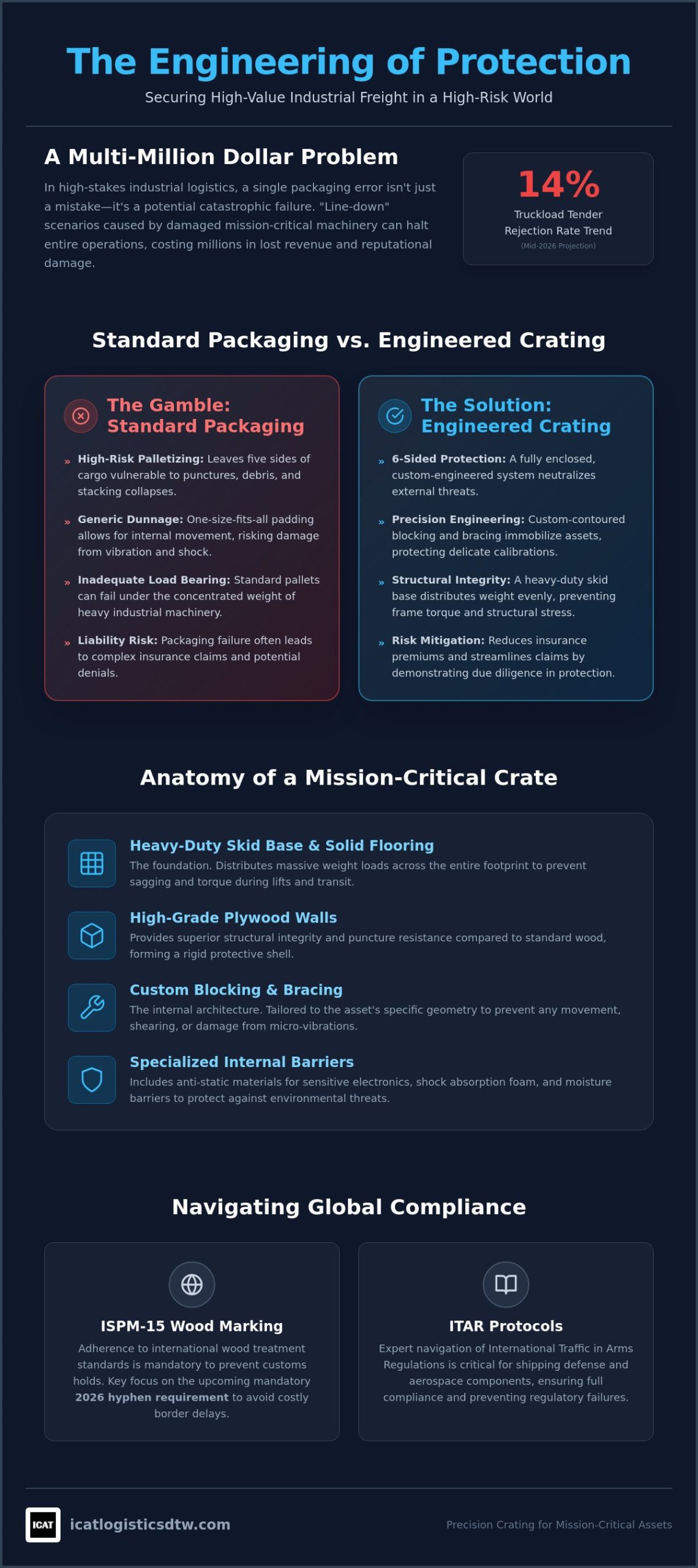
The global freight journey is riddled with “vulnerability points” where cargo is most at risk. These include intermodal transfers, crane lifts, and customs inspections where assets are handled by third-party personnel. Precision packaging and crating services freight providers identify these points during the design phase to reinforce structural weak spots. Effective crating significantly reduces insurance premiums and the likelihood of claim denials, as insurers often scrutinize packaging quality before honoring high-value policies. Crate engineering is a fusion of structural integrity and logistical efficiency.
The Difference Between Packaging and Engineering
There is a vast technical gap between simple packaging and true logistics engineering. Standard dunnage relies on generic padding, whereas mission-critical protection utilizes custom-contoured blocking and bracing tailored to the asset’s specific geometry. One-size-fits-all solutions are a liability for oversized freight; they allow for internal movement that can shear bolts or crack sensitive housings. Precision is the only acceptable standard. For high-value assets, the internal architecture of the crate must be as sophisticated as the machinery it protects, utilizing advanced materials to ensure the cargo remains immobile and isolated from external environmental threats.
Custom Wood Crates vs. Standard Packaging: Engineering for High-Value Cargo
Standard palletizing is a high-risk gamble when the asset is irreplaceable. A pallet provides a platform, but it leaves five sides of the cargo vulnerable to forklift punctures, debris, and stacking collapses. Professional packaging and crating services freight providers replace this vulnerability with a six-sided engineering solution. While a standard pallet might fail under 2,500 pounds of concentrated industrial weight, an engineered crate utilizes a heavy-duty skid base to distribute the load across the entire footprint. This structural integrity is non-negotiable for oversized equipment that requires precise weight distribution to prevent frame torque during transit.
Before finalizing your logistics plan, consult the high-value cargo shipping checklist to determine if your asset requires this level of structural intervention. Custom crating is not an accessory; it’s a requirement for any asset where the cost of failure exceeds the cost of the move.
Anatomy of a Mission-Critical Crate
The foundation of a high-performance crate starts at the base. For massive machinery, solid flooring is mandatory to prevent sagging. Wall construction moves beyond simple wood; high-grade plywood provides superior puncture resistance compared to thin dimensional lumber slats. Fastening systems remain the final point of failure. We utilize cleated ends and reinforced corners to ensure the crate maintains its geometric integrity even when stacked in a high-density cargo hold. This level of precision allows for safe movement through the chaotic environments of global hubs.
Internal Climate and Impact Control
Physical impact is only one threat. Environmental corrosion can ruin a calibrated instrument before it reaches its destination. For transoceanic shipments, vapor barrier packaging is the standard. We use vacuum-sealed Mil-Spec bags and industrial desiccants to eliminate moisture and salt-air exposure. Sensitive electronics require anti-static materials to prevent latent ESD damage. For impact mitigation, custom-cut foam inserts provide exact deceleration rates, far surpassing the inconsistent protection of generic dunnage. Every interior component is designed to keep the asset immobile and isolated.
To maintain total oversight, we integrate “tilt” and “shock” monitoring technology. These sensors act as a digital witness. If a crate is tipped beyond a 30-degree angle or subjected to a G-force impact exceeding pre-set thresholds, the indicator provides immediate, irrefutable evidence of mishandling. This transparency is vital for insurance documentation and technical inspections upon delivery. Integrating these engineering standards into your project logistics strategy ensures that your most valuable assets remain protected against both environmental elements and human error.
Compliance and Protection: ISPM-15, ITAR, and Specialized Industrial Standards
Engineering excellence is irrelevant if your shipment is seized at the border. In 2026, regulatory compliance has become a binary pass or fail metric for global logistics. Professional packaging and crating services freight providers act as the final gatekeeper, ensuring that every piece of timber and every security seal meets rigid international law. A single oversight in wood treatment or a missing hyphen in a certification mark can result in the immediate re-export of your mission-critical assets at your expense. When you are moving high-value machinery, compliance isn’t a suggestion; it’s a non-negotiable requirement for entry into the global market.
The most immediate threat to international transit is the full enforcement of the ISPM-15 hyphen requirement, which began on January 1, 2026. U.S. Customs and Border Protection (CBP) and APHIS now mandate that all Wood Packaging Material (WPM) must feature a compliant mark with a hyphen separating the country code and the facility code. This is a zero-tolerance standard. Beyond the wood itself, defense-related shipments must navigate the complexities of the International Traffic in Arms Regulations (ITAR). For manufacturers in the Great Lakes region, partnering with ITAR compliant logistics Michigan experts ensures that your packaging protocols align with the latest DDTC Revision 5.2 guidelines released in June 2026.
International Export Crating Requirements
The IPPC “Wheat” stamp is the only universal language customs officials recognize. This mark proves the wood has been heat-treated to 56 degrees Celsius for 30 minutes to eliminate pests. For freight moving through Mexico or Canada, documentation must be flawless to avoid the “refused entry” nightmare. Non-compliant timber doesn’t just cause a delay; it can lead to the total impoundment of the cargo, triggering the very line-down situations your logistics plan was designed to prevent.
Defense and Aerospace Standards
Standard commercial crating is insufficient for defense-sector requirements. Mil-Spec packaging demands specific atmospheric barriers and tamper-evident sealing to maintain a secure chain of custody. As of the June 15, 2026, proposed rules for ITAR Part 130, electronic submission and consolidated reporting have become the new standard for compliance. We integrate these security protocols into our project logistics framework, ensuring that oversized defense equipment is not only physically protected but also legally shielded from seizure or regulatory fines. Precision in documentation is as vital as precision in the crate’s structural build.
Operational Logistics: Evaluating On-Site vs. Off-Site Crating Services
The decision of where to crate your assets is a strategic choice that dictates the risk profile of the entire shipment. Handling is the primary enemy of precision machinery. For massive industrial turbines or sensitive medical imaging arrays, moving the asset twice, once to a crating facility and once to the final destination, doubles the probability of a transit incident. Professional packaging and crating services freight providers offer on-site mobilization to eliminate this unnecessary movement. By bringing the engineering team to your facility, the asset is secured in its final shipping configuration before it ever touches a trailer or a crane.
This operational synchronization is essential for expedited freight shipping Detroit schedules. In the automotive and defense sectors, where “line-down” costs are measured in thousands of dollars per minute, the crating process must be a seamless extension of the production line. If you are managing a complex relocation or a mission-critical export, you can partner with a logistics expert to determine the most efficient crating location for your specific cargo requirements.
The On-Site Crating Process
On-site crating begins long before a crew arrives at your dock. We utilize CAD drawings and technical specifications to pre-engineer the crate components in a controlled environment. This allows for rapid mobilization of materials and specialized crews to your facility. Once on-site, the team performs real-time adjustments to account for unexpected equipment configurations or external sensors that may not have been in the original blueprints. This flexibility ensures a perfect fit, which is the only way to guarantee the cargo remains immobile during the high-G maneuvers of air or ocean transit.
Rigging and Loading Integration
The hand-off between rigging teams and crating specialists is a critical vulnerability point. Structural alignment must be verified before the crate is sealed. We identify and mark the center of gravity (CoG) and specific lift points on the exterior of the crate. This provides unmistakable instructions for crane operators and forklift drivers at every transfer point in the global supply chain. By coordinating site surveys to assess floor loads and clearances before the move begins, we secure the last mile of protection before the truck departs. Precision at the point of origin is the only way to ensure zero-damage delivery at the point of destination.
Securing the Supply Chain: Why ICAT Detroit Leads in Precision Crating
Precision is the only currency that matters in high-stakes logistics. At ICAT Detroit, we understand that a crate is not a commodity; it’s a structural extension of the asset it protects. We integrate packaging and crating services freight solutions directly into a comprehensive transportation management strategy. This eliminates the dangerous disconnect between the packaging team and the carrier. For the automotive and defense sectors, where the margin for error is non-existent, this unified approach ensures every variable is neutralized before the asset leaves the facility floor.
Our operation is strategically located in Taylor, Michigan, positioned to serve as the primary logistics hub for the Midwest’s industrial powerhouse. We specialize in the handling of oversized cargo and complex project logistics that standard providers are not equipped to manage. In a 2026 freight market where truckload tender rejection rates have climbed to 14 percent, reliability is the ultimate competitive advantage. The ICAT promise is rooted in flawless execution. We take full ownership of the outcome, projecting a mentality where failure is not an option for high-value, time-critical freight.
A Partner in Mission-Critical Logistics
We provide single-point accountability for both the technical packaging and the global transportation of your assets. This “one hand to shake” model ensures that compliance with ITAR protocols and ISPM-15 standards is woven into the shipping plan from day one. You gain real-time visibility and proactive communication, ensuring you are never left guessing about the status of a crated asset. Our team thrives on solving the most difficult oversized and project logistics challenges, moving massive machinery with the same exactness required for sensitive aerospace components.
Next Steps for Your High-Value Freight
Securing your 2026 logistics budget requires a proactive look at risk mitigation. If you have an upcoming move involving mission-critical assets, the time to plan is now. A technical crating evaluation allows our engineers to assess your equipment’s specific vulnerabilities and design a custom solution that fits your timeline and budget. This prevents the high costs of transit damage and the operational nightmare of “line-down” situations. We invite you to consult with an ICAT expert to develop tailored protection strategies that secure your most valuable industrial assets. By integrating specialized packaging and crating services freight into your early-stage planning, you ensure that your supply chain remains resilient regardless of global transit conditions.
Secure Your 2026 Global Transit Strategy
In the high-stakes landscape of 2026, the margin for error in industrial logistics has effectively vanished. We’ve established that custom-engineered protection is the only way to neutralize the dynamic forces of global transit. Rigid adherence to ISPM-15 and ITAR standards is now a binary requirement for market entry. Whether you’re managing a “line-down” emergency or moving sensitive defense technology, the integrity of your packaging and crating services freight provider is the primary factor in supply chain resilience.
ICAT Detroit provides the steady, expert hand required to navigate these chaotic scenarios. From our Taylor, Michigan hub, we deliver ITAR-compliant expertise and specialized handling for oversized and project cargo. We don’t just build a box; we deliver a comprehensive engineering solution that integrates with your expedited shipping needs. Take total ownership of your delivery outcomes and eliminate the risk of transit damage. Request a Precision Crating and Freight Quote from ICAT Detroit to secure your mission-critical assets. Our team is ready to deploy the precision and reliability your operation demands.
Frequently Asked Questions
What is the difference between a crate and a pallet for freight shipping?
A crate provides total six-sided protection and structural reinforcement, whereas a pallet is merely a base platform that leaves five sides of your cargo exposed. For high-value assets, a crate acts as a protective engineering solution that withstands lateral forces and stacking pressures. Utilizing specialized packaging and crating services freight over standard palletizing is the only way to guarantee the physical isolation of sensitive industrial equipment during transit.
Is ISPM-15 certification required for all international crating services?
ISPM-15 certification is mandatory for all wood packaging material moving through international customs to prevent the spread of invasive pests. As of January 1, 2026, all marks must include a hyphen between the country and facility codes to be considered compliant. Failure to meet these heat-treatment standards results in immediate shipment rejection and potential fines at the border, regardless of the cargo’s value.
Can crating services be performed on-site at my manufacturing facility?
Yes, performing crating on-site is the preferred strategy for massive or exceptionally fragile machinery. By building the crate at your facility, you eliminate the risk of damage during the initial transit to a packing warehouse. Our teams mobilize with pre-engineered components to secure the asset in its final shipping configuration directly on your production floor, minimizing handling points.
How much does custom crating add to the total cost of freight shipping?
Custom crating is a risk-mitigation investment that prevents the catastrophic costs of “line-down” situations and insurance claim denials. While it adds a specific layer to the logistics budget, it eliminates the unpredictable expenses associated with transit damage and structural failure. The total value is measured in zero-damage delivery and the preservation of irreplaceable mission-critical assets that standard insurance often cannot fully replace.
What types of internal protection are used for sensitive electronic freight?
Sensitive electronics require specialized internal barriers like anti-static (ESD) packaging and custom-cut foam inserts to prevent latent damage. We also utilize vapor barriers and industrial desiccants to prevent moisture ingress during transoceanic moves. To ensure total oversight, we often integrate digital shock and tilt monitors that provide irrefutable evidence of any mishandling during the journey.
How do crating services ensure ITAR compliance for defense shipments?
ITAR compliance is maintained through rigid security protocols, including tamper-evident seals and specialized atmospheric packaging that meets military specifications. Defense-grade packaging and crating services freight providers ensure that all documentation and physical barriers meet the latest DDTC Revision 5.2 standards. This level of oversight protects both the sensitive technical data and the physical integrity of military-grade hardware.
What information do I need to provide for a custom crating quote?
To generate an accurate engineering quote, you must provide the asset’s exact dimensions, total weight, and center of gravity. We also require information regarding the final destination, the intended mode of transport, and any specific fragility concerns or regulatory requirements like ITAR. This data allows our engineers to design a crate that balances structural integrity with logistical efficiency.
Can specialized crating prevent damage for oversized project cargo?
Specialized crating is the primary defense for oversized project cargo, utilizing heavy-duty skid bases to distribute massive weight across a wider footprint. Standard packaging cannot handle the torque or concentrated loads of heavy industrial turbines or large-scale aerospace assemblies. Engineered crates provide the necessary reinforcement to maintain geometric stability during high-risk crane lifts and intermodal transfers.