
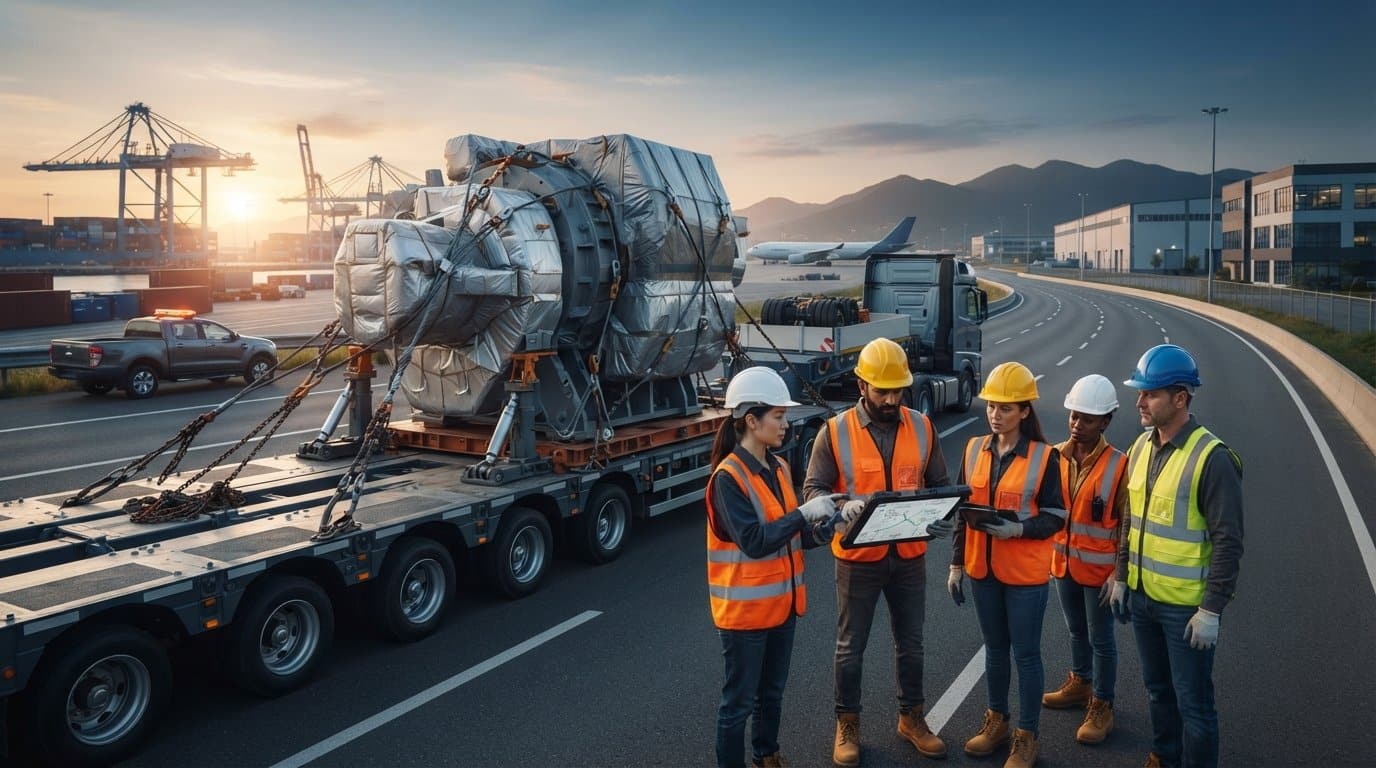
Specialized logistics is not commodity transportation; it is precision engineering. According to research from Siemens, an unplanned automotive assembly line shutdown costs roughly $2.3 million per hour. When high-value tooling or sensitive industrial machinery moves across domestic lanes or international borders, entrusting that shipment to a standard broker is an unacceptable risk. You need a vetted specialized freight logistics provider that manages every mile with absolute operational control.
You already know the frustration of generic freight brokers who overpromise on capacity, fail to secure critical route permits, and abandon your load when pressure mounts. A single transit breakdown exposes your operation to catastrophic line-down cost, damaged tooling, and crippling regulatory penalties. In this guide, you will discover how to evaluate and select a specialized freight logistics provider for high-stakes, oversized, and time-critical industrial cargo. We examine the technical vetting standards, proactive contingency frameworks, and compliance benchmarks necessary to achieve zero-defect transit and protect your production schedule.
Key Takeaways
- Learn why standard hub-and-spoke freight networks jeopardize sensitive machinery, and how dedicated transit eliminates multi-terminal handling risks.
- Discover the technical vetting criteria required to evaluate a qualified specialized freight logistics provider for high-stakes, out-of-gauge shipments.
- Understand how precision route planning, heavy-duty transport assets, and proactive permit management protect against severe regulatory delays.
- Shift from evaluating baseline freight rates to calculating total operational risk, shielding your business from severe production downtime.
- Uncover how engineered project planning and rigorous chain-of-custody compliance keep complex, time-critical cargo moving without disruption.
Defining Specialized Freight Logistics: Beyond Standard Cargo
Specialized freight logistics is the custom engineering and operational execution required to transport cargo that exceeds standard physical, environmental, or security thresholds while mitigating catastrophic supply chain risk. Standard commercial carriers rely on terminal networks and automated cross-dock operations. For dry van boxes, that works. For sensitive or massive industrial components, it introduces severe hazards: repeated physical handling, careless forklift transfers, and unaccountable load swapping. Every terminal transfer increases the risk of structural damage or unrecoverable schedule delays.
Unlike commodity operations run by general freight companies, specialized transportation demands dedicated logistics planning that aligns transport assets directly to specific physical and timeline requirements. A true project logistics partner treats every move as a standalone engineering challenge rather than a simple freight transaction.
Parameters Classifying Cargo as Specialized Freight
Cargo moves into the specialized category when standard line-haul methods cannot ensure its physical integrity or delivery window:
- Dimensional Out-of-Gauge (OOG): Freight exceeding standard 53-foot dry van dimensions (over 8.5 feet wide or 13.5 feet high) requiring flatbed shipping, step-decks, or double-drops.
- Excess Weight Profiles: Heavy cargo demanding multi-axle configurations, bridge weight calculations, and axle weight distribution engineering.
- Mission-Critical Deadlines: Production-line tooling or assembly parts where delayed delivery triggers severe manufacturing downtime.
- Sensitive Technical Assets: Industrial robotics, medical equipment, or aerospace parts requiring climate control, high-security monitoring, and air ride service.
Transaction Brokers vs. Specialized Logistics Providers
Understanding the distinction between transactional brokers and a dedicated specialized freight logistics provider protects you from catastrophic operational failure. Digital load boards match your freight to the lowest-bidding independent operator without vetting mechanical capability or route compliance. In that model, you buy truck space, but you get zero operational oversight.
A specialized freight logistics provider delivers complete route surveys, selects verified transport equipment, and builds proactive contingency protocols before cargo moves. By maintaining single-source accountability from origin rigging to final placement, you eliminate handoff failures and secure predictable delivery timelines.
Core Capabilities of a Specialized Freight Logistics Provider
Precision execution requires multimodal mastery. When industrial machinery exceeds standard shipping thresholds, your transport plan cannot rely on a single domestic freight mode. The ongoing growth of specialized logistics companies reflects the reality of modern manufacturing: components are heavier, tighter delivery tolerances are non-negotiable, and supply lines span multiple continents. A capable specialized freight logistics provider synchronizes road, air, and sea assets under unified operational control.
Heavy-Duty Transport Assets and Oversized Freight Handling
Physical transit begins with matched equipment. Transporting tall stamping dies, production skids, or structural tooling demands open-deck trailers, step decks, or lowboys. Proven oversized freight handling ensures weight is evenly balanced across multi-axle configurations, preventing mechanical frame damage and axle violations. For global movement, Flat Rack Shipping and breakbulk configurations secure irregular cargo on container vessels. Professional providers execute physical route surveys in advance, cataloging overhead bridge clearances, construction pinch points, and turning radiuses to keep heavy loads moving without sudden detours.
International moves bring additional complexity. Managing crating, port drayage, and ocean customs requires dedicated coordination. Reviewing real-world strategies for project cargo ocean freight shows how synchronized water-to-land handoffs prevent port demurrage fees and structural transit damage.
High-Value Cargo Protection and Chain-of-Custody Compliance
High-value industrial assets demand strict security protocols. Standard logistics networks rely on frequent terminal cross-docking, exposing sensitive machinery to unauthorized handling. Specialized operations deploy dedicated solo or team drivers who run continuous point-to-point transit. Chain-of-Custody Compliance ensures verified personnel verify, log, and sign for assets at each milestone. Integrated GPS tracking and geo-fenced alert boundaries provide continuous visibility over cargo position, shock absorption, and temperature stability.
Expedited Solutions: Air Freight and Hand-Carry Services
Unplanned factory emergencies require decisive air transit. When surface transportation cannot beat a critical assembly deadline, dedicated air charter flights and priority air freight shipping bypass congested ground corridors. For critical circuit boards, sensors, or replacement tooling inserts, an onboard hand-carry service provides an accompanied courier who physically escorts cargo from handoff directly into the receiving plant. For urgent automotive or industrial disruptions, discovering how expedited freight shipping Detroit resolves production emergencies can keep your lines running. If you are facing an urgent transit challenge, contact our operations team to review available options.
How to Evaluate and Vet a Specialized Logistics Provider
Move past superficial online star ratings and standard carrier certificates. Vetting a specialized freight logistics provider requires evaluating engineering competence, regulatory precision, and execution capability under operational pressure. As outlined by the Council of Supply Chain Management Professionals (CSCMP), logistics management involves integrating transportation, inventory scheduling, and material handling into a cohesive operation. When high-value industrial machinery is on the line, that integration leaves zero margin for trial and error.
Vetting Engineering Capabilities: Route Surveys and Permits
Never rely on assumed road clearances. You must verify that your logistics provider conducts physical route surveys that uncover low overpasses, weight-restricted bridges, and tight turning radiuses before cargo leaves the dock. A qualified specialized freight logistics provider coordinates multi-jurisdictional oversize and overweight permits across state lines, staging civilian pilot cars and local police details along approved corridors to prevent costly transit halts.
Auditing Regulatory Compliance and Customs Protocols
Administrative errors halt cargo just as fast as mechanical failures. Confirm your partner applies precise Incoterms 2020 rules to define transfer of risk and transit liability. On cross-border lanes, verify their process for Automated Export System (AES) and Importer Security Filing (ISF) data submissions. Inaccurate or delayed AES filings can draw penalties up to $10,000 per violation, while missing an ISF deadline triggers $5,000 fines. Ensure they enforce ISPM-15 heat-treated wood packaging standards and respect the FMCSA Driver Coercion rule so your loads are never compromised by safety violations.
Verifying Contingency Execution and Escalation Readiness
When weather shifts or mechanical failures strike, automated call queues won’t save your delivery window. Demand clear escalation frameworks with direct access to dedicated operations personnel around the clock. Review their secondary routing protocols for bypass corridors, alternate airports, and emergency equipment transfers. Finally, examine their cargo insurance coverage to verify that policy limits match full asset replacement value rather than default carrier liability minimums.
Financial Analysis: Specialized Logistics vs. Disruption Costs
Procurement teams that evaluate industrial transport purely on upfront freight rates introduce severe vulnerability to plant operations. Saving a few hundred dollars on line-haul spot rates means nothing if late arrival halts a manufacturing plant. A five-figure specialized transport fee is negligible when measured against a six-figure hourly production line shutdown. Investing in a qualified specialized freight logistics provider functions as operational insurance against catastrophic factory downtime.
| Risk Factor | Commodity Freight Approach | Specialized Logistics Protection |
|---|---|---|
| Equipment & Dispatch | Unvetted spot-market capacity; frequent terminal cross-dock transfers | Dedicated equipment, air ride suspension, and verified team drivers |
| Permits & Routing | Standard GPS navigation; delayed or missing multi-state permits | Pre-run physical route surveys, utility coordination, and verified permits |
| Financial Exposure | Carrier liability minimums; vulnerability to massive line-down charges | Asset-specific valuation coverage; protected delivery milestones |
Calculating True Line-Down Losses in Manufacturing
Automotive assembly disruptions create severe line-down costs that can quickly surpass $38,000 per minute. Tier-1 suppliers face brutal chargebacks and contractual delay penalties from original equipment manufacturers when a single missing die or stamping tool halts output. Choosing an established specialized freight logistics provider replaces spot-market roulette with dedicated logistics planning, protecting corporate operating margins and supplier ratings.
Eliminating Regulatory Fines and Clearance Penalties
Financial exposure extends well beyond plant walls. Overlooking Importer Security Filing deadlines triggers immediate $5,000 federal penalties per violation. Moving unpermitted heavy machinery across state jurisdictions risks impounded loads, physical bridge citations, and project-stalling transit holds. By contrast, experienced logistics teams secure state permits efficiently, such as single-trip MDOT permits starting at $15 for oversize freight. Strategic customs and trade management uncovers legitimate tariff relief, preventing compliance delays while protecting substantial project capital. If your next machinery shipment carries severe financial exposure, contact our logistics specialists to audit your routing and risk profile.
Executing Mission-Critical Moves with ICAT Logistics Detroit
Navigating volatile shipping environments requires more than simple dispatch coordination. With over 35 years in the cargo shipping business, ICAT Logistics Detroit engineers solutions for high-stakes industrial, aerospace, and automotive freight. Choosing the right specialized freight logistics provider means working with a partner that takes absolute ownership of project outcomes. Our team maintains access to over 30,000 airports worldwide and operates a 56,000-square-foot facility near Detroit Metropolitan Airport. This hub delivers secure staging, custom export packaging, and temperature-controlled warehousing to prepare sensitive assets before long-distance transit. As an NMSDC-certified minority business enterprise and EPA SmartWay partner, we protect your cargo and your supply chain integrity through every mile.
Engineered Success Across Automotive, Aerospace, and Defense
Theory means nothing without proven field execution. Decades of specialized operations demonstrate our ability to resolve high-pressure logistics challenges under tight operational tolerances:
- Heavy Industrial Transport: Engineered the route and coordinated multi-axle transit for a 42-ton package measuring 30 feet long, 8.5 feet wide, and 10 feet high under severe schedule constraints.
- Critical Cross-Border Tooling: Synchronized multimodal logistics to move 56,000 lbs of automotive tooling from China to Mexico within an uncompromising 14-day window.
- Duty and Tariff Protection: Applied rigorous trade compliance frameworks to save an automotive partner more than $1 million in taxes on an oversized shipment to China.
Initiating Your Specialized Project Transport Plan
Flawless transit starts long before equipment arrives at the loading dock. Engaging a dedicated specialized freight logistics provider during the early stages of capital procurement allows logistics engineers to evaluate road weight constraints, crane rigging limits, and port handling capabilities in advance.
We work directly with your operational teams to define transit corridors, secure mandatory multi-state permits, and deploy active monitoring to eliminate blind spots. When failure isn’t an option, request a customized quote to put seasoned logistics specialists behind your next critical move.
Eliminate Operational Risk on Your Next Critical Move
High-stakes machinery and time-critical industrial components cannot be left to commodity freight brokers. Precision route surveys, strict chain-of-custody protocols, and proactive compliance frameworks keep your production lines moving and protect your operating margins from crippling downtime. Choosing the right specialized freight logistics provider turns high-risk transit into a predictable, reliable operational advantage.
With over 35 years of specialized cargo forwarding experience, ICAT Logistics Detroit delivers the engineering expertise required for zero-defect transit. As an NMSDC-certified Minority Business Enterprise and EPA SmartWay partner, our team takes total ownership of complex moves, from resolving tough customs hurdles to saving an automotive client over $1 million in trade taxes. Don’t leave your critical equipment to chance. When your delivery tolerances allow zero margin for error, connect with our specialized logistics team to build an airtight transport plan that safeguards your schedule.
Frequently Asked Questions
What qualifies a shipment for a specialized freight logistics provider?
A shipment qualifies when its physical dimensions, weight, sensitivity, or timeline exceed standard freight network capabilities. Cargo measuring wider than 8.5 feet or heavier than legal axle limits requires specialized multi-axle trailers and engineering. High-value tooling, fragile robotics, or assembly-critical components requiring environmental monitoring, air-ride transit, or dedicated couriers also demand an experienced specialized freight logistics provider rather than standard common carriers.
How does specialized freight forwarding differ from standard freight brokerage?
Standard freight brokers simply match available loads to the lowest-bidding carrier on digital load boards, offering little technical support. A specialized freight logistics provider engineers the entire movement from end to end. This includes conducting route surveys, calculating axle weight distributions, securing multi-state permits, managing customs compliance, and maintaining continuous active monitoring to ensure zero-defect delivery for mission-critical cargo.
Why is a physical route survey required for oversized freight handling?
Physical route surveys uncover roadway obstructions that digital mapping systems overlook. Operating oversized transport requires verifying overhead bridge clearances, low-hanging utility lines, turning radius constraints, and active construction zones before wheels roll. Identifying structural choke points in advance prevents emergency rerouting, load impoundment, structural bridge strikes, and catastrophic transit delays on industrial machinery moves.
How do specialized providers prevent line-down emergencies for automotive plants?
Providers prevent manufacturing halts by eliminating cross-dock handoffs and building active contingency plans. They deploy point-to-point dedicated ground teams, priority air charters, or onboard hand-carry couriers for urgent replacement dies or critical parts. Continuous GPS tracking and real-time operational oversight allow logistics controllers to bypass unexpected highway bottlenecks or airport congestion immediately, safeguarding production schedules against multi-million-dollar downtime.
What certifications should a specialized defense or industrial freight partner hold?
Industrial and defense shippers should verify partners maintain active compliance with relevant federal trade regulations, such as ITAR registration for defense assets and ISPM-15 certification for export wooden packaging. Additional industry credentials include EPA SmartWay partnership for transport efficiency and certifications from recognized bodies such as the National Minority Supplier Development Council (NMSDC) to support corporate supplier diversity objectives.
How does chain-of-custody compliance protect high-value industrial cargo?
Chain-of-custody compliance protects high-value freight by establishing an unbroken, documented paper and digital trail for every handover. Verified personnel sign for physical custody at origin, transfer hubs, and destination. Combined with tamper-evident seals, continuous satellite tracking, and geofencing alerts, this protocol prevents unauthorized handling, cargo theft, and untracked transit damage while cargo moves across domestic corridors or international borders.