

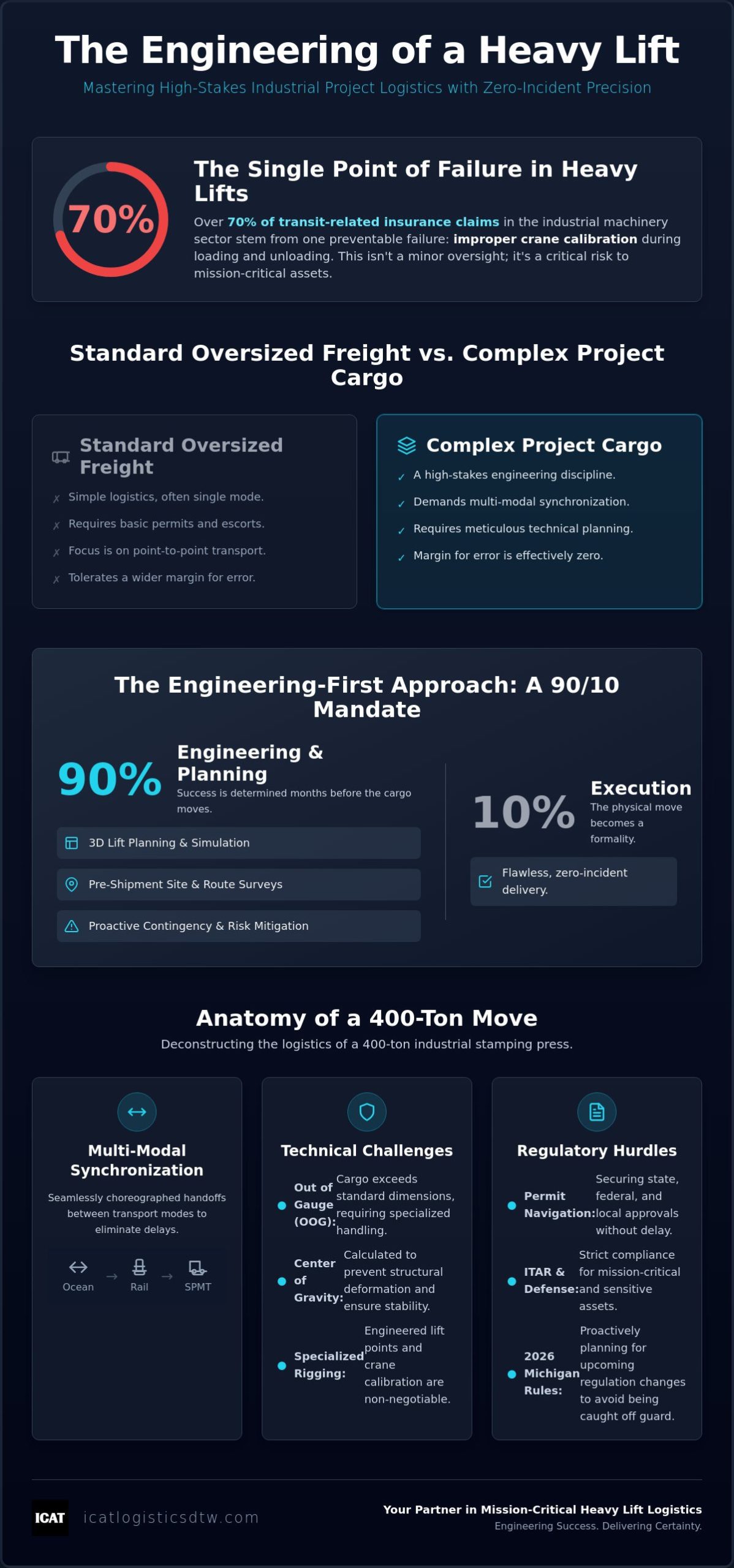
Over 70% of transit-related insurance claims in the industrial machinery sector stem from a single, preventable failure: improper crane calibration during loading and unloading. When you’re moving 400-ton assets across borders, the margin for error effectively disappears. You understand that a single permit delay or a miscalculated axle weight doesn’t just stall a truck; it halts an entire production line and bleeds capital. Successfully managing a project logistics heavy lift requires more than just equipment. It demands a level of technical foresight where every multi-modal transfer is mapped to the millimeter and every contingency is neutralized before the wheels turn.
This article provides the strategic framework and technical precision required to execute high-stakes moves without failure. We’ll examine how to navigate the tightening specialized equipment market and the specific 2026 permit regulation changes in Michigan that are currently catching unprepared teams off guard. By the end of this case study, you’ll have a clear blueprint for maintaining full visibility over the multi-modal chain and securing zero-incident delivery for your most critical engineering assets. We’re moving beyond basic transportation into the realm of mission-critical engineering.
Key Takeaways
- Master the distinction between standard oversized freight and the complex synchronization required for non-standard, high-value project cargo.
- Learn why an engineering-first approach, where planning accounts for 90% of the operation, is the only way to ensure zero-incident delivery.
- Discover the strategic framework for navigating ITAR compliance and the legal hurdles of mission-critical defense and industrial shipping.
- Examine the technical requirements for a project logistics heavy lift by analyzing the movement of a 400-ton industrial stamping press.
- Identify the criteria for selecting an expert partner capable of managing the high-pressure demands of multi-modal industrial logistics.
Defining Project Logistics for Heavy Lift in High-Stakes Environments
Project logistics is not merely the act of moving large objects from one point to another. It is a high-stakes engineering discipline. Specifically, it involves the strategic management of Project Cargo, where assets are so massive, high-value, or non-standard that they defy traditional transportation methods. Executing a successful project logistics heavy lift requires a departure from standard freight mindsets. You aren’t just booking a truck; you’re orchestrating a synchronized movement of capital equipment that often represents the future of a production facility.
Precision is the only acceptable baseline. While standard oversized freight might only require a wider trailer and a few permits, complex project cargo demands multi-modal synchronization. This often involves moving assets from deep-sea heavy-lift vessels to specialized rail cars, and finally onto Self-Propelled Modular Transporters (SPMTs) for the final mile. In the automotive and defense sectors centered around Detroit, a “mission-critical” mindset is the standard. Failure doesn’t just mean a late delivery. It means a line-down scenario at a Tier-1 facility where every hour of idleness costs thousands of dollars in lost productivity.
Identifying Out of Gauge (OOG) and Breakbulk Cargo
Cargo is classified as Out of Gauge (OOG) when its dimensions exceed what can fit inside a standard shipping container or on a traditional flatbed trailer. This isn’t just a size issue; it’s a structural challenge. Unlike standard freight, breakbulk cargo cannot be containerized and must be loaded individually. We assess these components based on their fragility and center of gravity. Whether it’s a turbine or a massive fuselage, the lifting points must be engineered to prevent structural deformation during the project logistics heavy lift process. We often favor Roll-on/Roll-off (Ro-Ro) for mobile machinery, but static heavy industrial components require specialized rigging and crane calibration to ensure the load remains stable throughout the transfer.
The Economic Impact of Project Logistics Failure
The cost of delay is frequently the most expensive line item in any industrial project. When a heavy lift fails, the repercussions ripple through the entire supply chain. If a 400-ton stamping press is delayed by a week due to a permit oversight or a technical failure, the plant commission date slides, and contractual penalties accrue. We treat risk mitigation as a proactive engineering task rather than an insurance fallback. Precision in the planning phase is the primary cost-saver. By identifying potential bottlenecks in the multi-modal chain early, we eliminate the hidden costs of idle crews and emergency rerouting. Reliability isn’t just about safety; it’s about protecting the massive capital investment represented by the cargo itself.
Technical Engineering and Route Optimization for Industrial Assets
Execution is the final step in a long chain of technical decisions. In a project logistics heavy lift, success is determined months before the cargo moves. We operate on a 90/10 rule: 90% engineering and planning, 10% flawless execution. This engineering-first approach eliminates the variables that lead to catastrophic failures. In 2026, the complexity of industrial assets requires complex cargo logistics planning that integrates 3D lift planning and simulation software. We simulate every turn, every lift, and every bridge clearance virtually to ensure the physical move is a formality, not a gamble.
Synchronizing multi-modal transfers is the core of this discipline. Moving a turbine from a Detroit railhead to a heavy-lift vessel requires absolute timing. Each handoff between ground, rail, and ocean freight introduces risk. We mitigate this through rigorous oversight of the entire chain. For those navigating the Michigan industrial corridor, understanding the Federal Highway Administration guidelines is just the starting point. Local expertise in the Detroit-to-Mexico route is essential for maintaining production timelines. Partnering with a specialist in oversize freight handling ensures these technical details are managed before they become crises.
Pre-Shipment Site and Route Surveys
We don’t trust old data. A physical route survey is mandatory for every project logistics heavy lift. This four-step process includes:
- Step 1: Physical bridge and overpass clearance verification using laser measurement tools.
- Step 2: Soil stability analysis at the origin and destination to ensure heavy-lift crane staging doesn’t result in ground subsidence.
- Step 3: Coordination with utility companies to raise or move overhead lines along the transit route.
- Step 4: Identification of secure “safe-haven” locations for overnight staging where the load is protected and accessible.
Rigging and Specialized Handling Protocols
The physics of the lift cannot be ignored. High-tonnage assets require rigging and specialized transport protocols that account for shifting centers of gravity (CoG). Precision in CoG calculations determines the stability of the entire load. We select lifting tackle, including spreader beams and high-capacity shackles, based on the specific structural integrity of the cargo. Every sling is inspected. Every shackle is rated. When the margin for error is zero, the quality of your rigging partner is the primary emotional currency of the project.
Navigating Regulatory Barriers: Permits, ITAR, and Global Compliance
Technical engineering is only half the battle. The regulatory framework surrounding a project logistics heavy lift is often the more complex hurdle. Without the correct legal oversight, a technically perfect move can stall indefinitely at a state border or an international port. We treat compliance as a mission-critical component of the engineering process itself. This is especially vital in Michigan, where industrial moves frequently intersect with defense requirements. Managing ITAR compliant logistics Michigan requires a specific security posture. You aren’t just moving weight; you’re moving controlled technology. This necessitates a rigid chain-of-custody that keeps high-security cargo protected and compliant throughout the transit.
The Mexico-USA industrial corridor presents its own set of challenges. Oversized freight moving through these routes requires a deep understanding of both US and Mexican regulations. We utilize proactive customs brokerage and trade compliance to prevent port-side heavy-lift delays. If your asset sits at the border for three days because of a documentation error, the technical precision of the lift becomes irrelevant. We coordinate with the Specialized Carriers & Rigging Association (SC&RA) to ensure our standards align with global best practices for specialized transport. This level of oversight ensures that legal barriers don’t compromise your production timeline.
Strategic Permit Acquisition for Oversized Cargo
Success requires managing multi-state and international permit requirements simultaneously. We utilize a permit acquisition oversized cargo framework to secure permissions weeks before the wheels turn. This process includes escort vehicle coordination and direct law enforcement liaison protocols. We don’t wait for approvals; we drive the process. This proactive involvement eliminates the “unexpected” permit delays that frequently halt industrial projects.
Compliance Standards for Defense and Aerospace
High-security heavy lift projects demand a higher tier of accountability. We manage the chain-of-custody for dual-use industrial equipment that falls under strict 2026 trade compliance standards. Every multi-modal transfer is documented. Every handoff is verified. We ensure that your mission-critical cargo meets all federal and international security requirements without sacrificing speed. Reliability in this sector is built on a foundation of absolute legal precision.
Case Study Framework: Executing a 400-Ton Industrial Move
The movement of a 400-ton industrial stamping press represents the pinnacle of operational risk. In this specific mission, a Tier-1 automotive facility in the Detroit corridor required the delivery and installation of a mission-critical asset within a non-negotiable production window. Failure meant a total production halt. Success required a project logistics heavy lift strategy that synchronized rail, road, and rigging specialists with surgical precision. We don’t leave outcomes to chance. The strategy focused on neutralizing variables before the asset ever left the manufacturer’s floor.
Execution followed a rigid engineering blueprint. By establishing a critical path with real-time oversight, our team maintained full visibility over every multi-modal transition. This proactive involvement ensured that the 400-ton load moved through the Detroit industrial hub without a single regulatory or physical delay. The resolution was absolute: on-time delivery, zero incidents, and immediate production line integration. This is the standard when the margin for error is non-existent.
Phase 1: The Logistics Audit and Planning
Precision begins with a technical feasibility study. For a 400-ton load, we analyzed the structural load points and center of gravity to determine the exact equipment requirements. Securing long-lead time assets is the first priority. We coordinated the acquisition of specialized multi-axle rail cars and hydraulic modular trailers months in advance. A key component of this phase involved finalizing packaging and crating services freight requirements. We engineered custom crating to protect the press’s sensitive internal components from the harmonic vibrations inherent in rail transport.
Phase 2: Multi-Modal Execution and Oversight
The highest risk occurs during the transition between modes. We managed the complex transfer from rail to heavy-haul truck under a full police escort, ensuring the route remained clear of obstructions. The technical oversight continued through the “last-mile” rigging into the facility. This required synchronized crane lifts to position the press onto its foundation within a three-millimeter tolerance. Following the installation, we conducted a post-move audit to verify asset integrity and close out all documentation. If you are preparing for a high-stakes industrial move, you need a partner who takes full ownership of the outcome. Contact our team to discuss your next oversize freight handling mission.
Selecting a Project Logistics Partner for Mission-Critical Heavy Lift
Choosing a partner for a project logistics heavy lift isn’t a procurement task. It’s a strategic engineering decision. When the margin for error is non-existent, you don’t need a vendor with a fleet; you need an expert capable of managing the entire ecosystem of the move. While many assume that asset-based trucking companies provide more control, the reality is often the opposite. Asset-light logistics management often outperforms asset-based models because it isn’t limited by a specific inventory of trailers or cranes. Instead, we source the exact technical equipment required for your specific mission, ensuring the physics of the move dictate the equipment, not the other way around.
Your selection criteria must prioritize three pillars: technical engineering depth, regulatory expertise, and urgency response. At ICAT Detroit, we leverage our proximity to the Detroit industrial hub to provide localized oversight while utilizing a global network to move assets anywhere on the planet. This dual-layered approach ensures that your mission-critical cargo remains under the supervision of a steady, expert hand from origin to final installation. We take full ownership of the outcome, positioning ourselves as a protective partner in high-pressure industrial environments where trust is the primary emotional currency.
The Value of Agency-Level Oversight
In complex moves, information silos are the primary cause of failure. Agency-level oversight provides a single point of truth through a dedicated project manager who oversees every technical and regulatory detail. This isn’t just about tracking a shipment. It’s about real-time communication protocols that keep all stakeholders informed at every critical path milestone. We bridge the gap between your corporate production strategy and the technical ground-level execution, ensuring that the move aligns with your broader timeline and budget requirements. This level of oversight turns a chaotic multi-modal chain into a predictable, manageable process.
Next Steps: Engineering Your Industrial Move
Initiating a project logistics heavy lift requires early involvement. While we thrive in high-pressure, time-sensitive scenarios, the gold standard for complex moves is six to twelve months of lead time. This window allows for the rigorous permit acquisition and technical feasibility studies required for high-tonnage assets. Prepare your technical documentation, including CAD drawings and weight distribution charts, to facilitate an accurate logistics audit. When failure isn’t an option, the planning must be absolute. Consult with ICAT Detroit for your heavy lift project to secure the precision and reliability your mission demands.
Securing Your Industrial Future through Technical Precision
Successful execution in the heavy lift sector requires a total departure from standard freight mindsets. You must prioritize an engineering-first framework where route optimization and regulatory foresight are established months before the first lift occurs. The complexity of 2026 trade standards and ITAR compliance means that localized expertise in the Detroit industrial corridor is no longer optional. It’s a requirement for survival. Executing a successful project logistics heavy lift isn’t just about moving tonnage; it’s about protecting massive capital investments and ensuring zero-incident production line installs.
We provide the specialized rigging expertise and engineering oversight necessary to neutralize risk in high-pressure environments. Our team understands the mission-critical urgency that industrial leaders face when the margin for error is zero. We take full ownership of the multi-modal chain, bridging the gap between technical requirements and operational reality. Don’t leave your next industrial move to chance. Request a Strategic Project Logistics Audit from ICAT Detroit to ensure your next mission is executed with absolute precision. Your production timeline remains our primary objective.
Heavy Lift Project Logistics: Frequently Asked Questions
What is the difference between heavy lift and standard oversized freight?
Standard oversized freight typically involves loads that exceed legal width or height but can still be transported on conventional flatbeds or step-decks with basic permits. Heavy lift is a specialized engineering discipline involving non-standard, high-value assets that exceed 100 tons or require technical rigging. These moves demand specialized trailers, such as hydraulic modular transporters, and precise center-of-gravity calculations to ensure the structural integrity of the asset remains intact during the project logistics heavy lift process.
How far in advance should I plan a project logistics heavy lift move?
Six to twelve months of lead time is the industry standard for mission-critical moves. This window is necessary to conduct technical feasibility studies, secure specialized equipment like heavy-lift rail cars, and navigate the complex multi-state permit acquisition process. While expedited timelines are possible for urgent industrial needs, early engagement allows for the rigorous route surveys and utility coordination required to eliminate physical and regulatory bottlenecks before the wheels turn.
Are permits required for heavy lift project logistics in Michigan?
Yes, any load exceeding 80,000 pounds gross vehicle weight or specific axle limits requires overweight and oversized permits from state and local authorities. In Michigan, 2026 regulations have introduced stricter oversight on axle spacing and bridge weight distributions. We manage this entire process, coordinating with law enforcement for escorts and ensuring all documentation is secured well before the asset enters the Michigan industrial corridor to prevent costly roadside delays.
How does ITAR compliance affect heavy lift project logistics for defense?
ITAR compliance adds a layer of high-security oversight and rigid chain-of-custody requirements to the move. For defense-related cargo, we ensure that every individual involved in the transport and rigging process meets federal security standards. Documentation must be flawless to prevent seizures or delays at international borders. This mission-critical approach protects controlled technology and ensures that your high-value defense assets are delivered without compromising national security or trade compliance standards.
What specialized equipment is typically used for 100+ ton industrial moves?
Moves of this magnitude require hydraulic modular trailers or Self-Propelled Modular Transporters (SPMTs) that can distribute weight across dozens of axles. For rail segments, specialized Schnabel cars or heavy-duty flatcars are utilized. Lifting these assets necessitates high-capacity gantry systems or calibrated cranes outfitted with custom spreader beams and shackles. We source the exact equipment required for the physics of your specific load rather than relying on a fixed fleet of standard trailers.
Can project logistics handle multi-modal moves involving ocean and rail?
Yes, a successful project logistics heavy lift strategy often integrates ocean, rail, and road transport into a single synchronized chain. We manage the transition of breakbulk cargo from deep-sea heavy-lift vessels to specialized railheads and finally to heavy-haul trucks for the last-mile delivery. Each transfer point is overseen by a project manager to ensure that the asset is handled with absolute precision during the handoff between different modes of transport.
What is a route survey in the context of heavy lift logistics?
A route survey is a physical, boots-on-the-ground inspection of the entire transit path to identify physical obstructions. We use laser measurement tools to verify bridge and overpass clearances, analyze soil stability for crane staging areas, and coordinate with utility companies to raise overhead lines. This process eliminates the variables that lead to transit failures, ensuring the route is technically viable for the specific dimensions and weight of your industrial asset.
How do you mitigate risk for high-value industrial assets during transit?
Risk mitigation is an engineering task that starts with 3D lift simulations and precise center-of-gravity calculations. We utilize specialized packaging and crating to protect sensitive internal components from harmonic vibrations during transit. By maintaining full visibility over the multi-modal chain and utilizing real-time tracking, we neutralize threats before they result in damage. We don’t rely on insurance as a primary strategy; we rely on technical excellence to ensure zero-incident delivery.