
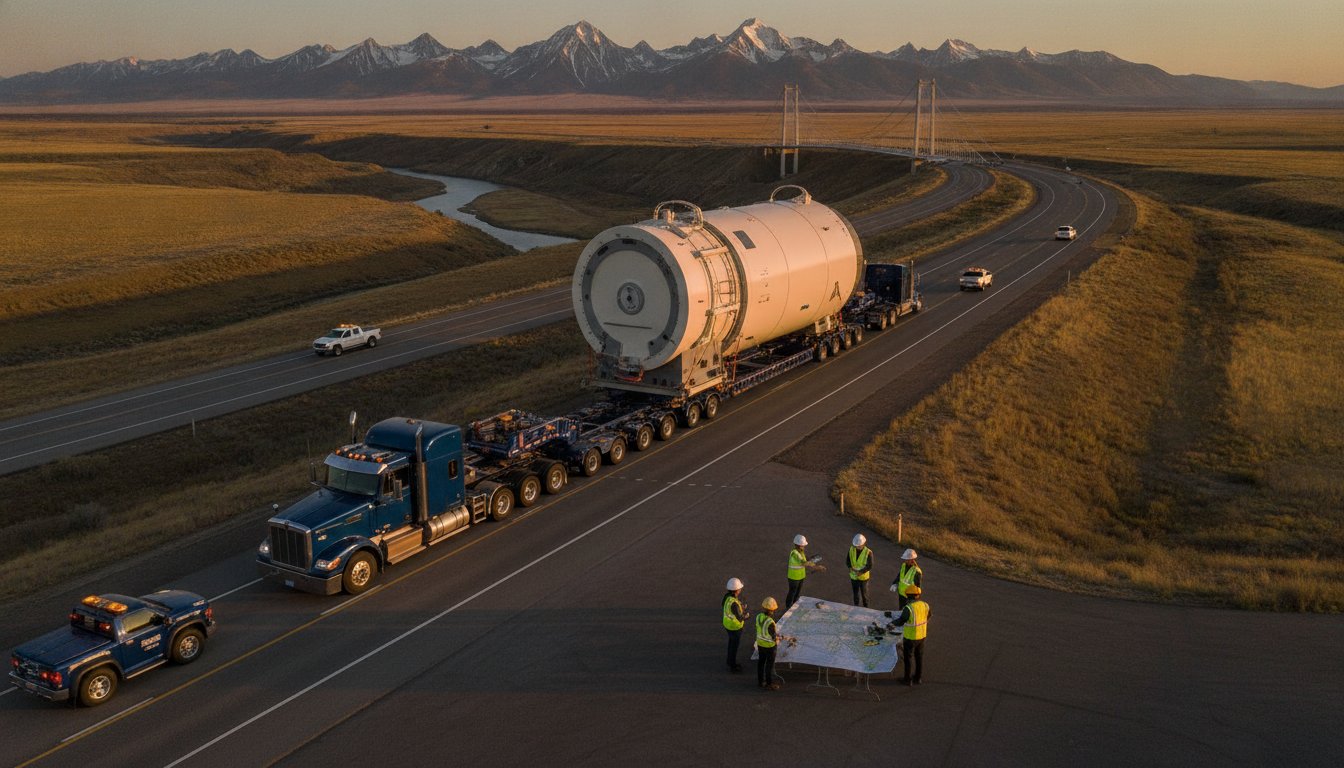
Oversized cargo route planning is not a logistics administrative task. It is a precision engineering discipline where a single miscalculation, one overlooked bridge rating or one missed permit jurisdiction, can ground a multi-million-dollar shipment and shatter a production schedule that took months to build. If you’re moving heavy-haul freight across state lines or international borders in 2026, you already know this pressure firsthand.
You’re right to treat this as a zero-failure operation. The regulatory patchwork across US states, Canadian provinces, and Mexican federal corridors is genuinely complex, and the consequences of getting it wrong range from costly delays to catastrophic bridge-strike incidents or ITAR violations that carry serious legal exposure. Every corridor has its own weight limits, permit timelines, and escort requirements, and they don’t align neatly for your convenience.
This guide delivers an expert-level framework for executing oversized moves with predictable timelines and full compliance. You’ll work through the core engineering principles behind route assessment, the regulatory realities of cross-border permitting, and the operational controls that protect both your cargo and your reputation from the first mile to the last.
Key Takeaways
- Professional oversized cargo route planning is an engineering discipline, not an administrative task — standard GPS tools are a direct liability for heavy-haul operations and must be replaced with purpose-built survey methodology.
- Physical route constraints like bridge ratings, vertical clearances, and weight-restricted culverts require systematic pre-move assessment to prevent costly groundings and schedule failures.
- Cross-border moves through the US-Mexico-Canada corridor demand harmonized permit strategies across multiple jurisdictions, each with its own timelines, escort requirements, and compliance triggers.
- Multimodal integration — combining ground, air, and ocean freight — is often the decisive factor in moving oversized industrial components on schedule without compromising cargo integrity.
- A zero-failure execution protocol aligns drivers, riggers, and client stakeholders before the first wheel turns, ensuring every variable is controlled from permit acquisition to final delivery.
The High-Stakes Reality of Oversized Cargo Route Planning
Oversized cargo isn’t a category defined by a single number. In 2026, federal baseline thresholds set the floor at 8.5 feet wide, 13.5 to 14 feet tall, and 80,000 pounds gross vehicle weight, but every state layered on top of those baselines operates with its own tolerances, permit windows, and infrastructure constraints. A transformer moving from a Michigan fabrication facility to a Texas substation doesn’t cross one regulatory environment. It crosses dozens. Understanding where those thresholds sit, and exactly how your load interacts with each one, is the foundational act of professional oversized cargo route planning.
The financial exposure here is not abstract. When an industrial production line goes down waiting for a critical component that’s sitting on the shoulder of a restricted bridge approach, the cost accumulates by the hour. Line-down events in automotive and heavy manufacturing can run into tens of thousands of dollars per hour in lost production, missed contractual milestones, and emergency re-sequencing costs. A single failed route decision doesn’t just delay a shipment. It can fracture a supplier relationship that took years to build.
Standard GPS tools are not equipped for this environment. Consumer routing platforms optimize for speed and distance. They have no awareness of posted bridge ratings, seasonal load restrictions, low-clearance rail crossings, or the turning radius constraints of a 13-axle configuration. Feeding a superload into a standard navigation system is an active liability, not a shortcut. Purpose-built route survey methodology, cross-referenced against state DOT data and physical reconnaissance where necessary, is the only defensible approach.
This is precisely where project logistics earns its value. Pre-move infrastructure assessment, permit acquisition sequenced across multiple jurisdictions, and carrier coordination all have to happen in parallel, not in sequence. The logistics architecture has to be engineered before the first wheel turns. For a thorough grounding in the foundational framework governing these moves, oversize load regulations and transport requirements provide a useful reference point on how regulatory structures vary across road networks.
Understanding ‘Superload’ Designations
A load transitions from oversized to superload status when it exceeds the upper permit thresholds that standard overdimensional permits can accommodate. While exact triggers vary by state, loads exceeding 150,000 pounds gross weight or surpassing approximately 16 feet in width or height routinely require superload classification. At that threshold, engineering requirements escalate sharply:
- Multi-axle trailer configurations become mandatory to distribute weight across a wider footprint and protect pavement and bridge decking from point-load damage.
- Structural engineering analysis is required for each bridge crossing, often demanding a licensed engineer’s stamp on route-specific load calculations.
- Advance coordination with state DOTs extends permit timelines significantly, sometimes requiring submissions weeks or months ahead of the move date.
- Curfew restrictions on movement windows tighten, limiting transit to off-peak hours or specific days of the week depending on corridor traffic classifications.
Loads in this category demand specialized oversize freight handling from the earliest planning stage, not as an afterthought once permits are pulled.
The Human Element: Pilot Cars and Escort Protocols
Pilot vehicles aren’t optional accessories. They’re operational infrastructure. Lead cars verify live clearances ahead of the load, while chase vehicles manage following traffic and respond to unexpected hazards behind the convoy. State regulations dictate escort configurations based on load dimensions and route characteristics, and those requirements shift at every state line. Some corridors mandate law enforcement escorts for loads exceeding specific width or weight thresholds, with coordination requirements that must be arranged days in advance through the relevant state patrol or sheriff’s office. Communication discipline across the driver, escort vehicles, and any utility crews handling temporary line lifts is non-negotiable. A single communication gap at a critical clearance point is how incidents happen, making the availability of recovery specialists like Edremit Çekici Hizmeti essential for managing roadside emergencies.
The Technical Anatomy of a Professional Route Survey
A route survey is not a desk exercise. It’s a structured engineering investigation that interrogates every physical constraint between origin and destination before a single permit application is filed. For professional oversized cargo route planning, that investigation has to be exhaustive, because the variables that ground a move are rarely the obvious ones. It’s the culvert with an undocumented weight restriction three miles off the interstate. It’s the rail crossing with a 13-foot-6-inch clearance bar that doesn’t appear in any state DOT database. It’s the private access road at an industrial plant that wasn’t designed for a 13-axle configuration.
Physical constraint identification starts with four categories that must be resolved before route selection is finalized:
- Vertical clearances: Every overhead obstruction, including utility lines, signal gantries, bridge soffits, and canopy structures, must be measured against the load’s travel height with tolerance for road crown and trailer flex. Utility coordination for temporary line lifts requires advance scheduling with the relevant provider, and in 2026, that scheduling window has tightened in many urban corridors due to increased construction activity.
- Bridge ratings: Posted load limits reflect legal operating thresholds, not structural maximums, but the gap between those two figures requires licensed engineering analysis to exploit safely. Bridges without current inspection data are non-starters until ratings are confirmed.
- Lane geometry and turning radii: Long-deck trailers carrying industrial components don’t negotiate standard intersection geometry. Swept-path simulations for complex turns must be modeled against actual road geometry, not idealized CAD assumptions.
- Last-mile site access: Industrial plants, defense installations, and fabrication yards frequently have internal road networks that were never engineered for superload ingress. Pavement thickness, gate clearances, turning aprons, and overhead obstructions at the delivery site require dedicated site surveys independent of the corridor assessment.
Infrastructure Compatibility and Bridge Strikes
Bridge strikes are not recoverable events. They damage critical public infrastructure, expose the carrier to significant legal liability, and can close a corridor for days while structural assessments are completed. The oversize and overweight vehicle permit requirements documented by the Federal Highway Administration underscore how bridge analysis sits at the center of the permitting framework, not as a supplementary check. In the Midwest specifically, a substantial portion of bridge inventory predates modern load rating standards, and relying on posted ratings alone without engineering review is an unacceptable risk posture for high-value loads. Three-dimensional corridor modeling, which simulates load passage through constrained urban segments and tight interchange geometries, has become a standard tool for moves where margin is measured in inches, not feet.
Digital Route Surveying vs. Physical Assessment
LiDAR-based mapping and high-precision aerial survey data have materially improved the speed and accuracy of initial route analysis. Digital tools can identify clearance conflicts and surface condition anomalies across hundreds of miles in a fraction of the time required for manual review. But digital data has a timestamp, and infrastructure changes constantly. Active construction zones, temporary overhead obstructions, and freshly posted weight restrictions don’t always propagate into mapping databases on a timeline that protects your move. For high-value loads, physical reconnaissance of critical segments remains non-negotiable. Eyes on the ground catch what the data misses, and for complex project logistics involving defense or automotive components, that ground-truth verification is what separates a controlled move from an expensive surprise.
If your next move involves constrained corridors, aging infrastructure, or a delivery site that’s never received a load of this scale, connect with a specialist who can build the survey methodology before the clock starts running.
Strategic Multimodal Integration: When Ground Transport Isn’t Enough
Ground transport is the backbone of oversized cargo route planning, but it isn’t always the complete answer. Some components are too time-critical for a five-day ground move. Some corridors are physically impassable for a given load configuration. Some industrial presses weigh so much that ocean freight isn’t just an option — it’s the only structurally sound approach. Professional multimodal integration means knowing exactly when to switch modes, how to execute that transition without losing cargo integrity, and how to build contingency pathways before the primary route is ever threatened.
The decision framework isn’t complicated, but it demands honest analysis. Ground remains the default for most overdimensional moves because it offers the most control over routing, timing, and physical handling. The moment a corridor constraint, a permit timeline, or a production deadline makes ground transport untenable, the mode decision has to be made quickly and with full visibility into the tradeoffs.
Oversized Air Freight: The Final Resort for Emergencies
Air freight for oversized industrial components is not a routine option. It’s a precision tool deployed when a line-down event or a mission-critical deadline makes ground transit speed unacceptable. Nose-loading freighter aircraft — including variants of the Boeing 747 and Antonov platforms — can accommodate long-length components that standard cargo doors cannot accept, but access to those aircraft is limited and scheduling windows are tight. Getting an oversized load to a specialized cargo airport requires its own ground coordination: a dedicated heavy-haul move to an air cargo facility that can handle the dimensions, with ramp access and ground handling equipment confirmed in advance. The cost differential versus ground is significant, and that cost is only justified when the production cost of delay exceeds the freight premium. That calculation needs to happen before the crisis, not during it. Air freight shipping for oversized components requires carrier relationships and aircraft access that aren’t available through standard freight channels.
Port Logistics and Specialized Rigging
For massive industrial equipment — large presses, reactor vessels, turbine housings — ocean freight resolves the weight and dimensional constraints that would make overland movement across multiple jurisdictions prohibitively complex. The vessel-to-trailer transfer is where execution risk concentrates. Crane capacity, lift geometry, and rigging point engineering must be confirmed against the actual cargo specifications, not estimated. Port congestion compounds this: oversized cargo staging areas at major industrial ports operate under tight constraints, and a delayed berth assignment can cascade directly into permit expiration on the receiving end.
Contingency planning is what separates reactive logistics from engineered logistics. Every multimodal plan for a mission-critical move should identify secondary mode options before departure: if the primary port is congested, which alternate port has the crane capacity and staging area to receive the load? If the air freight window closes, what’s the fastest ground alternative? Building those decision trees in advance is how professional project logistics teams protect delivery commitments when the primary plan meets real-world friction.
Navigating Cross-Border Complexity: The Mexico-US-Canada Corridor
Three countries. Three regulatory frameworks. Zero margin for misalignment. Cross-border oversized cargo route planning through the North American corridor is where permit complexity compounds fastest, because you’re not just managing one jurisdiction’s requirements — you’re harmonizing them across federal, state, and provincial layers that don’t communicate with each other on your behalf.
US federal baseline permits don’t transfer at the border. Canadian provincial permits operate independently of each other, meaning a load transiting Ontario into Quebec requires separate permit acquisition for each province, with different dimensional thresholds and escort configurations. South of the border, the challenge shifts again. Mexico shipping for oversized cargo introduces specialized equipment requirements, security considerations that don’t exist on northern corridors, and a permit structure administered through the Secretaría de Infraestructura, Comunicaciones y Transportes that demands advance coordination well beyond what most US-domestic operators are accustomed to managing. Carriers operating south of the border without established local relationships and security protocols are exposed to risks that no amount of US-side planning can mitigate.
Taylor, Michigan sits at the center of this operational geography for good reason. As a strategic hub for North American heavy haul, it provides direct corridor access to the Ambassador Bridge and the Windsor-Detroit Tunnel for Canadian crossings, while maintaining proximity to major Midwest fabrication facilities serving both automotive and defense clients. Coordinating a superload move that originates in Michigan, crosses into Ontario, and re-enters the US at a southern border crossing requires a logistics architecture that’s built around that geography from day one.
Customs brokerage for oversized loads adds another layer of precision. Dimensional cargo doesn’t move through standard customs lanes, and documentation errors that might cause a minor delay for a standard freight shipment can ground an oversized load for days while inspectors resolve discrepancies. Trade compliance has to be embedded into the permit acquisition process, not bolted on afterward.
ITAR and Defense Compliance in Route Planning
Sensitive defense assets don’t just require permits. They require controlled chain of custody from origin to destination. Government and DoD cargo moving as oversized freight carries ITAR obligations that govern route selection, escort qualifications, documentation handling, and who has physical access to the load at every transfer point. Security escorts for ITAR-controlled oversized assets aren’t standard pilot cars — they’re vetted personnel operating under specific protocols. Cross-border documentation for defense shipments requires export licensing coordination that must be resolved before the load is tendered, not at the border crossing.
Automotive Supply Chain Resilience
For automotive and EV manufacturers, the tolerance for border delay is essentially zero. Stamping dies and large assembly line components moving between Mexican fabrication facilities and US or Canadian plants operate inside just-in-time windows where a 48-hour customs hold doesn’t just delay a delivery — it can halt a production line. Pre-cleared oversized corridors at designated commercial crossings, combined with advance customs filing and dimensional pre-approval, are the operational tools that protect those windows. Route planning for these moves has to account for crossing-specific capacity constraints, because not every port of entry has the ramp geometry or staging area to accommodate a wide-load configuration. Talk to a cross-border heavy haul specialist before your next North American move to confirm your corridor is fully pre-cleared for your load’s specific dimensions.
Executing the Move: The ICAT Detroit Zero-Failure Protocol
Planning ends. Execution begins. The distance between a well-engineered route plan and a successful delivery is filled entirely by operational discipline, and that discipline has to be built into the process before the first truck leaves the yard. For ICAT Detroit, project logistics isn’t a service layer added on top of transport coordination. It’s the architecture that holds every other element together, from permit sequencing through final positioning at the delivery site.
Pre-shipment briefings are where that architecture becomes operational. Every stakeholder in the move, drivers, rigging crews, escort vehicle operators, and client-side receiving teams, receives a consolidated briefing that covers the approved route, critical clearance points, permit windows, communication protocols, and contingency triggers. Ambiguity at this stage doesn’t surface as a question. It surfaces as an incident. The briefing eliminates it before the convoy rolls.
Real-time visibility is non-negotiable for high-value oversized assets. Live tracking through every corridor segment gives the operations team the situational awareness to respond to unexpected route conditions, construction closures, or permit window conflicts before they become delays. Clients receive that same visibility. They’re not waiting for check-in calls. They’re watching the move progress against the planned timeline with the same data the operations team is using.
Post-move analysis closes the loop. Route data, timing variances, permit processing timelines, and site access observations are documented and integrated into the planning baseline for recurring shipments. A client moving tooling or automotive components on a quarterly cycle shouldn’t be re-engineering the same route from scratch each time. That institutional knowledge compounds into faster permit acquisition, tighter timelines, and lower risk exposure on every subsequent move.
Specialized Rigging and Site Surveys
Delivery isn’t complete when the trailer reaches the gate. For industrial equipment, the final positioning of the load inside the facility is where precision rigging determines whether installation runs on schedule or stalls. Site surveys confirm that floor loading capacity, crane access points, and internal clearances are compatible with the incoming load before arrival. Rigging crews coordinate directly with installation teams so that the handoff from transport to placement is seamless. Downtime between delivery and operational readiness is where production schedules bleed. Coordinated rigging eliminates that gap.
Requesting a Mission-Critical Quote
An accurate estimate for oversized cargo route planning requires specific inputs: origin and destination addresses including site access details, load dimensions and gross weight, required delivery window, and any known regulatory triggers such as ITAR classification or cross-border crossings. Lead time is the variable most often underestimated. Permit acquisition for superloads in major industrial corridors can require weeks of advance filing, and route surveys for constrained segments need to happen before permits are submitted, not after. Starting the conversation early is what protects the delivery date.
Request a quote for your next oversized move and give your team the lead time to build a plan that doesn’t leave anything to chance.
Securing Your High-Stakes Logistics Architecture
The margin for error in heavy-haul transport has reached an absolute minimum. As infrastructure ages and regulatory frameworks across the North American corridor tighten, professional oversized cargo route planning is the only mechanism that guarantees your assets arrive without incident or delay. You’ve seen how technical surveys, multimodal integration, and rigorous cross-border compliance form the backbone of a successful move. Relying on outdated data or generic routing tools is a risk your production schedule cannot afford.
ICAT Detroit provides the steady, expert hand required for these mission-critical operations. With an ITAR compliant framework, a specialized project logistics team, and a global multimodal network, we take full ownership of the outcome. We don’t just move freight; we engineer the entire passage from origin to final positioning. When the stakes are this high, trust is the primary currency. Let us handle the complexities of your next shipment so you can focus on your core operations with absolute confidence.
Secure Your Mission-Critical Oversized Move with ICAT Detroit. Your most complex logistical challenges are solvable with the right engineering partner.
Frequently Asked Questions About Oversized Cargo Route Planning
How long does it take to get permits for an oversized load?
Permit timelines vary significantly by state and load classification. Standard overdimensional permits in many states can be processed within one to five business days through online portals. Superload permits are a different matter entirely. Loads exceeding upper dimensional thresholds often require engineering submissions, DOT review periods, and utility coordination that can push processing timelines to several weeks or longer in major industrial corridors.
Cross-border moves compound this further. A single shipment transiting multiple states requires separate permit applications filed in sequence or parallel, each with its own processing clock. Starting permit acquisition before route surveys are finalized is a recoverable mistake. Starting it after the delivery window is already tight is not.
What is the maximum width for a load without needing a pilot car?
There’s no single federal answer to this question. Pilot car requirements are set at the state level, and thresholds vary. Most states require at least one escort vehicle when a load exceeds 12 feet in width, but some states trigger that requirement at 10 feet. A handful require escorts based on length or weight thresholds independent of width. Assuming one state’s rules apply in the next jurisdiction is a common and costly error.
Some corridors also mandate law enforcement escorts above specific dimensional thresholds, which require advance coordination with state patrol or county sheriff offices. Before any move, escort requirements must be confirmed for every state the load will transit, not just the state of origin.
Can oversized cargo be shipped via air freight?
Yes, but it’s a precision tool reserved for genuine emergencies, not a routine alternative to ground transport. Nose-loading freighter aircraft, including certain Boeing 747 and Antonov variants, can accommodate long or wide industrial components that standard cargo doors can’t accept. Access to these aircraft is limited, scheduling windows are tight, and the cost premium over ground transport is substantial.
The decision to use air freight for oversized cargo should be driven by a clear calculation: does the cost of production downtime or a missed deadline exceed the freight premium? That analysis needs to happen before a crisis forces the decision. Getting an oversized component to a specialized cargo facility also requires its own coordinated ground move, so air freight is never a single-step solution.
What are the common causes of oversized load transport delays?
Permit processing backlogs are the most frequent culprit, particularly when applications are filed with incomplete engineering documentation or submitted too close to the move date. Unexpected route conflicts, including undocumented weight restrictions, active construction closures, and utility line conflicts requiring unscheduled lifts, are the second major category. These are almost always preventable with thorough pre-move route surveys.
Border crossings introduce their own delay vectors. Documentation discrepancies on dimensional cargo can ground a shipment for days while customs inspectors resolve the issue. Weather restrictions, curfew violations on time-sensitive corridors, and communication failures between driver, escort, and operations teams account for most remaining delays. Disciplined oversized cargo route planning eliminates the preventable causes before the convoy departs.
How do state-to-state permit requirements differ for heavy haul?
Substantially. Each state sets its own dimensional thresholds, fee structures, movement windows, escort requirements, and route approval processes. A load that qualifies for a single-trip permit in one state may require an engineering review and a multi-week approval process in the next. Some states restrict oversized movement to daylight hours only; others prohibit travel on specific holidays or during peak traffic periods.
Weight limits add another layer of complexity. Axle spacing requirements, gross weight caps, and bridge formula calculations differ across jurisdictions. A trailer configuration optimized for one state’s weight distribution rules may not satisfy the adjacent state’s requirements without modification. Multi-state moves require each jurisdiction’s rules to be resolved independently and then reconciled into a single executable plan.
What is a route survey and when is it legally required?
A route survey is a structured engineering assessment of every physical constraint between origin and destination, covering bridge ratings, vertical clearances, lane geometry, turning radii, and last-mile site access. It’s the foundation of professional oversized cargo route planning, executed before permits are filed, not after. Some states require a documented route survey as part of the superload permit application, particularly for loads that approach or exceed structural bridge thresholds.
Even where it isn’t legally mandated, skipping a route survey is an unacceptable risk posture for high-value loads. Digital mapping tools and DOT databases provide a useful starting point, but they don’t capture active construction zones, freshly posted restrictions, or site-specific access constraints at the delivery location. Physical ground reconnaissance of critical segments remains the standard for moves where the margin is measured in inches.
How does ITAR compliance affect oversized cargo route planning?
For defense assets moving as oversized freight, ITAR compliance restructures the entire planning process. Route selection isn’t just an infrastructure question; it’s a controlled chain-of-custody requirement. Every transfer point, every escort vehicle operator, and every individual with physical access to the load must meet specific vetting standards. Documentation handling follows export licensing protocols that must be resolved before the load is tendered, not at the border.
Security escorts for ITAR-controlled oversized cargo aren’t standard pilot cars. They’re vetted personnel operating under defined protocols. Cross-border moves involving defense components require export licensing coordination that runs parallel to the permit acquisition process. Any gap between these two tracks creates compliance exposure that no amount of operational speed can fix after the fact.
What equipment is needed for transporting oversized industrial machinery?
The specific configuration depends on the load’s dimensions, weight, and center of gravity, but the core equipment categories are consistent. Extendable lowboy trailers handle tall components that require a low deck height to meet vertical clearance limits. Multi-axle configurations, including hydraulic platform trailers with steerable axles, distribute weight across a wider footprint to protect bridge decking and meet per-axle weight limits. Specialized rigging equipment, including spreader bars and custom lift points, is required for loading and unloading components that can’t be handled with standard crane hooks.
Site surveys at the delivery location determine whether additional equipment is needed for final positioning inside the facility, including specialized jacking systems or skidding equipment for components that must be moved into position after the trailer can no longer advance. Packaging and crating specifications must be engineered to withstand all mode transitions the cargo will experience, not just the primary ground segment.