
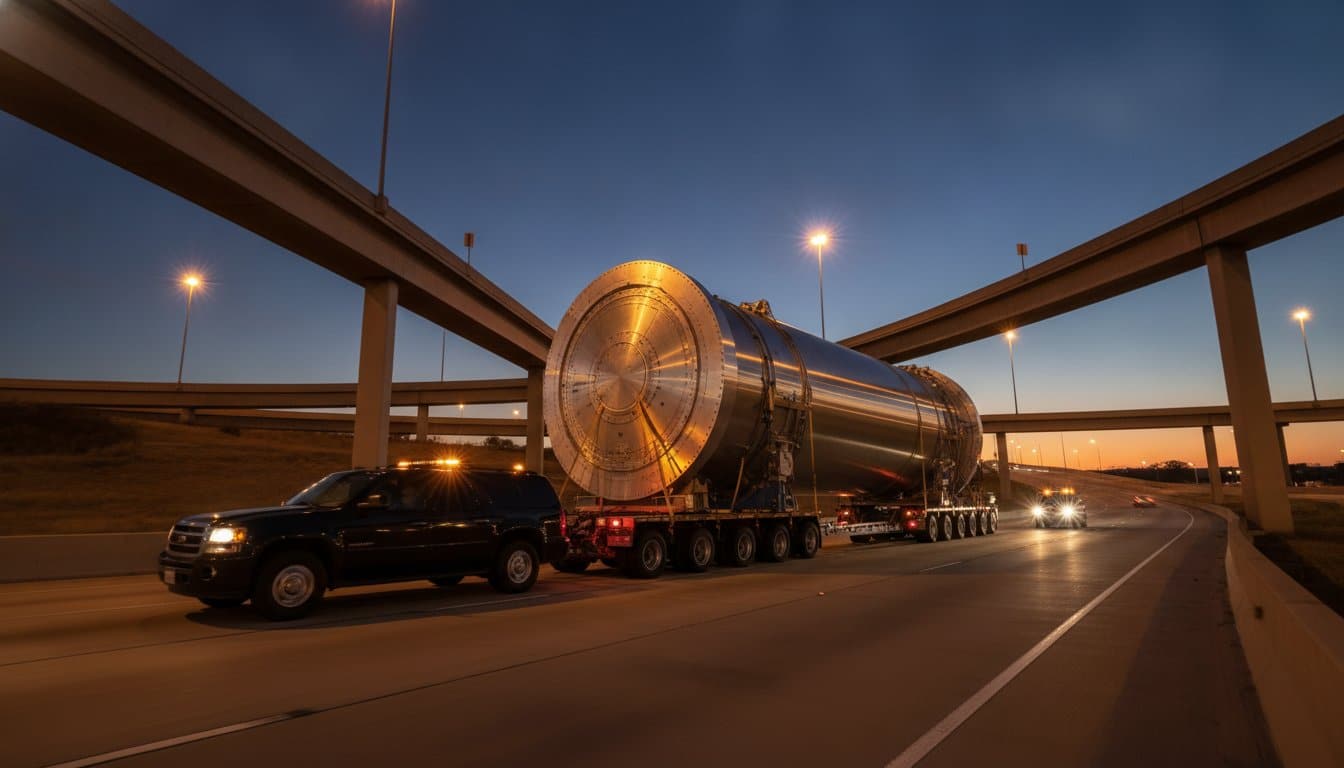
A single administrative oversight during the permit acquisition oversized cargo process isn’t just a paperwork error. It’s a multi-million dollar liability that can paralyze a global supply chain in minutes. When a critical industrial component sits impounded at a state line, “line-down” costs in manufacturing hubs like Taylor, Michigan, escalate by the second. You recognize that in high-stakes project logistics, there’s no margin for error. Regulatory fragmentation across states is a volatile landscape where a missed update in Louisiana or a misunderstood validity window in Indiana results in immediate fines and operational paralysis.
This guide provides the strategic framework required to master these complexities. We’ll show you how to secure necessary permits for flawless industrial transport while mitigating the risks inherent in moving high-value assets. You’ll gain a methodical preview of the 2026 regulatory environment, including centralized state authorities and updated escort requirements. By the end of this manual, you’ll have the exact methodology to ensure zero-delay transit and absolute compliance for every mission-critical load you manage. Precision is the only currency that matters. Failure is not an option when the assets are this valuable.
Key Takeaways
- Recognize “oversized” as a strict legal designation rather than a descriptive term to avoid catastrophic fines and impoundment.
- Identify the critical thresholds for superloads and the legal distinction between divisible and non-divisible loads that trigger mandatory permitting.
- Master the complexities of permit acquisition oversized cargo by synchronizing time-sensitive authorizations across fragmented state and international jurisdictions.
- Implement physical route surveys to identify low-clearance obstacles and weight-restricted bridges that digital mapping tools frequently overlook.
- Integrate permit management into a comprehensive project logistics framework to ensure zero-delay transit for high-value industrial assets.
The High Stakes of Oversized Cargo Permit Acquisition
An Oversize load isn’t a descriptive phrase. It’s a legal designation that fundamentally alters the liability profile of your shipment. When cargo exceeds the standard 8.5-foot width or the 80,000-pound federal weight limit, it enters a high-stakes regulatory environment where precision is the only safeguard. In sectors like defense and automotive manufacturing, permit acquisition oversized cargo is a mission-critical operation. A single administrative error or a misunderstood state statute doesn’t just result in a fine. It causes impoundment, project paralysis, and catastrophic financial loss.
The cost of non-compliance is absolute. Authorities can halt a multi-million dollar asset at a weigh station for days while new permits are processed. For a Taylor, Michigan-based industrial hub, this translates to “line-down” emergencies that cost thousands of dollars per minute. An expert logistics partner doesn’t just “get” permits. They assume full ownership of the regulatory burden, integrating permit management into a broader project logistics strategy to ensure continuous movement.
Defining the Margin for Error
A one-inch miscalculation is enough to halt a shipment. If your physical dimensions exceed the permit’s stated values, your insurance coverage may be voided instantly. This leaves your high-value assets exposed to total loss without recourse. Precision planning prevents these scenarios. Every height, width, and axle weight must be verified against the specific bridge clearances and road capacities of the planned route. In 2026, the margin for error has narrowed as enforcement agencies utilize more sophisticated automated weighing and measuring systems to catch discrepancies at the state line.
The Evolution of Oversized Regulations in 2026
The regulatory landscape is shifting toward centralization and stricter enforcement. In May 2026, Louisiana enacted House Bill 746, centralizing all permitting authority under the DOTD to prevent local government conflicts. Meanwhile, Indiana amended its permit validity periods as of July 1, 2026, limiting standard single-trip permits to five days. These rapid changes require constant vigilance. Texas now mandates a $10,000 surety bond for standard permits, and overweight maintenance fees can reach $375 for loads exceeding 200,000 pounds. Staying compliant means tracking these updates daily to avoid the delays that break supply chains.
Defining the Parameters: When is a Permit Mandatory?
Legal compliance is not a matter of opinion. It’s a matter of exact measurement. According to Federal oversize and overweight regulations, any load exceeding 8 feet 6 inches in width or 80,000 pounds in gross vehicle weight (GVW) requires specific authorization. However, the most critical distinction in permit acquisition oversized cargo is the “non-divisible” requirement. Regulatory bodies generally refuse to issue permits for loads that can be reasonably dismantled or broken down. If your cargo is divisible, you must ship it as multiple standard loads. Failure to prove non-divisibility results in immediate permit denial and potential fines for attempting to bypass standard shipping protocols.
Superloads represent the highest tier of regulatory scrutiny. These are shipments that exceed extreme thresholds, often 120,000 pounds or more depending on the state. Texas, for example, classifies loads between 200,001 and 254,300 pounds as superheavy, requiring a $15,000 surety bond. For these moves, engineering drawings and structural bridge analysis become mandatory. The complexity increases exponentially with every additional pound and inch.
Dimensional Thresholds for Oversized Freight
The standard width limit on the interstate highway system is 102 inches. Once a load crosses this threshold, it triggers requirements for “Oversize Load” signage and amber warning lights. Height limits are set by individual states. While many use a 13 foot 6 inch baseline, North Carolina allows up to 14 feet. Exceeding these limits introduces the risk of striking overhead obstructions. This leads to immediate impoundment and potential criminal liability. Length regulations are equally complex. They often depend on the specific trailer configuration and the distance between the kingpin and the rear axle.
Weight and Pressure: Axle vs. Gross Weight
Gross weight is only one metric. Infrastructure damage is caused by pressure, not just mass. This is why axle weight limits are strictly enforced at 20,000 pounds for single axles and 34,000 pounds for tandem axles. Proper weight distribution is non-negotiable. If you are moving heavy industrial machinery, you may require specialized multi-axle trailers to spread the load across more contact points. Precision is vital. A trailer that is technically capable of carrying the weight might still fail a bridge inspection if the axle spacing is too narrow. If you are unsure how your specific configuration matches state requirements, consult with a logistics specialist to verify your equipment before the load is secured.
Navigating the Jurisdictional Grid: Multi-State and International Moves
State borders are the friction points of industrial transport. While federal guidelines exist, the actual execution of permit acquisition oversized cargo happens at the state level. Each jurisdiction operates with its own set of constraints, curfew hours, and escort requirements. For example, State-level transportation permits from Caltrans require specific documentation that differs significantly from requirements in neighboring Nevada or Arizona. The primary challenge is not just obtaining the permit, but synchronizing it. A permit valid for five days in Indiana must align perfectly with the ten-day window allowed for escorted loads in another state. If a mechanical delay or weather event occurs in Ohio, your downstream authorizations may expire before you reach the border. This creates a cascading failure that halts the entire project.
Effective movement requires the integration of Customs and Trade Compliance into the initial planning phase. You cannot treat documentation as an afterthought. It’s the foundation of the move. When you operate across state lines, you aren’t just managing a truck; you’re managing a legal timeline.
The Michigan Advantage: Gateway to the Great Lakes and Canada
Operating out of Taylor, Michigan, provides a strategic vantage point for Great Lakes industrial corridors. However, moving over-dimensional (OD) loads across the border into Canada introduces extreme complexity. You must coordinate with the Michigan DOT (MDOT) for route approval through heavy industrial zones before reaching the Ambassador Bridge or the upcoming Gordie Howe International Bridge. Each crossing has its own weight tolerances and clearance limits. Precision in the planning phase ensures that your cargo doesn’t just reach the border, but clears it without a secondary inspection or structural reassessment. To ensure your fleet remains in peak condition for these demanding routes, AA Truck Body & Paint provides specialized body repair and painting for heavy-duty commercial trucks.
Managing Mexico shipping requires a dual-track regulatory approach. You must satisfy the requirements of the Secretaría de Infraestructura, Comunicaciones y Transportes (SCT) in Mexico while simultaneously preparing for US state DOT inspections. Drayage at the border is a high-risk touchpoint where security and documentation for industrial tooling must be flawless. Any discrepancy between the Mexican permit and the US state permit leads to immediate impoundment. We manage this interplay by assuming full oversight of the drayage process and ensuring that all cross-border security protocols are met before the wheels turn. Failure at the border is not an option when high-value assets are in transit.
The Route Survey: Engineering the Path of Least Resistance
Digital mapping is a tool, not a solution. For permit acquisition oversized cargo, a software-generated route is merely a hypothesis. Real-world obstructions like low-hanging telecommunication wires, temporary construction barriers, and unmapped bridge repairs can turn a routine transport into a multi-million dollar liability. A physical route survey is an engineering necessity, not an administrative suggestion. It involves a certified professional physically driving the proposed path to document every potential bottleneck. For superloads, state DOTs often mandate these surveys as a prerequisite for permit issuance. This process transforms a standard move into a controlled, predictable operation where failure is engineered out of the equation.
A comprehensive “Transportation Plan” is the final output of this engineering phase. It serves as the master document for the entire transit, detailing every stop, escort position, and emergency contingency. Every turn, bridge, and wire is a potential failure point. We eliminate these variables through methodical site surveys and end-to-end oversight. If your cargo requires an engineered transportation plan to clear the route, contact our project logistics team to initiate a professional route survey and secure your mission-critical delivery.
Physical Obstruction Analysis
Precision requires physical verification at every mile. Surveyors use telescopic height poles to ensure over-height industrial machinery has the required vertical clearance, often accounting for a mandatory safety buffer of at least 6 inches. Turn radii are equally critical. Long-haul equipment often requires “swept path” analysis to determine if a trailer can clear urban intersections without striking curbs or utility poles. We also apply the Federal Bridge Formula to calculate exact weight distribution across axles. This prevents the cargo from exceeding the structural capacity of aging infrastructure. This level of technical excellence is mandatory for high-value defense and automotive assets where the margin for error is zero.
The Human Element: Escorts and Law Enforcement
Permits often mandate a specific human presence to mitigate risk and manage public safety. Depending on the dimensions, state law may require private pilot cars or uniformed law enforcement escorts. Their role is proactive protection, not just observation. Certified flaggers must manage traffic at critical junctions, while front and rear escorts maintain constant radio communication with the driver and the command center. This synchronization prevents the “line-down” scenarios that cripple manufacturing. In 2026, state-level requirements continue to evolve; for instance, Indiana now extends permit validity to ten days when a law enforcement escort is present, reflecting the increased safety and oversight these professionals provide during transit.
ICAT Detroit: Precision Logistics for High-Value Industrial Assets
Trust is the primary emotional currency in high-stakes industrial transport. At ICAT Detroit, we don’t treat permit acquisition oversized cargo as an administrative checkbox. We treat it as a strategic engineering discipline. Our methodology integrates every regulatory requirement into a holistic Project Logistics framework. This ensures that the administrative burden never compromises the physical timeline. Operating from our Taylor, Michigan hub, we provide the surgical precision of a local expert backed by a global network capable of moving the most complex industrial assets on earth. We take full ownership of the outcome, projecting a mentality where failure is not an option.
Our team reduces friction by managing the entire lifecycle of the move. We handle the engineering calculations, the state-level negotiations, and the physical route surveys. This allows your internal teams to focus on core operations while we navigate the chaotic regulatory landscape. We position ourselves as a protective partner, utilizing a results-oriented structure that prioritizes movement and exactness over marketing fluff.
ITAR and Defense Sector Precision
Compliance is non-negotiable when dealing with ITAR-compliant defense cargo. We understand that government and military contracts demand a zero-failure mentality. Our team manages the sensitive interplay between security protocols and oversized transport permits, ensuring that high-sensitivity shipments move without a single unauthorized stop. We maintain absolute control over the documentation and security requirements. This proactive involvement is essential for maintaining the integrity of the defense supply chain. Flawless execution is our baseline standard.
Automotive Supply Chain Resilience
The automotive sector operates on a knife-edge where delays are measured in thousands of dollars per minute. Moving oversized stamping dies and tooling requires a level of synchronization that standard carriers cannot match. We provide expedited oversized solutions designed to eliminate manufacturing downtime. Whether it’s a “line-down” emergency or a planned facility relocation, our team ensures that every permit is synchronized and every route is pre-cleared. We strip away the friction of jurisdictional fragmentation, providing a single point of accountability for your most valuable assets. Ready to secure your next mission-critical transport? Request a Quote today and experience the precision of ICAT Detroit.
Master the Logistics of Absolute Precision
Navigating the 2026 regulatory landscape requires more than just administrative effort. It demands an engineering mindset. Successful permit acquisition oversized cargo relies on the seamless synchronization of state-level authorizations, physical route surveys, and rigorous technical analysis. Whether you’re moving heavy industrial tooling through Taylor, Michigan, or managing complex cross-border drayage into Mexico, the margin for error is non-existent. You’ve seen that a single inch of miscalculation or a missed permit window can paralyze a multi-million dollar project in minutes.
ICAT Detroit provides the specialized project cargo engineering and ITAR-certified expertise needed to protect your most valuable assets. By leveraging our global agency network, we ensure that every mission-critical load reaches its destination without the catastrophic costs of “line-down” delays or regulatory impoundment. We take ownership of the complexities so you can maintain operational momentum. Our team stands ready to navigate the jurisdictional grid with the surgical precision your industry demands. Trust is built on reliability, and we don’t consider failure a possibility.
Secure Your Mission-Critical Move: Request an Oversized Freight Quote
Let’s move your cargo with the absolute precision and composure that your high-stakes operations deserve.
Frequently Asked Questions
How long does it typically take to acquire an oversized load permit?
Standard authorizations typically take three to five business days to process. However, “superload” status or complex moves requiring bridge engineering analysis can extend this timeline to several weeks. State DOTs operate on varied schedules, and any discrepancy in your application results in immediate rejection. We recommend initiating the process at least 14 days before your scheduled departure to account for potential administrative delays and route survey verification. Precision saves time.
Do I need a separate permit for every state the cargo passes through?
Yes, you must secure a separate permit for every state on your transport route. State sovereignty dictates these requirements, meaning a Michigan permit has no legal standing once you cross into Ohio or Indiana. Each jurisdiction has its own thresholds, fees, and escort mandates. Synchronization is the critical challenge in permit acquisition oversized cargo. If one state’s authorization expires due to a delay in another, your entire project hits a standstill.
What is the difference between an oversized permit and a superload permit?
A superload permit is required when cargo exceeds extreme dimensional or weight thresholds, often starting at 120,000 pounds. While standard oversized permits are relatively routine, superloads trigger intensive scrutiny. This often includes mandatory structural engineering reviews, bridge weight distribution analysis, and law enforcement escorts. In Texas, loads exceeding 200,001 pounds are classified as superheavy. These moves require high-tier surety bonds, often between $10,000 and $15,000, to cover potential infrastructure damage.
Are permits required for oversized cargo transported by sea or air?
Road permits are not required for the sea or air portion of the journey. However, they are mandatory for the ground drayage to and from the port or airfield. You can’t move an over-dimensional component on public roads without state DOT authorization, regardless of its final destination. Port-to-door logistics require a seamless handoff between maritime documentation and road permits. Even when dealing with high-end recreational vessels, such as the yachts available through boatico.com, the logistics of moving from water to road require specialized oversight. We manage these transition points to ensure your cargo never sits idle.
Annual “envelope” permits are available in many states for loads that fall within specific, non-extreme dimensions. For example, Texas offers an annual permit for $4,000, while California allows annuals for loads up to 12 feet wide and 14 feet high. These are efficient for repetitive industrial shipments. However, they don’t cover superloads or cargo with extreme height. You’ll still need single-trip permits for any equipment that exceeds the annual permit’s strict parameters.
What happens if my oversized cargo is involved in an accident without a valid permit?
Operating without a valid permit results in the immediate voidance of your insurance coverage and massive legal liability. You face criminal negligence charges, heavy fines, and potential vehicle impoundment. If an accident occurs, you are financially responsible for all damages without recourse to your policy. Precision in permit acquisition oversized cargo is the only way to maintain the legal and financial protections necessary for high-value industrial assets. Failure is not an option.
Are there specific times of day when oversized loads are prohibited from moving?
Movement is typically prohibited during peak traffic hours, at night, and on major holidays. Most states restrict travel to the window between 30 minutes before sunrise and 30 minutes after sunset. Alabama and California have strict New Year’s Day travel bans for oversized freight. Urban centers often enforce additional morning and evening rush hour curfews. Your permit will specify the exact allowable travel hours. Violating these windows results in immediate permit revocation.
How much do oversized cargo permits generally cost?
State-mandated permit fees vary significantly based on dimensions, weight, and the specific jurisdiction. These are government-imposed costs that are separate from the logistics service fees. For heavy-haul loads, states often require surety bonds, which frequently range from $10,000 to $15,000 depending on the risk profile. You must also account for the costs of private pilot cars or law enforcement escorts. We provide a full breakdown of these regulatory expenses during the planning phase.