
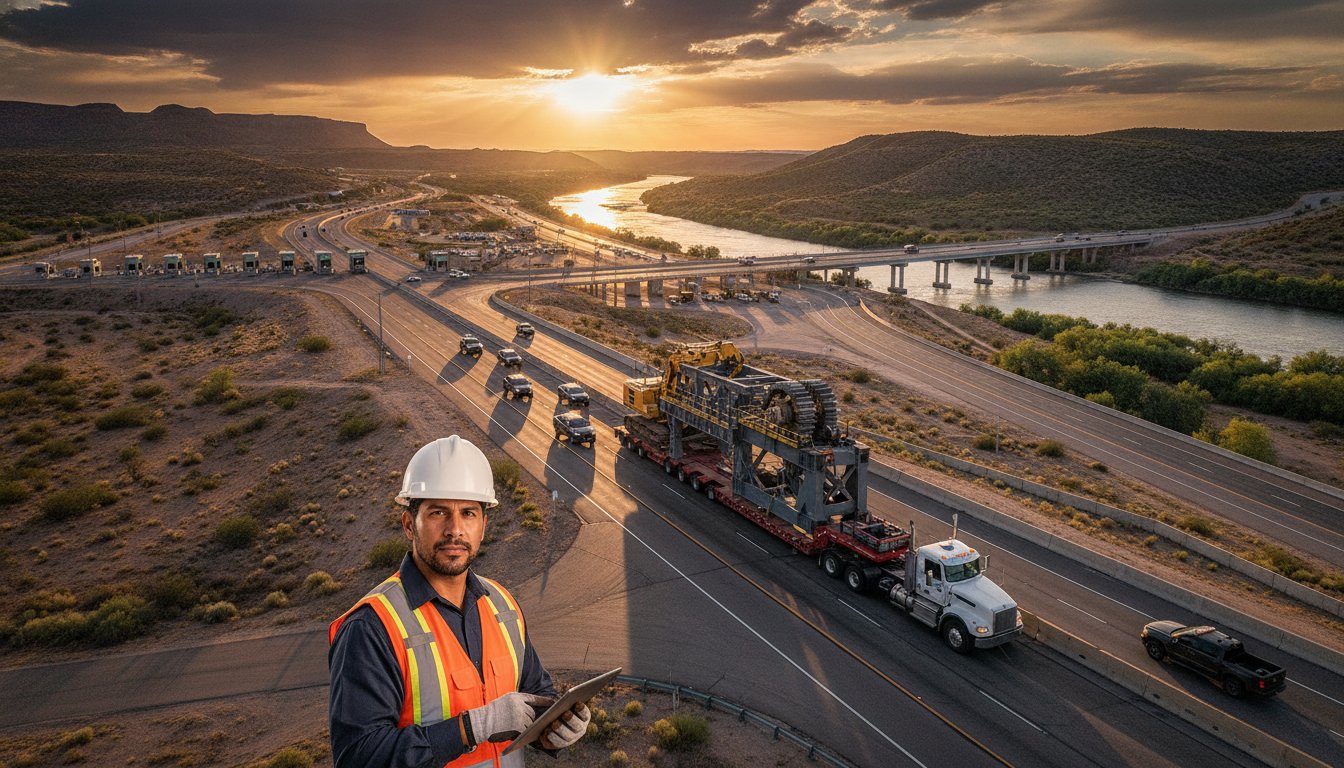
A single missing SAT permit or an incorrectly measured axle weight doesn’t just cause a delay. It triggers a cascade of compounding costs that can shut down an entire assembly line for days. Successful oversize freight shipping to Mexico is an engineering challenge that requires more than a trailer and a driver; it demands absolute regulatory precision and mission-critical oversight.
You understand the high-stakes nature of these movements. The fear of seeing critical industrial machinery impounded at the border is a valid concern for any logistics manager facing tight production deadlines. We promise to help you master the technical and operational complexities of these routes to ensure your cargo arrives without costly delays. This article examines the strategic integration of specialized rigging, current permit processing requirements, and the customs protocols necessary to maintain a steady flow across the Michigan-to-Mexico corridor. We will break down how to select the right equipment and navigate the specific documentation needed to keep your operations moving forward. By the end of this guide, you’ll have the framework to manage these complex shipments with the confidence of a seasoned veteran.
Key Takeaways
- Differentiate between US DOT standards and Mexican NOM-012-SCT-2-2017 regulations to eliminate the risk of cargo being impounded at the border.
- Optimize equipment selection by matching cargo geometry to specialized trailers like RGNs and lowboys, ensuring maximum stability for heavy-haul loads.
- Navigate the complexities of oversize freight shipping to Mexico by integrating the Pedimento documentation process with rigorous ITAR compliance.
- Secure your supply chain against “line-down” scenarios through strategic border crossing selection and the use of multi-modal expedite options.
- Maintain absolute operational control with real-time visibility and proactive risk mitigation strategies designed for high-value industrial transport.
Defining Oversize Freight: Regulations and Standards for Mexico
Mexico’s regulatory environment for heavy-haul transport is governed by rigid standards that differ significantly from US DOT protocols. The primary directive, NOM-012-SCT-2-2017, establishes the maximum dimensions and weights for vehicles traveling on federal highways. For professionals managing oversize freight shipping to Mexico, understanding these nuances is the difference between a seamless crossing and a multi-day impoundment. While a load might be legal in Texas, it often triggers “Specialized Transport” requirements the moment it crosses the border.
Executing project logistics for oversized cargo requires an engineering mindset. It’s not just about the truck; it’s about the route’s physical capacity. Bridge heights, power line clearances, and the turning radii of Mexican federal roads demand precise surveying. This is where specialized escort vehicles, or pilot cars, become mandatory. Depending on the width and length, you may require one or two escorts to manage traffic and ensure the safety of the load and the public. Failure to coordinate these assets ahead of time results in immediate stoppage by authorities.
Understanding Legal Limits and Permit Thresholds
In Mexico, a load is classified as specialized the moment it exceeds 2.6 meters in width, 4.25 meters in height, or the standard weight limits defined for its specific axle configuration. When these thresholds are crossed, you must secure a permit from the SICT (Secretaría de Infraestructura, Comunicaciones y Transportes). Weight distribution is particularly critical. Mexican road infrastructure varies between states; what’s permissible on a primary toll road (Cuota) may be physically impossible on a secondary free road (Libre) due to bridge load ratings. Precision in axle pressure calculations is non-negotiable for maintaining road safety and legal compliance.
The Permitting Process: Timelines and Complexity
Securing an SICT permit is a methodical process that requires technical drawings, exact route planning, and verified equipment specifications. You must submit your application well in advance of the ship date to account for standard processing windows. Current 2026 SAT (Mexico Tax Administration) oversight has also increased the scrutiny on permit documentation, making early filing essential to avoid border bottlenecks.
- Identify the exact cargo dimensions and gross vehicle weight.
- Submit the proposed route to SICT for infrastructure and clearance verification.
- Coordinate with state and local authorities for multi-state movements.
A common failure point is neglecting local permits. While a federal permit covers the highway, moving oversize freight shipping to Mexico through municipal zones often requires separate local police escorts and transit authorizations. Managing these lead times prevents the “line-down” emergencies that occur when critical machinery is stuck waiting for a signature.
Specialized Equipment and Engineering for Heavy-Haul Cargo
Standard flatbed solutions fail when cargo dimensions exceed legal limits. For oversize freight shipping to Mexico, the equipment selection process is a matter of physics and route feasibility. We utilize multi-axle configurations to distribute weight across fragile infrastructure, preventing both road damage and permit violations. This level of technical oversight ensures that high-value cargo remains compliant with NOM-012-SCT-2-2017 standards throughout the transit. It’s not just about moving the load; it’s about the precision engineering required to keep it stable across thousands of miles.
Selecting the Right Trailer for Complex Geometry
Matching cargo to the correct trailer deck height is critical. While step-decks offer versatility for moderately tall loads, ultra-high industrial machinery often requires lowboys or Removable Goosenecks (RGN). RGNs allow for “drive-on” loading. This is essential for heavy equipment that cannot be easily craned due to height or weight constraints. For long-span aerospace components or infrastructure parts, extendable trailers provide the necessary support to prevent structural fatigue. Securing these loads requires specialized tensioning protocols. Cross-border transit involves varying road qualities. Therefore, tie-down points must be engineered to withstand constant vibration and lateral forces over thousands of miles of Mexican highway. Proper load-leveling engineering is what separates a successful move from a catastrophic equipment failure.
Rigging and Site Surveys: Preventing Operational Failure
The journey begins long before the truck arrives. A comprehensive site survey at both the origin and the destination is non-negotiable. We analyze dock heights, overhead clearances, and ground stability to ensure the rigging team can operate safely and efficiently. Coordinating crane services requires surgical timing. This avoids detention fees and the dreaded “line-down” scenarios that plague poorly planned moves. Learn more about our specialized rigging and project logistics to see how we manage these complex variables.
Packaging and crating serve as the final security layer for oversize freight shipping to Mexico. High-value industrial components are susceptible to environmental damage and shifting during long-haul transit. Custom-engineered crates provide the structural integrity needed for multi-modal transitions. They protect sensitive surfaces and internal mechanisms from the rigors of the road. If your machinery requires this level of precision and protection, you can consult with our engineering team to finalize your load plan and secure your assets.
Strategic Border Crossings: Routes and Mode Comparisons
Strategic route selection determines the ultimate success of oversize freight shipping to Mexico. While Laredo is the primary gateway for North American trade, the World Trade Bridge is often saturated with standard dry van traffic. For oversized loads, the Columbia Solidarity Bridge frequently provides superior clearance and faster processing for specialized permits. Every hour spent idling at the border increases the risk of a “line-down” scenario at the destination factory. Choosing the right entry point is a tactical decision that requires real-time knowledge of border congestion and permit processing speeds.
The choice between “transload” and “through-trailer” service is a critical risk management decision. For standard freight, transloading is a common cost-saving measure. For oversized industrial machinery, it’s a significant liability. Every time a specialized load is transferred to a different trailer, the risk of structural damage or securement failure increases. We prioritize through-trailer solutions to ensure the original rigging and securement remain undisturbed from the origin to the final installation site. This continuity of care is essential for maintaining the integrity of high-value assets.
Ground vs. Air: When Speed Trumps Cost
When the financial impact of a delayed component reaches five or six figures per hour, ground transport is no longer a viable option. Heavy-lift air charters provide the immediate resolution required for mission-critical parts that cannot wait for the permitting and transit times of road travel. Explore our Air Freight Shipping solutions for urgent cargo. While ground transit remains the cost-effective choice for planned project logistics, air freight removes the variables of border congestion and physical road infrastructure constraints. We evaluate the urgency of each shipment to determine if the speed of flight justifies the premium cost.
Primary Border Hubs for Specialized Freight
Laredo remains the epicenter of heavy-haul logistics due to its concentrated network of customs brokers and specialized carriers. However, over-reliance on this hub can be a mistake during peak periods or when local infrastructure projects limit clearance. Navigating the unique challenges of Mexico shipping requires a diversified approach to border entry. For cargo arriving by sea, ports like Veracruz or Altamira offer alternative entry points, but they come with their own set of infrastructure bottlenecks and crane availability issues. Southern Mexico’s terrain, characterized by steep grades and narrow tunnels, requires a level of route surveying that standard logistics providers often overlook. Success depends on identifying these geographic constraints before the cargo leaves the dock.
Customs, Compliance, and Trade Security Protocols
The border is more than a physical crossing; it’s a legal gauntlet. For oversize freight shipping to Mexico, documentation errors don’t just cause delays; they lead to immediate cargo seizure. The Pedimento is the most critical document in this process. It serves as the official record of the transaction for the Mexican Tax Administration (SAT). You can’t bypass this requirement. A licensed Mexican Customs Broker, known as an Agente Aduanal, must validate every detail of the filing. They carry personal legal liability for the accuracy of your data. This makes their role proactive rather than administrative. They must verify that the physical cargo matches the paperwork before the wheels ever touch the bridge. For companies looking to further master the technicalities of Mexican corporate and financial law, CECANI offers specialized manuals that provide a framework for navigating complex local regulations.
Precision in valuation is where many shippers fail. If the SAT suspects a valuation dispute, your cargo will be halted indefinitely for an audit. We integrate customs brokerage with physical transport to eliminate these discrepancies. This ensures that the technical specifications of your oversized machinery align perfectly with the declared values and HS codes. Managing these details upfront prevents the financial hemorrhaging associated with border impoundment.
Defense and aerospace sectors operate under the strictest federal oversight. Moving oversized components for these industries requires specialized ITAR (International Traffic in Arms Regulations) compliance. There’s no margin for error when handling sensitive technology. We maintain a rigorous, end-to-end chain of custody to ensure every asset is tracked and secured throughout the transit. ITAR Compliant Logistics Michigan: Managing Mission-Critical Defense Cargo provides the framework for these high-security movements. Security isn’t an afterthought; it’s the foundation of the logistics plan. We coordinate with both US and Mexican authorities to ensure that all export licenses are valid and that the physical transport meets the required security tier.
Documentation and Valuation Accuracy
The Commercial Invoice must include a precise description of the goods, the unit value, and the country of origin in a format that satisfies SAT requirements. Proper classification using the Harmonized System (HS) codes is essential for determining applicable duties and taxes. For manufacturing equipment, we often utilize the IMMEX (Maquiladora) program. This allows for temporary importation, where duties are deferred if the equipment is used for export production. However, the documentation for temporary moves is scrutinized even more heavily than permanent imports. We provide the oversight necessary to defend your valuation and keep your cargo moving through the customs gate without friction.
To secure your cross-border compliance strategy and prevent costly impoundments, contact our trade compliance specialists today.
Mitigating Risk in Mission-Critical Oversize Logistics
In the high-stakes environment of industrial manufacturing, a “line-down” scenario isn’t just an inconvenience; it’s a financial catastrophe. When oversize freight shipping to Mexico involves multi-million dollar machinery or defense-tier components, the margin for error is non-existent. We don’t just move cargo; we manage outcomes through a lens of absolute precision. This requires real-time visibility across every mile, especially through high-risk areas where standard GPS tracking often fails. Our mission-driven approach ensures that every stakeholder is synchronized, from the initial rigging crew to the final installation team at the destination plant. Trust is our primary currency, and we earn it through flawless execution.
Contingency Planning for Unforeseen Delays
Infrastructure failure, sudden weather events, or mid-transit regulatory shifts can strand a specialized load. We mitigate these risks by developing primary, secondary, and tertiary route plans before the first axle turns. If a bridge on a Mexican federal highway is suddenly restricted, we already have the alternate SICT-approved route mapped and ready for deployment. Expedited Freight Shipping Detroit: Mission-Critical Logistics for Industrial Leaders provides the rapid-response framework necessary when timelines compress. Our 24/7 oversight isn’t a supplemental feature; it’s a core requirement for project cargo that cannot afford a single hour of unplanned downtime. We also verify that cargo insurance is specifically tailored for oversized dimensions, covering unique heavy-haul risks that standard policies frequently exclude.
Transparency and Strategic Partnership
A traditional broker model is fundamentally insufficient for the technical complexities of cross-border heavy-haul. You need a logistics partner that takes full ownership of the entire mission. ICAT Detroit coordinates directly between US and Mexican entities, bridging the gap between differing operational cultures and legal requirements. We act as a steady, expert hand, navigating the chaos of border congestion and technical hurdles with composure. This proactive involvement ensures that the integration of moving parts is seamless and that your production schedule remains protected. To secure your supply chain with an elite logistics partner, request a specialized quote for your oversized Mexico shipment today.
Mastering the Cross-Border Heavy-Haul Mission
The complexities of oversize freight shipping to Mexico demand more than just a transportation provider; they require a strategic partner with a dedicated engineering mindset. Success hinges on a precise understanding of Mexican federal highway regulations and the ability to execute flawless rigging in high-pressure industrial environments. By integrating customs brokerage with specialized logistics, you eliminate the documentation discrepancies that lead to catastrophic border impoundments. This proactive approach protects your production schedule and your bottom line.
We maintain a zero-error standard for every mission. Our team of specialized industrial rigging experts and ITAR-certified compliance officers ensures your high-value assets remain secure and compliant from origin to installation. With 24/7 mission-critical support, we navigate infrastructure hurdles and regulatory shifts with composed authority. Don’t leave your most critical industrial cargo to chance when the margin for error is non-existent. Secure Your Mission-Critical Move: Get an Oversize Freight Quote and move your cargo with absolute confidence.
Frequently Asked Questions
What are the maximum dimensions for shipping freight to Mexico without a permit?
Mexico’s NOM-012-SCT-2-2017 defines standard legal limits as 2.6 meters in width and 4.25 meters in height. Anything exceeding these measurements requires a specialized permit from the SICT. Weight limits also apply based on axle configuration. Crossing these thresholds without authorization leads to immediate impoundment at the border. Shippers must verify these dimensions against current federal road standards to ensure compliance before transit begins.
How long does it take to get an oversized cargo permit in Mexico?
Processing times for SICT permits vary depending on the complexity of the route and cargo weight. While standard permits might take a few weeks, current 2026 SAT oversight and complex multi-state routes can extend this window significantly. Shippers should plan for lead times that account for both federal and local municipal authorizations. Early filing is the only way to prevent border bottlenecks and production delays during high-stakes moves.
Is an escort vehicle required for all oversized loads in Mexico?
Escort vehicles, or pilot cars, are mandatory for loads that exceed specific width and length thresholds defined by the SICT. The number of escorts required depends on the degree of the oversize dimensions and the classification of the highways being used. These pilots manage traffic and ensure clearance through narrow passages. Coordination with local police escorts is often necessary when moving through high-traffic municipal zones or industrial corridors.
Can oversized freight be shipped via air to Mexico?
Yes, heavy-lift air charters provide a mission-critical solution for oversize freight shipping to Mexico when ground transit is too slow. This mode bypasses the permitting delays and physical infrastructure constraints of road travel. While air freight carries a premium cost, it’s often the only way to resolve a “line-down” emergency. We evaluate cargo geometry to ensure compatibility with specialized nose-loading or side-door cargo aircraft for immediate resolution.
What is the difference between an oversized and a project cargo shipment?
Oversized freight refers specifically to cargo that exceeds legal dimensional or weight limits. Project cargo is a broader logistics category involving the coordinated movement of multiple high-value components, often including oversized pieces, for a specific industrial goal. Project logistics requires a comprehensive engineering plan that integrates rigging, crating, and multi-modal transport. It demands a higher level of oversight to synchronize delivery with complex installation schedules.
How does ITAR compliance affect oversized freight shipping to Mexico?
ITAR compliance adds a layer of federal security oversight to the movement of defense-related oversized components. Shippers must maintain a verified chain of custody and secure specific export licenses from the U.S. Department of State. Failure to follow these protocols results in severe legal penalties and cargo seizure. We ensure that every oversize freight shipping to Mexico involving sensitive technology meets the highest tier of security and regulatory scrutiny without exception.
What is the role of a Mexican customs broker in oversized freight?
The Mexican Customs Broker, or Agente Aduanal, is legally responsible for the accuracy of the Pedimento filing. For oversized moves, they must verify that the physical dimensions and valuation of the machinery align perfectly with the documentation. They act as the primary liaison between the shipper and the SAT. Their proactive involvement ensures that the cargo clears customs without triggering audits or valuation disputes that cause terminal delays at the bridge.
How do I calculate the cost of shipping oversized freight to Mexico?
Calculating costs for heavy-haul logistics requires a detailed analysis of several variables. You must account for permit fees, escort vehicle costs, specialized rigging, and the specific trailer type required for the cargo’s geometry. Route-specific factors like toll road fees and bridge clearance surveys also impact the total. We provide a methodical breakdown of these expenses to ensure your budget reflects the actual operational requirements of a mission-critical industrial move.