
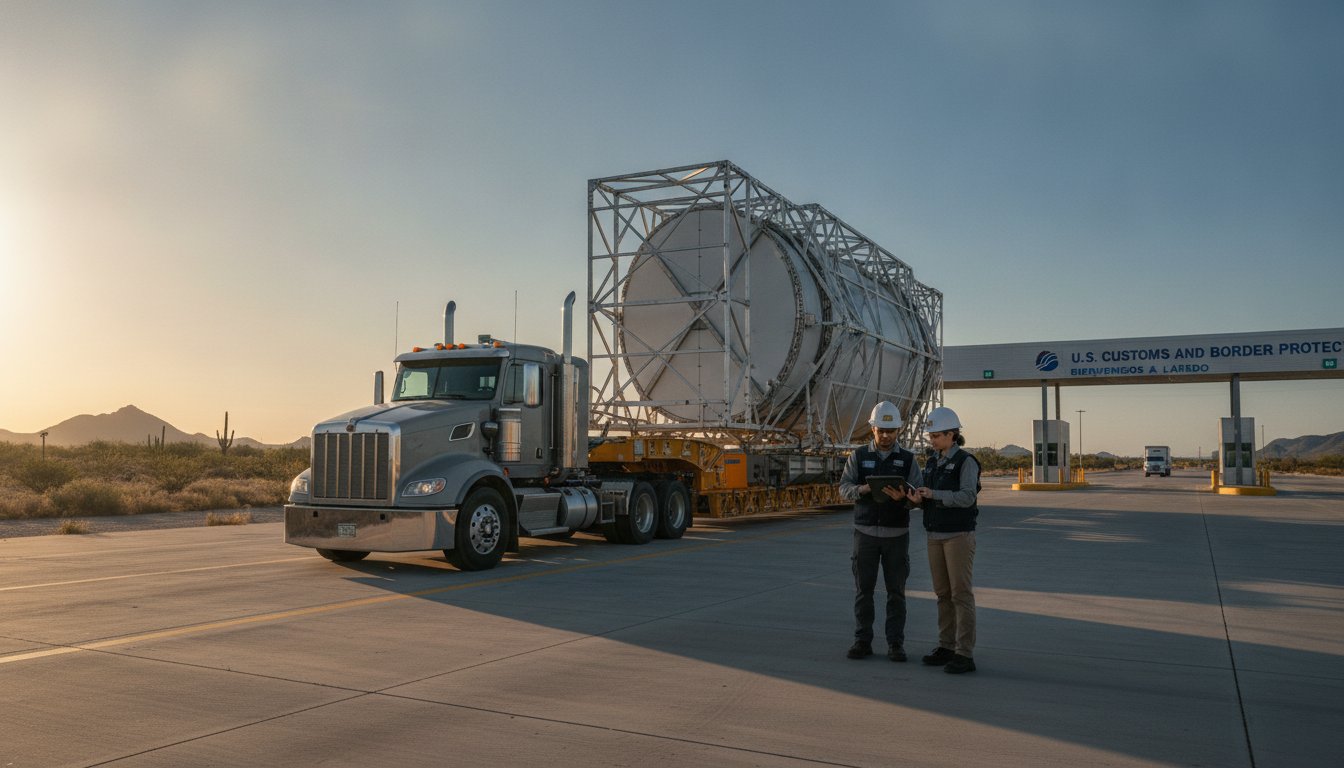
A single oversight in permit synchronization at the Laredo gateway can freeze a multi-million dollar project in its tracks. When you’re managing oversize freight shipping Mexico to USA, you’re not just moving cargo; you’re navigating a high-stakes regulatory gauntlet where the margin for error is zero. The complexity of aligning Mexican federal standards, such as NOM-012-SCT-2-2017, with individual U.S. state permits creates a landscape where even seasoned logistics managers feel the pressure of unpredictable border wait times.
It’s understandable to view the 2026 Mexico customs law reforms and heightened HTS code scrutiny as significant obstacles to your operational flow. This guide is designed to eliminate that uncertainty. You’ll learn how to master the technical nuances of cross-border heavy haul, from securing multi-jurisdictional permits to ensuring flawless customs compliance for high-value industrial equipment. We’ll provide a clear roadmap for achieving zero-delay border crossings and total end-to-end visibility, positioning you as the steady hand in a mission-critical environment.
Key Takeaways
- Identify the critical permit hierarchy required to synchronize Mexican federal regulations with specific U.S. state mandates.
- Analyze the operational risk profiles of transloading versus through-trailer services for high-value industrial assets.
- Navigate the 2026 customs law reforms to maintain seamless oversize freight shipping Mexico to USA without regulatory delays.
- Implement ITAR-compliant protocols and specialized crating strategies for high-stakes defense and automotive logistics.
The High-Stakes Reality of Mexico to USA Oversize Freight Shipping
In the industrial sector, time isn’t just money; it’s the difference between a functional supply chain and a total assembly line shutdown. Managing oversize freight shipping Mexico to USA requires more than just a truck and a driver. It demands a tactical understanding of cross-border infrastructure and the discipline to manage high-value assets moving through some of the busiest commercial corridors in the world. We operate with the understanding that every shipment is a mission-critical link in a larger manufacturing ecosystem. The margin for error is non-existent when moving specialized equipment across international lines.
What Qualifies as Oversize Freight in Cross-Border Trade?
An Oversize load is defined by dimensions or weight that exceed standard legal limits. In the United States, this typically applies to any cargo wider than 8.5 feet, taller than 13.5 to 14 feet, or heavier than 80,000 pounds in gross vehicle weight. Mexico’s regulatory framework, governed by NOM-012-SCT-2-2017, often sets the width threshold at 9.8 feet. These aren’t just numbers on a manifest. They represent industrial stamping presses, aerospace components, and defense vehicles that cannot be disassembled. While “wide loads” might require simple escorts, “superloads” involve extreme dimensions that necessitate custom route engineering and bridge stress analysis. Precision in these measurements is non-negotiable. One inch of discrepancy can result in a rejected permit or a physical collision with infrastructure.
The Cost of Failure: Why Precision Matters
For automotive and industrial manufacturers, the stakes are absolute. A delayed shipment of tooling or machinery doesn’t just push back a deadline. It triggers line-down emergencies that cost thousands of dollars per minute. When oversize freight shipping Mexico to USA encounters a border delay, the ripple effect is immediate. Permits have strict expiration windows. If a load is stuck at the Laredo crossing because of a documentation error, the permits for the remaining five states on the route may expire before the cargo clears customs. This creates a cycle of re-permitting, increased storage costs, and lost production time. For situations where every second counts, integrating expedited freight shipping Detroit protocols into the project plan is the only way to mitigate these risks. We treat every move as a mission-critical operation where failure is not a viable outcome. Success requires the simultaneous synchronization of physical transport, multi-jurisdictional permits, and rigorous customs brokerage.
Navigating the Regulatory Landscape: Permits and Documentation
Regulatory oversight for oversize freight shipping Mexico to USA is an intricate hierarchy. It begins at the Mexican federal level with NOM-012-SCT-2-2017 and transitions into a patchwork of U.S. state mandates. While the Federal oversize and overweight regulations set the baseline, each state maintains absolute authority over its road networks. This means a load moving from Laredo to Detroit requires separate legal authorization for every mile of the journey. Failure to synchronize these permits results in cargo being impounded at state lines, regardless of how much “buffer time” was built into the schedule. In high-stakes logistics, buffer time is a myth. Only precision provides a safety net.
Step-by-Step Permit Acquisition Process
Successful execution begins with a physical route survey. This isn’t a digital estimate. It’s a boots-on-the-ground verification of bridge clearances, utility wire heights, and turning radii. Once the route is validated, the application process must be simultaneous. We secure Mexican export documentation alongside U.S. state-level transit permits to ensure the entire permit chain is active before the wheels turn. This process often includes contracting certified pilot cars. These escort vehicles are mandated by law once dimensions exceed specific thresholds, such as a width of 12 feet in many U.S. jurisdictions. If your cargo requires this level of oversight, our team can help you coordinate the necessary resources for a flawless move.
Synchronizing Multi-State Transit
The challenge intensifies as cargo crosses from Texas or Arizona into the heart of the Midwest. Each state has unique requirements for travel times, often restricting oversized movement to daylight hours or prohibiting travel during holiday weekends. Managing this requires comprehensive project logistics that account for the speed of the load and the expiration of the permits. If a weather delay occurs in Oklahoma, the permits for Missouri and Illinois must be revised immediately. Proactive oversight prevents a single delay from cascading into a total operational failure. Documentation for the tractor and trailer, including proof of insurance and specialized equipment certifications, must be perfect. Any discrepancy is an invitation for a DOT inspection that can sideline a shipment for days. We treat every permit as a mission-critical document because, in this industry, a single typo can halt a multi-million dollar project.
Strategic Border Crossing: Transloading vs. Direct Through-Trailer
The physical transition at the border is the most volatile phase of oversize freight shipping Mexico to USA. It isn’t just a change of trucks. It’s a high-stakes handoff. Congestion at ports like Laredo or El Paso can turn a meticulously planned schedule into a series of costly delays. Shippers must decide between the continuity of through-trailer service and the flexibility of transloading. Each path carries distinct risks for high-value industrial assets. Precision at this stage is the only way to maintain the momentum of your project.
Through-Trailer Service: Minimizing Cargo Handling
Through-trailer service maintains the cargo on a single specialized trailer from the point of origin in Mexico to the final destination in the U.S. This method is the preferred choice for sensitive aerospace components or precision tooling. It eliminates the physical risk inherent in lifting and re-securing oversized loads. However, it requires a seamless agreement between Mexican and U.S. carriers. Equipment interchange and insurance liability become complex. Not all Mexican trailers are insured for U.S. transit. We prioritize Mexico shipping solutions that resolve these liability gaps before the cargo reaches the border, ensuring the asset never leaves its original bed.
Transloading: Flexibility at the Gateway
Transloading involves moving freight from a Mexican trailer to a U.S. trailer at a specialized border warehouse. This is often necessary when specialized U.S. trailers are restricted from entering Mexico or when specific drayage providers are used to bridge the international gap. For heavy-haul cargo, this requires specialized rigging and heavy-lift crane equipment. The risk of damage is highest during this transfer. Flawless execution depends on expert oversight and strict adherence to Cargo security and customs compliance protocols. If the rigging isn’t exact, the load won’t be legal for U.S. highway transit.
The drayage process is where many shipments stall. At the Laredo crossing, the Columbia Bridge is frequently utilized for its wider lanes and higher clearances, which are essential for oversize loads. Choosing the right gateway is a strategic decision, not an administrative one. We manage these transitions by coordinating the transfer in real-time. This ensures the U.S. carrier is positioned and ready the moment the load clears the bridge. This proactive involvement prevents the cargo from sitting in high-traffic yards, reducing exposure to environmental risks or accidental damage. In a mission-critical environment, visibility at the border is your greatest asset.
Customs Compliance and Risk Mitigation for Industrial Cargo
Regulatory failure at the border is an avoidable catastrophe. When managing oversize freight shipping Mexico to USA, your customs strategy must be integrated into the logistics workflow from day one. It isn’t an administrative afterthought. It’s a core operational requirement. Accurate Harmonized Tariff Schedule (HTS) classification is the foundation of this process. For heavy machinery like industrial stamping presses or complex tooling, a single digit error in an HTS code can trigger intensive secondary inspections. These delays don’t just stall the truck; they jeopardize the entire project timeline. Precision in documentation is the only way to ensure your cargo moves at the speed of your business.
Risk mitigation extends beyond paperwork to the physical security of the asset. High-value oversized loads require specialized packaging and crating solutions designed for the rigors of multi-modal transit. Standard blocking and bracing are often insufficient for the lateral forces experienced during the drayage and long-haul phases. We treat the protection of your equipment as a mission-critical objective, ensuring that every asset is secured against environmental exposure and physical impact. If you are moving high-value machinery, contact our compliance experts to review your documentation before it reaches the port of entry.
ITAR and Defense Logistics: A Specialized Requirement
Defense-related shipments introduce an extra layer of federal oversight. Navigating ITAR regulations requires absolute transparency and a supply chain where every participant is registered and compliant. This isn’t optional. It’s a matter of national security and legal survival. Moving defense vehicles or aerospace components across the Mexico-U.S. border demands a partner who understands the nuances of ITAR-compliant logistics. We manage the secure chain of custody and ensure that all technical data and physical hardware are handled with the required level of sensitivity and control.
Customs Brokerage for Heavy Machinery
Pre-clearing shipments is the standard for elite logistics operations. By submitting documentation to U.S. Customs and Border Protection (CBP) well in advance, we facilitate immediate movement upon arrival at the gateway. This process includes the management of duties, taxes, and specialized certifications. Utilizing C-TPAT certified partners is a tactical advantage that reduces the frequency of physical exams. In the 2026 regulatory environment, digital monitoring and precise HTS coding are under increased scrutiny. Utilizing advanced logistics technology from Alliance International Logistics (AIL) can help commercial enterprises maintain the high level of data accuracy required for these global operations. We act as your steady hand, navigating these complexities to prevent your load from becoming “stuck” in a customs warehouse. Reliability is built on a foundation of rigorous compliance and proactive communication.
The ICAT Detroit Advantage: Engineering the Move
Software subscriptions cannot manage a physical rigging emergency at the border or navigate a complex customs audit. Successful oversize freight shipping Mexico to USA requires an engineering mindset and veteran expertise. We provide industrial leaders with a single point of contact to synchronize every moving part of the logistics chain. From securing Mexican federal permits to coordinating U.S. state escorts and final customs clearance, we take full ownership of the outcome. This end-to-end oversight eliminates the communication gaps that frequently lead to costly border delays. Reliability is our primary currency.
Our strategic location in Taylor, Michigan, positions us at the terminal end of the most critical industrial corridor in North America. We specialize in the “Detroit to Mexico” lane, offering deep expertise in the specific infrastructure challenges and regulatory nuances that define this route. Whether moving massive stamping presses or sensitive EV battery manufacturing equipment, we ensure the cargo moves with absolute precision. We don’t just move freight. We manage the high-stakes variables that determine the success of your project.
Why Industrial Leaders Trust ICAT Detroit
We maintain a proven track record in the automotive and EV sectors, where the cost of a production delay is measured in thousands of dollars per minute. Our teams are trained to manage line-down emergencies with a combination of expedite ground solutions and specialized project logistics. We provide immediate access to a fleet of specialized equipment, including multi-axle heavy haul trailers and flatbeds. We ensure the right equipment is deployed for every unique dimension. Failure is not an option when your supply chain is on the line.
Start Your Mission-Critical Move
Precision is born in the planning phase. We advocate for early involvement, allowing our experts to conduct comprehensive site surveys and feasibility studies long before the cargo is loaded. This proactive approach identifies physical obstacles and regulatory hurdles while they are still manageable. We don’t just react to challenges; we engineer them out of the process. Real-time communication and absolute transparency are the standards we uphold for every shipment. Your cargo is high-value and high-risk. It deserves a partner who treats it with the gravity it requires. Contact ICAT Detroit for a specialized oversize freight consultation to secure your next cross-border move with confidence.
Mastering the Cross-Border Heavy Haul
Successful execution in oversize freight shipping Mexico to USA isn’t a matter of luck. It’s the result of engineering every mile of the journey. You now have the tactical framework to navigate the regulatory hierarchy of permits and the physical complexities of the border gateway. Whether you prioritize through-trailer continuity or transloading flexibility, your strategy must eliminate variables that lead to assembly line shutdowns. Precision is the only path to a functional supply chain.
ICAT Detroit provides the steady hand required for these high-stakes moves. We deliver end-to-end project logistics management and ITAR compliant solutions specifically tailored for the automotive and defense industries. We take full ownership of your outcomes, ensuring that high-value industrial assets move with absolute composure and reliability. Don’t leave your project’s success to chance when the margin for error is non-existent.
Secure your mission-critical shipment-contact ICAT Detroit today. We are ready to engineer a seamless transition for your most complex cargo.
Frequently Asked Questions
What are the maximum dimensions for oversize freight before requiring a permit for Mexico to USA shipping?
In the United States, a permit is required if width exceeds 8.5 feet, height exceeds 13.5 to 14 feet, or gross weight exceeds 80,000 pounds. Mexico’s NOM-012-SCT-2-2017 standard generally requires permits for widths over 9.8 feet. Any cargo exceeding these legal limits falls under oversize freight shipping Mexico to USA protocols. Precision in these measurements is vital. A single inch of discrepancy can lead to bridge strikes or permit rejections at state lines.
How long does it take to get permits for an oversized load crossing the border?
Permit acquisition typically requires three to ten business days for standard oversized loads. However, “superloads” or extremely heavy equipment can require several weeks for structural bridge analysis and route engineering. In high-stakes logistics, assuming a quick turnaround is a risk you can’t afford. We initiate the permit application process simultaneously across all jurisdictions to ensure the entire transit chain is active before the wheels turn.
Do I need a different customs broker for oversized freight compared to standard cargo?
You should utilize a customs broker with specific expertise in industrial machinery and HTS classification. Standard brokers may lack the technical knowledge required to classify complex tooling or stamping presses accurately. Errors in classification lead to secondary inspections and prolonged border holds. We integrate specialized customs brokerage into our project logistics workflow to ensure immediate movement upon arrival at the gateway, preventing costly line-down scenarios.
Is through-trailer service available for all oversized loads coming from Mexico?
Through-trailer service isn’t universal and depends on equipment availability and insurance coverage. Many specialized U.S. trailers are restricted from entering Mexico; alternatively, the Mexican carrier might not have the required liability insurance for the U.S. leg. In these cases, transloading at a border facility is the tactical alternative. We evaluate your cargo’s sensitivity and carrier interchange agreements to determine the safest and most efficient crossing method for oversize freight shipping Mexico to USA.
What is the role of a pilot car or escort vehicle in cross-border oversize shipping?
Pilot cars provide essential safety oversight and are legally mandated once dimensions exceed specific state thresholds. These escort vehicles warn oncoming traffic of wide loads and assist drivers in navigating tight turns or low-clearance infrastructure. Their presence is a regulatory requirement that varies by state. We coordinate certified escort services as part of our comprehensive oversight, ensuring your shipment remains compliant with all local laws from the border to the destination.
How does ITAR compliance affect oversized shipments for the defense industry?
ITAR compliance adds a layer of federal security that requires all parties in the supply chain to be registered and vetted. For defense-related oversized cargo, this means maintaining a secure chain of custody and strict control over technical data. Failure to comply can result in severe legal penalties and the seizure of the asset. We manage these high-stakes requirements with a disciplined approach, ensuring every participant meets the necessary security standards for sensitive defense cargo.
Can ICAT Detroit handle the rigging and crating of heavy machinery at the origin in Mexico?
Yes, we provide specialized rigging and crating services at the point of origin in Mexico. Proper crating is the first line of defense against the lateral forces and environmental exposure experienced during transit. Our team conducts site surveys to engineer custom blocking and bracing for heavy machinery. This proactive involvement ensures your asset is physically secured before the journey begins, reducing the risk of damage during the transloading or drayage phases.
What happens if an oversized load is delayed at the border and permits expire?
If permits expire due to border congestion, you must re-apply for or amend the legal authorizations for every remaining state on the route. This creates a cascade of delays and additional costs. This is why we prioritize pre-clearance and use gateways like the Columbia Bridge in Laredo to minimize wait times. Our real-time monitoring allows us to identify potential delays early, giving us the opportunity to adjust schedules or amend permits before they expire.