

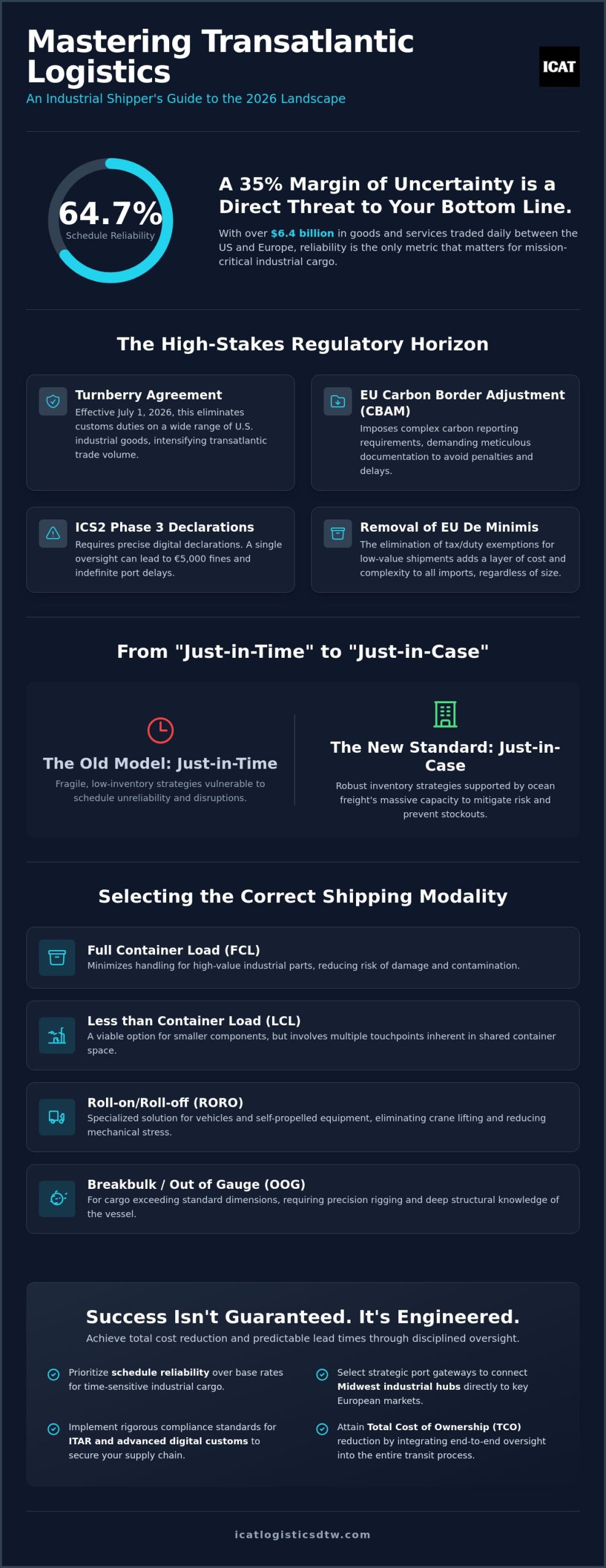
Global ocean liner schedule reliability currently sits at 64.7 percent. For an industrial shipper, that 35 percent margin of uncertainty is a direct threat to the bottom line. When your cargo is high-value or mission-critical, ocean freight shipping USA to Europe requires more than just booking space on a vessel. It demands a level of strategic precision that accounts for the 2026 implementation of the Turnberry Agreement and the complex reporting requirements of the EU Carbon Border Adjustment Mechanism. You understand that a single oversight in ICS2 Phase 3 digital declarations can lead to five thousand euro fines and indefinite port delays.
This guide serves as your operational blueprint for mastering transatlantic logistics. We’ll move beyond the basics to address the high-pressure realities of ITAR compliance, BIS Affiliates Rule due diligence, and the removal of EU de minimis exemptions. You’ll learn how to secure predictable lead times and achieve total cost of ownership reduction through disciplined oversight. We provide the technical clarity needed to transform a chaotic transit lane into a controlled, high-performance asset for your organization. Success in this corridor isn’t guaranteed. It’s engineered.
Key Takeaways
- Evaluate the 2026 transatlantic landscape to prioritize schedule reliability over base rates for time-sensitive industrial cargo.
- Navigate the technical differences between FCL, LCL, and RORO to ensure the structural integrity and security of heavy machinery and oversized freight.
- Streamline your logistics by selecting strategic port gateways that connect Midwest industrial hubs directly to key European markets through professional ocean freight shipping USA to Europe.
- Secure your supply chain against regulatory friction by implementing rigorous compliance standards for ITAR and advanced digital customs declarations.
- Attain total cost of ownership reduction by integrating end-to-end oversight into every stage of the transatlantic transit process.
The Transatlantic Trade Lane: Strategic Importance in 2026
The transatlantic corridor isn’t just a geographical connection. It’s the engine room of global manufacturing. Trade in goods and services between Europe and the United States currently exceeds $6.4 billion daily. For industrial leaders, transatlantic sea lanes represent more than transit routes; they’re strategic assets. Reliability is the only metric that matters. In a market where global schedule reliability often fluctuates around 64.7 percent, securing space for ocean freight shipping USA to Europe requires a partner who treats every container as mission-critical. Failure isn’t an option when a production line in Munich depends on a shipment from Detroit.
Industrial shippers have largely abandoned the fragile “just-in-time” models of previous decades. Today’s high-stakes environment demands “just-in-case” inventory strategies. Ocean freight supports this by providing the massive capacity needed for large-scale stock replenishment. This keeps operations running during localized disruptions. It’s a calculated move toward risk mitigation. A missing component in a German automotive plant or a delayed shipment for a defense contractor in Poland is a catastrophic failure of execution. Mission-critical sea freight provides the steady hand needed to move heavy industry across the Atlantic without the constant threat of stockouts.
Economic Drivers of Transatlantic Shipping
The automotive and defense sectors anchor this relationship. With ICAT Detroit’s strategic proximity to Michigan’s industrial heartland, we see how these sectors rely on the seamless movement of oversized and high-value cargo. The implementation of the Turnberry Agreement on July 1, 2026, has fundamentally changed the landscape by eliminating customs duties on a wide range of U.S. industrial goods. This policy shift has intensified the volume of high-value moves between the two continents. The North Atlantic Lane stands as the highest-volume B2B route globally. It serves as the primary conduit for the heavy machinery and specialized components that build modern infrastructure.
Ocean Freight vs. Air Freight: The Strategic Balance
Deciding between sea and air is a calculation of urgency versus total cost of ownership. While ocean freight offers the volume capacity required for massive project logistics, air freight provides the velocity needed for line-down situations. Many industrial leaders now employ hybrid strategies. They use ocean freight for the bulk of their supply chain while keeping Air Freight Detroit Michigan: Mission-Critical Logistics for Industrial Leaders as an immediate contingency for the most urgent components. This balance ensures that while costs remain controlled, the risk of a complete supply chain rupture is neutralized. When the margin for error is zero, your choice of modality determines your operational resilience.
Ocean Freight Modalities for Industrial Shippers
Selecting the correct shipping modality is an engineering decision. It is not merely a transaction. For ocean freight shipping USA to Europe, the method you choose determines the safety of your assets and the integrity of your production schedule. High-value industrial parts often demand Full Container Load (FCL) service. This minimizes handling. It reduces the risk of contamination or physical damage that occurs during consolidation. Less than Container Load (LCL) remains a viable option for smaller components, but only when the risk profile allows for the multiple touchpoints inherent in shared container space.
For the automotive and heavy machinery sectors, Roll-on/Roll-off (RORO) provides a specialized, efficient solution. Vehicles and self-propelled equipment are driven directly onto the vessel. This eliminates the need for crane lifting and significantly reduces mechanical stress on the asset. When cargo exceeds standard dimensions, the operation shifts to Breakbulk or Out of Gauge (OOG) shipping. These methods involve loading individual pieces of equipment that cannot fit into standard enclosed containers. It requires precision rigging and a deep understanding of the structural limits of the vessel. The complexity of U.S. and European Union trade means your modality choice must align with both physical safety and regulatory efficiency.
Project Cargo: Moving the Impossible
Relocating an entire manufacturing plant or moving massive infrastructure components across the Atlantic is the pinnacle of logistics. This is project cargo. It requires more than a simple booking; it demands a comprehensive site survey and specialized rigging plans. Every lift is a high-stakes operation where the margin for error is zero. For these complex requirements, industrial leaders rely on Project Cargo Ocean Freight: Navigating Mission-Critical Industrial Moves to ensure that every oversized component arrives in sequence and ready for immediate installation. Success depends on proactive involvement and the seamless integration of heavy-lift experts.
Containerization Strategies for High-Value Goods
Standard 20ft and 40ft containers are the workhorses of the industry, but high-value assets often require flat racks or open-top containers for specialized loading. Protection begins before the cargo reaches the port. Utilizing professional packaging and crating services is mandatory for ocean transit. Salt air and constant vibration are relentless. Industrial-grade crating must include vapor barriers and desiccant systems to prevent corrosion during the weeks spent at sea. Securing these mission-critical assets requires a methodical approach to blocking and bracing. If you are preparing a high-stakes move, consulting with an expert logistics partner early in the planning phase can prevent costly damage and avoidable delays. Precision at the point of origin is the only way to ensure flawless execution at the destination.
Strategic Port Selection: Connecting the US Midwest to Europe
Port selection is a strategic lever. It dictates your inland transit times and total cost of ownership. For ocean freight shipping USA to Europe, the choice of gateway determines whether your cargo bypasses or becomes trapped in coastal bottlenecks. Shippers in the Midwest often default to the nearest East Coast hub without considering terminal-specific throughput. This is a mistake. Strategic logistics requires evaluating the specific capabilities of each terminal against the requirements of your industrial cargo. The port is not just a destination. It’s a critical node where precision execution is required to maintain momentum.
A successful transatlantic move depends on proactive port management. By 2026, global schedule reliability has stabilized at 64.7 percent, but terminal congestion remains a localized threat. Selecting a port with specialized heavy-lift capabilities or superior rail connectivity can shave days off a transit schedule. When the margin for error is non-existent, the geographic location of the port is secondary to its operational efficiency. You need a gateway that supports the seamless integration of sea transit and inland drayage.
US East Coast and Great Lakes Gateways
The Port of Detroit serves as a mission-critical nexus for automotive and defense manufacturers. Its proximity to Michigan’s industrial heartland allows for rapid drayage and reduced inland costs. While major East Coast hubs like New York/New Jersey or Norfolk offer higher sailing frequencies, they’re often vulnerable to berth congestion and chassis shortages. By 2026, infrastructure upgrades at Great Lakes facilities have significantly improved throughput for specialized project cargo. Shifting your origin point to a less congested terminal can neutralize the risk of terminal delays. Precise coordination at the point of origin is the only way to ensure your ocean freight shipping USA to Europe stays on schedule.
European Hubs: Beyond the Water’s Edge
Rotterdam remains the dominant gateway for industrial centers in Germany and Central Europe. It offers unparalleled intermodal connectivity to the Rhine-Ruhr region. However, for shippers moving heavy machinery or oversized breakbulk, Antwerp is often the superior choice. Its specialized handling facilities are engineered for the high-stakes requirements of heavy industry. Hamburg provides the most efficient access to Baltic and Eastern European markets. Once your cargo clears the terminal, the focus shifts to the “Blue Banana” industrial corridor. This region contains the highest concentration of European manufacturing. Utilizing inland waterways and dedicated rail networks from these ports ensures that your freight doesn’t stall at the dock. Success is defined by the flawless transition from the vessel to the final industrial site.
Compliance, Documentation, and High-Security Protocols
Documentation is the primary failure point in transatlantic logistics. A single clerical error can halt a multi-million dollar production line. For ocean freight shipping USA to Europe, your paperwork must be flawless before the vessel leaves the berth. The Bill of Lading acts as the contract of carriage and document of title. The Commercial Invoice dictates duty calculations under the 2026 Turnberry Agreement. The Packing List allows for precise physical verification at the port of entry. These are not suggestions. They are legal imperatives that require absolute precision.
The most critical document in your export file is the Shipper’s Letter of Instructions (SLI). This document grants your forwarder the authority to act on your behalf. It ensures that every detail, from HTS codes to final delivery instructions, is executed with precision. Without a comprehensive SLI, the risk of miscommunication increases exponentially. In high-stakes industrial shipping, clarity is the only protection against avoidable delays. You must treat documentation as a core component of your engineering process.
ITAR Compliant Sea Freight
Defense-related cargo operates under a different set of rules. ITAR and EAR requirements demand absolute control over the chain of custody. When moving sensitive assets across the Atlantic, you need a partner capable of managing high-security protocols on the water. This includes GPS tracking, sealed container integrity, and vetted personnel at every touchpoint. Utilizing ITAR Compliant Logistics Michigan ensures that your mission-critical defense cargo meets all federal regulatory standards without sacrificing transit speed. Security is not an add-on; it is a fundamental requirement for every move.
Customs Brokerage: The Final Hurdle
Clearing customs should happen while the vessel is still at sea. Pre-clearance is the standard for elite industrial shippers. It neutralizes the threat of port-side bottlenecks. Professional customs brokerage in Michigan provides the strategic oversight needed to navigate ICS2 Phase 3 advance digital declarations. Failure to manage this leads to “Demurrage,” which is the fee charged for equipment staying at the port beyond allowed free time, and “Detention,” the cost for holding onto a container outside the terminal. These hidden costs can decimate a project budget. To secure your supply chain against regulatory friction, consult with a compliance expert to audit your documentation protocols before your next shipment.
ICAT Detroit: Executing Flawless Transatlantic Logistics
High-stakes industrial moves require more than a carrier. They need an architect. ICAT Detroit manages the entire lifecycle of ocean freight shipping USA to Europe with a level of technical precision that others cannot match. From our command center in Taylor, MI, we provide the proactive oversight required to neutralize threats before they impact your timeline. We don’t just book freight; we take full ownership of the outcome. This end-to-end involvement ensures that the strategic port selections and compliance protocols discussed earlier are executed without a single point of failure.
The complexity of 2026 trade regulations, including the specific reporting requirements of the EU Carbon Border Adjustment Mechanism, leaves no room for administrative oversight. We integrate our customs brokerage expertise directly with physical transit. This ensures your cargo moves through European hubs like Rotterdam or Antwerp without hesitation. Our methodology is rooted in the conviction that every industrial move is mission-critical. Whether it’s a single high-value component or a full plant relocation, we apply a steady, expert hand to navigate the most chaotic logistics environments.
Why Mission-Critical Expertise Matters
In the automotive sector, a late shipment isn’t just a delay. It’s a line-down event costing thousands of dollars per minute. We specialize in preventing these catastrophes through disciplined execution. Our team has a proven track record with oversized industrial equipment and defense-related assets that require rigorous ITAR compliance. We combine a deep, local understanding of Detroit’s manufacturing core with a robust global network. This allows us to maintain a relentless focus on your cargo from the moment it leaves your facility until it’s successfully installed at its European destination. We don’t believe in “best efforts.” We believe in results.
Take the Next Step in Your Global Strategy
Strategic logistics requires early engagement and a methodical approach to risk. Initiating a project cargo assessment allows us to identify potential friction points in your supply chain before they become costly failures. We recommend utilizing our Ocean Freight Forwarder Checklist to audit your current providers against the high standards required for ocean freight shipping USA to Europe in 2026. When the margin for error is zero, you need a partner who remains calm and direct under pressure. Consult with an ICAT Detroit logistics expert today to secure your transatlantic supply chain and achieve the cost predictability your organization demands.
Engineering Operational Resilience in the Transatlantic Corridor
Mastering the North Atlantic lane requires a transition from reactive logistics to proactive engineering. Success depends on the precise integration of specialized modalities, strategic port selection, and an uncompromising approach to regulatory compliance. By prioritizing schedule reliability over the lowest possible rate, you protect your production lines from the volatility of terminal congestion and evolving digital customs mandates. You’ve seen how strategic oversight transforms a complex transit into a predictable, high-performance component of your supply chain.
ICAT Detroit stands as the steady hand for your most demanding requirements. As Detroit-based high-stakes logistics experts, we provide the specialized project cargo engineering and ITAR compliant oversight necessary for defense and aerospace sectors. We take full ownership of your outcomes to ensure that ocean freight shipping USA to Europe remains a controlled asset rather than a liability. Your global strategy deserves a partner who understands that the margin for error is non-existent. Secure your mission-critical transatlantic shipment with ICAT Detroit. We’re ready to help you navigate the complexities of 2026 and beyond with absolute confidence.
Frequently Asked Questions
How long does ocean freight shipping from the USA to Europe typically take in 2026?
Transit times for ocean freight shipping USA to Europe typically range from 12 to 24 days depending on the specific port rotation. For example, a direct sailing from the East Coast to Rotterdam may take approximately 12 days, while routes from the Gulf or West Coast require significantly longer. You should account for an additional 7 to 10 days for inland drayage and terminal processing at both ends to ensure your production schedule remains intact.
What is the difference between FCL and LCL for industrial ocean freight?
FCL, or Full Container Load, provides you with exclusive use of a container, which is the preferred standard for high-value industrial parts to minimize handling risks. LCL, or Less than Container Load, involves consolidating your cargo with other shippers’ goods in a single unit. While LCL is cost-effective for smaller volumes, industrial shippers often prioritize FCL to ensure the structural integrity and security of mission-critical assets throughout the voyage.
Do I need ITAR compliance for all ocean freight shipping to Europe?
No, ITAR compliance is only mandatory if your cargo is listed on the United States Munitions List. This generally includes defense articles, specialized technical data, and aerospace components with military applications. However, if your shipment falls under these categories, every entity in your supply chain must be ITAR registered. Failing to verify this can result in severe federal penalties and the permanent seizure of your freight at the port of exit.
How are ocean freight rates calculated for oversized industrial equipment?
Rates for oversized industrial equipment are calculated based on the total footprint and the specialized equipment required, such as flat racks or open-top containers. Carriers apply “lost slot” fees for cargo that exceeds standard dimensions and prevents other containers from being loaded in adjacent spaces. Additionally, your quote will include surcharges for heavy-lift crane operations and specialized lashing required to secure the asset for high-seas transit.
What are the most common causes of delays in transatlantic shipping?
The most frequent causes of transatlantic delays are port congestion and documentation discrepancies. In 2026, many shippers face setbacks due to incomplete ICS2 Phase 3 digital declarations, which are now mandatory for all goods entering the EU. Other factors include seasonal weather disruptions in the North Atlantic and equipment shortages at major Midwest rail ramps. Proactive pre-clearance is the only reliable way to neutralize these regulatory and operational risks.
Can ICAT Detroit handle door-to-door ocean freight from the Midwest to Germany?
ICAT Detroit specializes in end-to-end project logistics from the US Midwest to any industrial center in Germany. We manage the entire chain of custody from your facility in Michigan to the final site in Europe. This includes specialized packaging, inland trucking to the port, ocean transit, and final mile delivery via European inland waterway or rail networks. Total oversight ensures that your timeline remains intact and failure is not an option.
Is cargo insurance included in my ocean freight quote?
Standard ocean freight quotes typically don’t include comprehensive cargo insurance. Carrier liability is strictly limited under international conventions, which often cover only a small fraction of an industrial asset’s actual value. We strongly recommend securing all-risk marine insurance to protect against damage from heavy seas, fire, or General Average declarations. Protecting your capital investment requires a dedicated insurance policy tailored to the specific value of your cargo.
What happens if my cargo exceeds standard container dimensions?
If your cargo exceeds standard container dimensions, it is classified as Out of Gauge or breakbulk freight for ocean freight shipping USA to Europe. We utilize specialized equipment like flat racks for cargo that is too wide or too high for a standard box. For exceptionally large machinery, the cargo may be loaded directly onto the vessel’s deck or into a specialized hold. This process requires custom engineering and precise rigging to ensure safe passage across the Atlantic.