
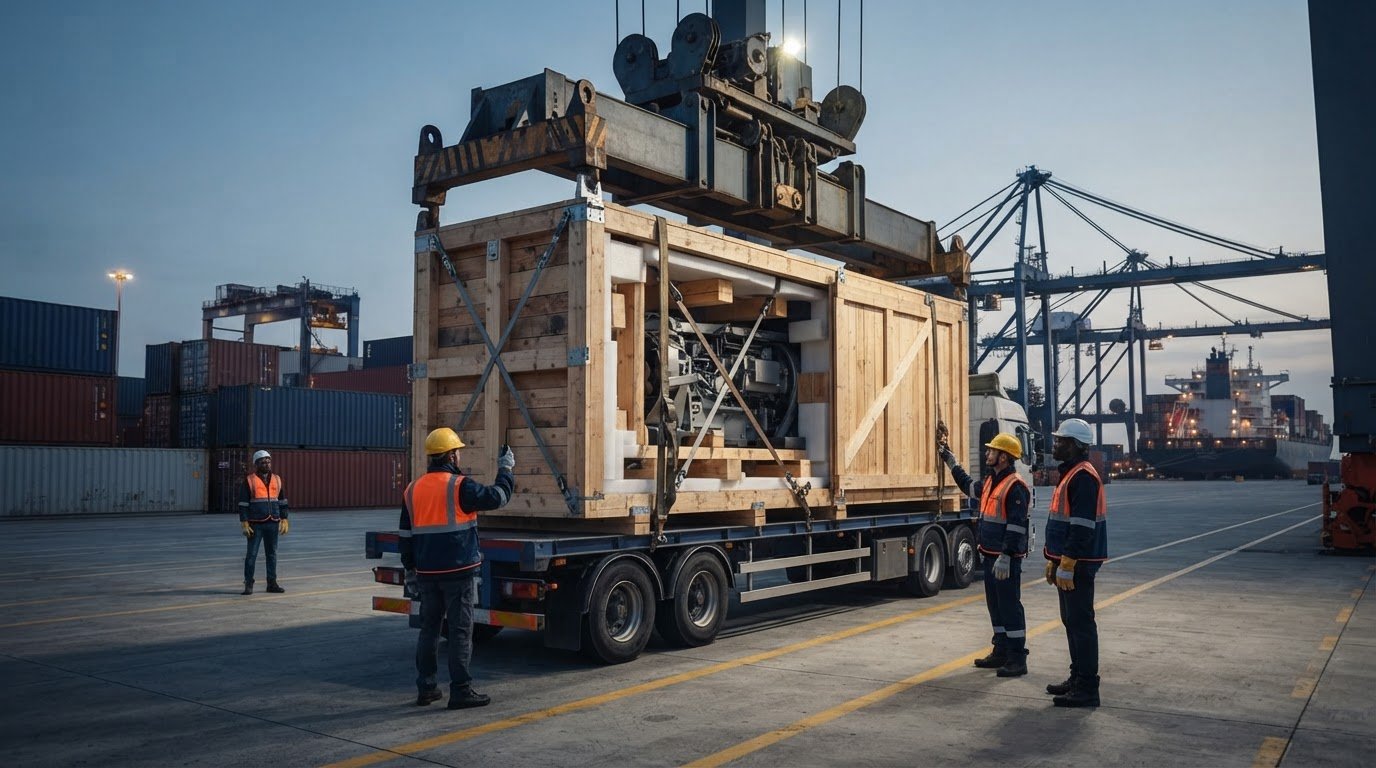
A crate alone doesn’t protect heavy machinery. Packaging, handling, and freight planning must work together. If you’re arranging crating services for heavy machinery, a mismatch between the equipment’s weight, dimensions, lifting points, or transport mode can expose valuable assets to damage and put operations behind schedule.
That risk is especially clear when crating and freight are handled as separate arrangements. You need packaging suited to the machine and a shipment plan that accounts for how it will be lifted, handled, and moved. ICAT Detroit coordinates packaging and crating with oversized freight handling and project logistics through its global network. The team has coordinated complex moves, including delivery of 56,000 lbs of automotive tooling from China to Mexico on a strict 14-day deadline.
This guide explains how to align crate design, export packaging, equipment securement, and freight coordination. You’ll learn which decisions shape a machinery shipment and how to keep requirements connected from preparation through delivery, helping protect equipment and reduce avoidable delays.
Key Takeaways
- Match crate design to the machine’s dimensions, weight, lifting points, configuration, and shipment route.
- Understand how internal supports, blocking, bracing, and securement work together to limit movement during handling and transit.
- Compare packaging approaches against your equipment and freight requirements, including export considerations.
- Plan crating services for heavy machinery as part of a coordinated process that connects preparation, freight, and shipment handoffs.
- See how ICAT Detroit connects packaging and crating with oversized freight handling and project logistics for complex moves.
Why Heavy Machinery Needs Crating Planned Around Its Shipment
Crating services for heavy machinery prepare equipment for transport by enclosing it in a purpose-built crate and fitting internal supports that help limit movement. The crate forms the protective outer structure. Packing, blocking, and bracing inside it support and secure the machine. The right plan reflects both the equipment and the shipment, not just the need for a wooden enclosure.
Crating and freight coordination are connected, but they serve different roles. Crating prepares and protects the machinery for handling and transit. Freight coordination plans how it will move, including the route, transport mode, and handoffs. If those decisions are made separately, the packaging may not suit the equipment’s movement through the shipment.
What does heavy machinery crating include?
A crate is a rigid shipping structure used to contain and protect cargo, including large, heavy items. The Crate reference describes this basic form. For machinery, the outer frame is only one part of the preparation. Internal supports help position the equipment, while blocking and bracing restrict unwanted movement. Securement helps hold the load in place within the packing system.
These elements need to suit the specific machine. Its shape, configuration, weight, and designated lifting points can affect how it is supported and prepared for loading. Crating prepares the equipment and its protective structure. Freight movement follows, with separate handling and transport requirements to coordinate.
What shipment risks should the plan address?
During loading, transfers, and transport, machinery may be exposed to movement, impact, moisture, or dust. These are planning considerations, not predictions that damage will occur. Identify where the machine is vulnerable and how it may be handled at each stage. Don’t rely on the crate alone to address every risk.
Weight and dimensions help define how equipment can be lifted, positioned, and moved. Configuration matters too: protruding or sensitive components may need specific support or protection. Equipment value can influence the level of care appropriate to the shipment. Route and transport mode also matter because each can shape handling steps and exposure during transit.
Plan packaging alongside freight, while keeping their roles distinct. ICAT Detroit connects packaging and crating with project logistics and oversized freight handling through its global network. Coordinating these elements helps align the crate, handling plan, and shipment requirements from preparation through movement.
How Heavy-Machinery Crate Design Fits the Equipment and Route
A crate plan should start with the machine and the journey it must make. Dimensions and weight affect how equipment can be positioned, lifted, and handled. Configuration, condition, and vulnerable components inform where support and protection may be needed. The route and transport mode also shape the shipment’s handling sequence and packaging requirements.
Which equipment details inform a custom crate?
Before planning, assemble accurate shipment details. Include the machine’s overall dimensions and weight, its configuration, fragile or exposed components, and designated lifting or handling points. Note whether parts are attached, removed, or especially sensitive. These details help guide the crate layout and the placement of internal supports, blocking, bracing, and securement.
Each element has a distinct role. Supports help hold the equipment in position; blocking and bracing restrict movement; securement helps keep the load stable within the crate. The arrangement should suit the machine’s condition and structure. For example, a component that extends beyond the main frame may need different protection from a compact, uniform machine. The approach depends on the equipment and shipment, rather than a fixed package of materials.
OSHA’s guidance for certain fixed machinery states that it must be securely anchored to prevent walking or moving. That workplace requirement is not a crate specification, but it reinforces the need to consider stability when planning machinery support and securement.
Crate-planning summary: Document the equipment’s dimensions, weight, configuration, condition, fragile components, lifting points, destination, route, transport mode, and handling requirements. Together, these details give the packaging and freight teams a shared basis for planning.
How do protection requirements change for export freight?
International shipments can involve packaging and documentation requirements that affect preparation. Consider the destination and freight arrangements at the same time as the packaging plan, so export needs are not treated as an afterthought. ICAT Detroit complies with ISPM-15 export standards. Its customs, documentation, and freight coordination experience helps connect packaging requirements with the shipment plan.
Protective choices depend on the machinery, route, handling steps, and export requirements. For more context on how packaging fits into freight preparation, read ICAT Detroit’s packaging and crating services for freight guide. If you’re planning a machinery shipment, discuss the equipment and route with ICAT Detroit so crating and freight coordination can be planned together.
Compare Crating Approaches and Freight Needs Before You Commit
Choose packaging and transport as connected decisions. Standard packaging may suit equipment with straightforward dimensions and handling needs. A custom crate may be more appropriate when the machinery’s configuration, exposed components, or planned handling calls for tailored support. Neither approach is right for every shipment, and weight alone doesn’t determine the answer.
| Planning factor | Standard packaging | Custom crating |
|---|---|---|
| Machinery | May fit equipment with simple shapes and conventional support needs. | Can be designed around unusual dimensions, configurations, or vulnerable components. |
| Route and mode | Must still account for the shipment’s route, transport mode, and handling steps. | Can be planned around specific handling and transfer requirements along the route. |
| Handling | Needs to accommodate planned lifting, loading, and movement. | Internal supports and securement can be tailored to the equipment and handling plan. |
| Export | Packaging and documentation needs depend on the shipment and destination. | Crate materials and export requirements should be considered together during planning. |
When is custom crating the more suitable approach?
Consider custom crating when equipment has irregular dimensions, a nonstandard configuration, sensitive components, or specific handling needs that standard packaging may not address. Weight is one factor, not the whole decision. The crate design should reflect how the equipment can be supported and secured, and what it will encounter during its planned movement.
A freight arrangement doesn’t replace a machinery-specific protection plan. The carrier and transport mode determine how freight moves; packaging addresses how equipment is prepared and protected. For road shipments, review the FMCSA cargo securement rules as part of transport planning. Crate securement and freight securement are related, but they are not interchangeable.
How should crating connect with the transport mode?
Ground, air, and ocean freight have different handling sequences and shipment constraints. Plan the crate around the selected mode, transfers, and destination rather than assuming one packaging arrangement fits all. For some out-of-gauge movements, oversized freight handling, flatbed shipping, or Flat Rack Shipping may be relevant. The suitable option depends on cargo dimensions and route requirements.
Project cargo may also involve multiple handoffs, transport modes, or timing constraints. ICAT Detroit connects packaging and crating with project logistics to coordinate those moving parts. If you’re assessing a complex machinery shipment, discuss your crating and freight requirements with the team before committing to an approach.
Prepare Heavy Machinery for Crating and Freight Coordination
Good preparation gives the crating and freight teams a shared, usable picture of the shipment. Start with reliable equipment details, then map the work from preparation through delivery. This can surface access constraints, documentation needs, and timing dependencies before they affect a handoff.
What information should you assemble before crating?
Gather the information available to you before planning begins. Include:
- Equipment details: dimensions, weight, configuration, condition, and any fragile or exposed components.
- Handling information: designated lifting points, known loading requirements, and handling constraints.
- Shipment details: pickup and delivery locations, destination, intended transport mode, and timing requirements.
- Site access: known restrictions at pickup or delivery, such as limited loading access or site-specific coordination needs.
Share changes as they arise. Updated dimensions, destination details, or schedule constraints can affect crate planning and freight coordination. Complete information supports decisions across the shipment, while the final plan must reflect the actual equipment, route, and handling requirements.
How can you coordinate crating with shipment milestones?
Keep the sequence visible. Treat each stage as a handoff and make sure the next stage has the information it needs:
- 1. Prepare: Compile equipment details, destination, access information, and timing constraints.
- 2. Plan and crate: Align packaging requirements with the machinery and planned handling.
- 3. Coordinate pickup: Match loading arrangements and site access with the shipment schedule.
- 4. Move the freight: Coordinate transport and any planned transfers along the route.
- 5. Prepare for delivery: Align the receiving site, delivery timing, and final handoff.
For cross-border freight, include customs and shipping documentation in the schedule alongside packaging and transport milestones. International project cargo may involve multiple coordinated steps. ICAT Detroit’s project logistics connects freight planning with shipment execution. Keep timing constraints visible early, especially when machinery supports an operational deadline. For more context on ocean project cargo, see the guide to ocean and sea freight shipping.
ICAT Detroit coordinates packaging and crating with freight requirements for industrial shipments. To discuss a heavy-machinery shipment, share your equipment and shipment details with ICAT Detroit.
How ICAT Detroit Coordinates Heavy-Machinery Crating and Freight
Crating is one part of a machinery shipment. ICAT Detroit connects packaging and crating with oversized freight handling, project logistics, and freight coordination, aligning equipment preparation with its planned movement. Crate requirements, shipment milestones, documentation, and handoffs can be considered as connected workstreams. ICAT coordinates freight through its global network.
What does coordinated project logistics add to crating?
Project logistics brings shipment tasks into a coordinated plan. Packaging requirements inform freight arrangements, while origin and destination, handling needs, timing, and documentation shape the sequence of work. ICAT Detroit coordinates freight and specialized handling. The aim is to keep shipment requirements aligned across preparation, pickup, transport, and delivery.
Past moves demonstrate experience with demanding industrial freight. ICAT Detroit coordinated delivery of 56,000 lbs of automotive tooling from China to Mexico on a strict 14-day deadline. The company also engineered delivery of a 42-ton package measuring 30 feet long, 8.5 feet wide, and 10 feet high. These examples show experience coordinating complex shipments; they don’t promise that another shipment will follow the same timeline or require the same arrangements.
For international cargo, consider packaging and crating alongside customs and shipping documentation. ICAT Detroit complies with ISPM-15 export standards and connects export packaging considerations with freight coordination. The required scope depends on the shipment, its route, and its handling requirements.
What should you include in a crating and freight inquiry?
Provide the details that let the team understand the shipment as a whole:
- Equipment dimensions, weight, configuration, and condition
- Origin, destination, and preferred shipment timing
- Fragile components, lifting points, and handling constraints
- Known pickup or delivery site access limitations
- Relevant export documentation or customs coordination needs
Project scope and pricing depend on the machinery, packaging requirements, route, transport arrangements, and timing constraints. Clear information supports practical planning by showing what work and transportation arrangements the move requires. ICAT Detroit brings its project logistics experience and global partner network to the coordination of industrial shipments.
Coordinate your heavy-machinery shipment with ICAT Detroit by sharing your equipment details, origin, destination, timing, and handling requirements.
Plan Your Machinery Shipment With Protection in Mind
Heavy machinery protection depends on matching the crate to the equipment and the shipment. Dimensions, weight, configuration, handling needs, and route all inform the plan. Crating services for heavy machinery work best when packaging, freight coordination, and shipment handoffs are considered together.
ICAT Detroit has coordinated delivery of 56,000 lbs of automotive tooling from China to Mexico on a strict 14-day deadline and engineered delivery of a 42-ton package measuring 30 feet long, 8.5 feet wide, and 10 feet high. Its 56,000-square-foot warehouse near Detroit Metropolitan Airport also supports its logistics operations. These examples reflect experience with complex cargo, not a promise that every shipment will follow the same timeline or plan.
Share your equipment details, origin, destination, timing constraints, and handling requirements so the shipment can be planned around its actual needs. Discuss your heavy-machinery shipment with ICAT Detroit and take the next step toward coordinated crating and freight planning.
Frequently Asked Questions
Does heavy machinery always need a custom crate?
No. The right packaging depends on the equipment and its shipment requirements. Standard packaging may suit machinery with straightforward dimensions, configuration, and handling needs. A custom crate may be appropriate when unusual dimensions, sensitive components, or specific lifting and securement needs call for tailored support. Consider the route and transport mode too. Weight matters, but it doesn’t determine the packaging approach on its own.
What information is needed to plan crating for heavy machinery?
Share the equipment’s dimensions, weight, configuration, and condition, along with details about fragile components and handling or lifting points. Include the origin, destination, intended transport mode, and relevant timing constraints. Known pickup or delivery site access limitations can also inform planning. These details help align the crate and freight arrangements with the actual shipment, rather than relying on assumptions about the machinery or its movement.
How do you protect heavy machinery from movement and impact during shipping?
Plan internal supports, blocking, bracing, and securement around the machine’s structure and handling needs. Supports help position the equipment, while blocking and bracing limit unwanted movement inside the crate. The crate and its internal protection should also reflect the loading and transport plan. These measures can help address movement and impact concerns, but no packaging plan should be described as eliminating all risk during handling or transit.
Does heavy machinery shipping require ISPM-15 export packaging?
It depends on the export shipment, packaging materials, and destination requirements. ISPM-15 is relevant to export wood packaging, so include packaging compliance in international shipment planning rather than assuming one requirement applies to every material or route. ICAT Detroit complies with ISPM-15 export standards and coordinates packaging considerations with freight and documentation planning for cross-border shipments.
How much do crating services for heavy machinery cost?
Pricing depends on the requirements of the specific shipment, so there isn’t one reliable figure for every machine. Factors may include equipment dimensions and weight, crate design, internal supports, handling requirements, route, transport mode, and destination. Export documentation or specialized freight coordination may also affect the project scope. Providing complete shipment details helps establish what work and transportation arrangements the move requires.
Can crating and freight shipping be coordinated through one logistics provider?
Yes. ICAT Detroit provides Packaging & Crating alongside freight coordination, Oversize Freight Handling, and Project Logistics. Coordinating these workstreams can connect packaging decisions with transport mode, shipment milestones, documentation, and handoffs. ICAT arranges freight through its global carrier network, helping align the crating plan with the planned movement.
How should you prepare heavy machinery for international shipping?
Gather accurate equipment dimensions, weight, configuration, origin, destination, handling needs, and timing constraints. Then align crating and export packaging with the planned route, transport mode, customs documentation, and shipment milestones. Avoid assuming packaging or documentation requirements are identical across destinations. ICAT Detroit coordinates cross-border freight and documentation and complies with ISPM-15 export standards.