
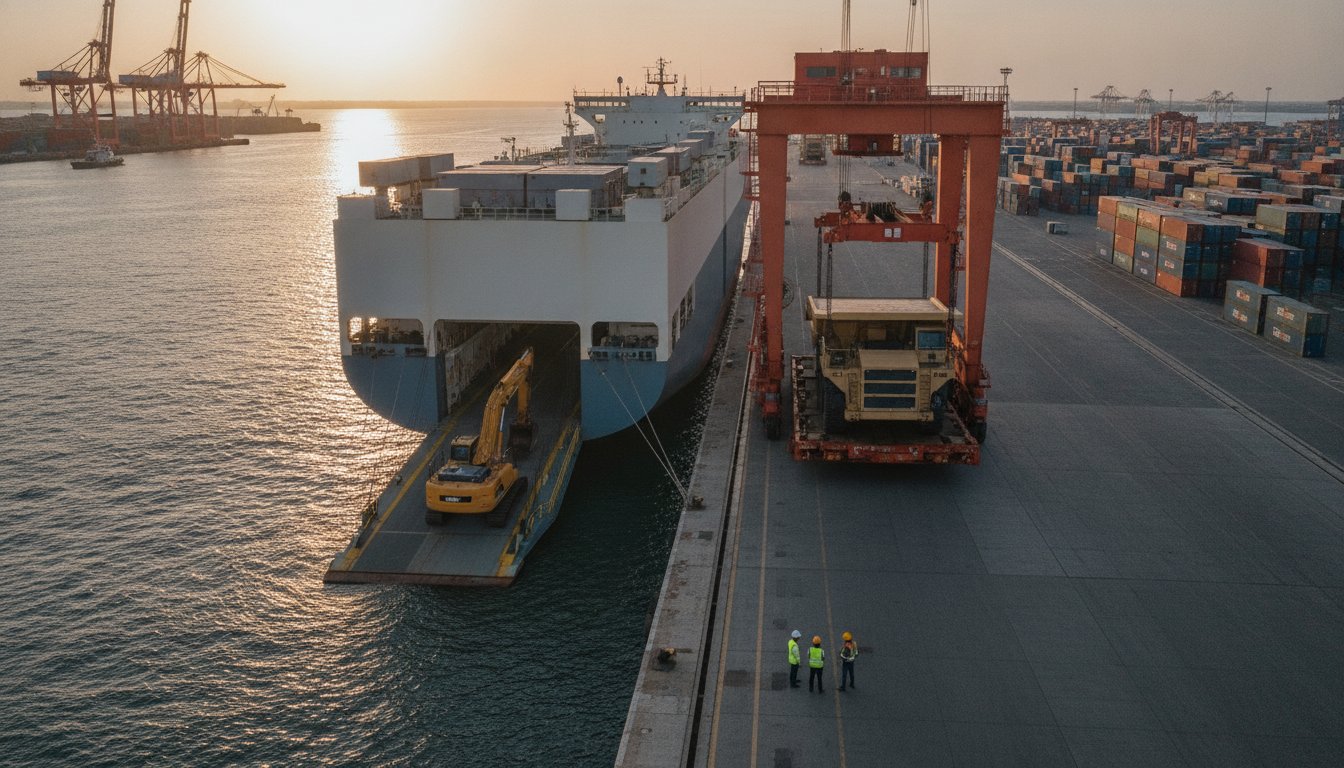
TL;DR: Heavy equipment ocean freight requires choosing between RoRo, flat rack, or breakbulk methods based on dimensions exceeding 8’6" wide or 9’6" high.
- Ground transport averages 3 to 10 days to reach port terminals before ocean transit.
- Except when cargo exceeds 100,000 lbs, which may require air chartering via Antonov AN-124.
- Select Roll-on/Roll-off for wheeled units to minimize port labor and expedite loading schedules.
- Export packaging must strictly meet ISPM-15 standards to avoid international customs holds and fines.
Shipping oversized heavy machinery (heavy-duty transport assets) internationally requires choosing between RoRo, containerized, and breakbulk ocean transit while managing strict trade compliance. Standard ground delivery takes 3 to 10 days to reach port terminals, where specialized ocean carriers take over. The decisions that shape the move are which method fits the load, how you budget true door-to-port cost, and when staging or air protects the schedule better than a long sea leg.
Match cargo size and deadline to the ocean path that fits
Selecting the correct ocean path depends directly on your project timeline and the size of your heavy machinery. A direct liner service prevents costly delays on tight build schedules, and reliable vessel space keeps the job site active.
Typical situations and a concrete fit from the same playbook:
- Standard heavy units under tight deadlines: choose specialized Roll-on/Roll-off shipping to minimize port labor.
- Over-dimensional units: select an open-top container or flat rack shipping method (Flat Rack Shipping) to secure non-standard dimensions.
- Programs with fixed sailings: lock inland pickup early so the 3-to-10-day ground average does not consume the vessel window.
The average time it takes to move goods through ground freight shipping is 3 to 10 days, with variability dependent on pickup and delivery locations. To manage custom timelines, coordinate transport through Ocean / Sea Freight Shipping • ICAT, Detroit. Matching route mechanics to oversized equipment (oversized ocean freight) protects your budget.
Tip: Account for ground transportation timelines when planning port drop-offs, as inland freight averages 3 to 10 days depending on the pickup location.
Budget the true cost of heavy equipment ocean transport
Transporting heavy machinery depends on equipment dimensions, route distance, fuel surcharges, ocean carrier rates, port handling fees, and chosen insurance levels. Moving massive cargo needs precise budget planning so terminal fees and idle time do not erase the quote you approved.
Base rates fluctuate based on whether you select a flat rack shipping method or roll-on/roll-off service. Ocean carriers also charge destination terminal fees, fuel adjustment factors, and specialized rigging expenses. Working with ICAT Detroit | Global & Local Freight Shipping maps full supply chain expenses early and protects the baseline you present to stakeholders.
Tariffs and duty classifications heavily alter final expenses. The USITC Harmonized Tariff Schedule 2026 defines exact import duty rates based on classification codes. Budgeting without checking these official codes is like driving blindfolded through a storm.
Unexpected delay penalties accumulate quickly at busy ocean terminals. Every hour gear sits idle increases the cost of production stoppage (line-down cost). A thorough route survey prevents expensive detours, and accurate customs filing avoids holding fines. White-glove handling plus clear shipping rules (Incoterms) lets you lock precise quotes before the vessel is named.
Request a line-item quote that separates ocean, inland, terminal, and duty so you can compare methods on equal footing.
Pick RoRo, flat rack, or breakbulk for your machinery profile
Choosing the right shipping method depends on your gear’s size and mobility. Heavy machinery moves via Roll-on/Roll-off, flat racks, or breakbulk.
| Method | Cargo Type | Key Advantage |
|---|---|---|
| RoRo | Wheeled or tracked units | Fast drive-on loading |
| Flat Rack | Oversized equipment | Standard vessel fitting |
| Breakbulk | Non-containerized gear | Handles extreme weight |
Freight earns the oversized designation if it surpasses a basic 40-foot High Cube container, usually measuring beyond 8 feet 6 inches in width or 9 feet 6 inches in height. That threshold changes vessel space needs at once. You can secure SAFETY AT SEA • ICAT, Detroit by matching equipment dimensions to proper vessel cradles.
For oversized equipment, flat racks function as open-sided platforms on traditional container ships. Driven machinery suits RoRo decks. Massive stationary gear requires breakbulk handling. According to the Ship transport Wikipedia article 2026, water transport remains the most effective venue for carrying bulk goods globally. Early method selection keeps the budget aligned with the load profile.
Clear permits and customs in 6 documented steps
Heavy machinery requires precise documentation to pass international ports without delays. Clear regulatory alignment prevents expensive port holds and keeps global supply chains active through correct customs filing.
- Verify compliance: Ensure custom packaging meets ISPM-15 export standards.
- Review terms: Align your shipping rules across every origin vendor.
- Audit origin filings: Confirm export permits for all sub-components before loading.
- Prepare documentation: File your customs paperwork (customs filing) ahead of vessel arrival.
- Coordinate transport: Secure local road permits for oversized equipment.
Situation: a Detroit-based customer needed 295 test units totaling 47,000 individual pieces from nine countries and 29 suppliers. Solution: advance planning and coordinated customs filing across the supplier set, including parts from India and Brazil that arrived only two days before the deadline. Result: the team closed the tight window and delivered the full set without a missed handover.
For critical port movements, check the PORT OF LOS ANGELES UPDATE • ICAT, Detroit to maintain schedule integrity. Method choice (including Flat Rack Shipping) still has to match the cargo profile once permits are in hand.
Prep machinery so border holds never start
Moving heavy machinery across international waters avoids border holds when site readiness is complete before the first lift. A massive excavator can sit motionless on a rainy dock when loose fittings trigger a secondary inspection; thorough prep removes that failure mode.
Situation: a defense contract client needed an oversized fire truck moved under international trade rules during severe COVID-19 transit disruptions. Solution: temporary indoor and outdoor warehousing, a correctly sized step deck trailer, loading onto a RO/RO vessel, and full customs filing. Result: delivery to Iraq on schedule despite the disruption window.
Extreme cargo demands specialized handling. Situation: sensitive oversized equipment with an equipment weight over 100,000 lbs could not move in standard ocean slots. Solution: charter of an Antonov AN-124 with drained fluid reservoirs, locked articulating arms, and the right shipping method where sea was still viable for other legs. Result: the overweight load moved under controlled conditions without a missed program date.
Drain reservoirs, lock articulating arms, and confirm method before dispatch so inspection risk stays low.
Vet carrier safety records and marine insurance limits
Vetting carrier safety records prevents massive losses when transporting heavy machinery.
Standard ocean bills of lading limit carrier liability to minimal sums. Relying on basic maritime law for high-value cargo leaves a gap; full marine cargo insurance protects the investment against unforeseen disasters.
Verified partner networks change exposure. Partner 3Li is certified by the National Minority Supplier Development Council. Ocean vessel operators must meet strict safety protocols before cargo is accepted, and logistics protection still demands document-level rigor on certificates and policy wording.
Tip: Verify whether your logistics partner holds diversity and quality certifications like NMSDC to align with corporate compliance goals.
Switch off ocean freight when line-down cost exceeds air
Ocean vessel transport is not ideal when tight deadlines make a cost of production stoppage higher than air cargo expenses.
If an urgent site delay threatens operations, air transportation becomes essential. Heavy machinery moving by ocean simply takes too long during an operational emergency; the sea leg behaves as a slow conveyor across long distances. Local staging fits projects that need immediate equipment deployment without waiting on that transit.
When long ocean timelines risk severe financial penalties, shift toward faster modes so idle crews do not outpace freight savings. If speed overrides budget calculations, bypass ocean shipping for that lane and revisit sea only after the line is stable.
Cut port delays by staging in 56,000 sq ft near DTW
Staging oversized equipment near major transit hubs prevents costly delays before port delivery.
Storing heavy machinery near Detroit’s airport keeps logistics moving. A 56,000-square foot warehouse near Detroit’s Metropolitan Airport supports inbound and outbound freight with warehousing services in the center of the region. The hub works as a controlled buffer for heavy supply chains rather than a last-minute scramble at the terminal.
Cargo is handled with white-glove processes on high-volume exports, and staging reduces total transit stress by absorbing inland variability before cutoffs. Build staging into the quote when multiple origins feed one sailing.
Frequently asked questions
How much does it cost to ship heavy equipment?
Your total cost for moving heavy machinery via heavy equipment ocean freight depends on overall dimensions, total weight, and destination port fees. Additional expense variables include custom packaging that meets ISPM-15 export standards and specialized road transport to ocean ports. To calculate precise figures for your project, request a personalized quote based on your cargo details.
How much does it cost to ship a 40-foot container internationally?
Container shipping rates change based on ocean trade routes, seasonal demand surges, fuel surcharges, and selected container types. Cargo that exceeds standard container dimensions, like height over 9 feet 6 inches, shifts from standard container shipping to specialized vessel space. Ask for current lane pricing on your origin and destination pair.
How can I get a free quote for international heavy equipment shipping?
Submit cargo weight, exact dimensions, pickup location, and final overseas destination port. Logistics experts analyze the machinery profile to select the proper shipping method and secure vessel space, then return a customized freight quote from those specs.
What types of equipment can be shipped overseas?
You can transport industrial machinery, heavy-duty vehicles, and oversized equipment across global ocean routes. Ocean vessels handle commercial test units, construction vehicles, and sensitive items; when sea is not viable, chartering aircraft such as an Antonov AN-124 can move sensitive freight weighing over 100,000 lbs. Each shipment is prepared for the mode that matches weight and dimension limits.
What is Heavy Equipment Shipping?
Heavy equipment shipping is the specialized international transport of large industrial machinery, oversized vehicles, and high-value manufacturing units by sea, land, or air. It involves logistics coordination, including customs paperwork clearance, precise loading, and compliance with international shipping rules. Dedicated logistics providers manage these end-to-end cargo movements so supply chains stay on schedule.
For businesses navigating these requirements in the Australian region, Freight and More Pty Ltd offers specialized freight forwarding and logistics solutions to ensure seamless international transit.
Streamline Your Global Ocean Logistics
You still face the same choices that opened this guide: which ocean method fits the load, how to budget door-to-port cost without surprise terminal fees, and when staging or air beats a slow sea leg for heavy machinery on global trade lanes in 2026. Decades of global logistics work go into oversized equipment moves that stay compliant from pickup through discharge.
Operations Manager and Director of International Chris Cser, alongside Dan Cser, lead the team executing complex international shipments. SupplyChainBrain listed the company among its "100 Great Supply Chain Partners." The team holds certification from the National Minority Supplier Development Council. Shipments maintain compliance with ISPM-15 export standards, shipping rules, and precise customs paperwork.
Contact the team for a tailored quote on your heavy equipment ocean freight shipment.