
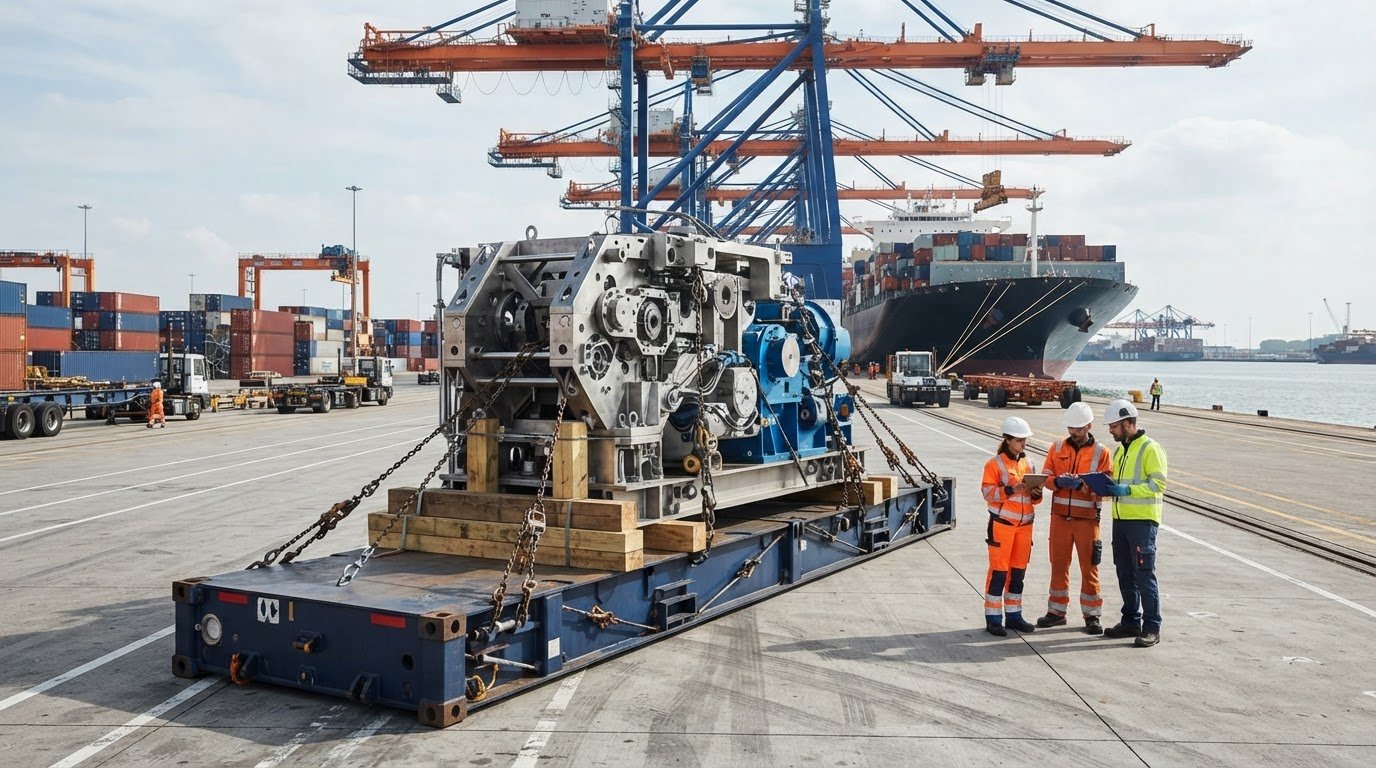
Could the wrong container choice add avoidable handling, exposure, or delay to an oversized shipment? Flat rack container shipping can suit cargo that exceeds standard container dimensions, but size alone does not settle the decision. The cargo’s shape, weight distribution, lifting points, and route all affect whether this option fits.
Before choosing equipment, compare loading access, enclosure needs, and the full route. This guide explains when Flat Rack Shipping may suit your cargo, what to check when assessing equipment, and how it compares with standard containers or breakbulk. You’ll also learn what to prepare for a coordinated freight plan, from final packed dimensions and gross weight to center of gravity and route requirements.
That planning matters when a shipment is high-value or time-critical. ICAT Detroit coordinated the delivery of 56,000 pounds of automotive tooling from China to Mexico on a strict 14-day deadline. That project reflects the coordination oversized freight demands, not a claim that flat rack equipment was used. The sections ahead will help you assess cargo geometry, exposure, loading, and routing before selecting a shipping method.
Key Takeaways
- Compare fixed and collapsible flat rack configurations by their setup, not by container length alone. Nominal length does not establish usable cargo space or payload.
- Compare flat racks with standard containers, open-top containers, and breakbulk based on enclosure needs and loading access.
- For flat rack container shipping, prepare verified measurements, weight, drawings or photos, lifting points, and handling constraints to support equipment assessment.
- Follow an ordered plan: document the cargo, assess equipment fit, plan handling, review the route, and coordinate shipment documents.
- Align ocean freight, oversized freight handling, customs documentation, and project logistics with your cargo and delivery requirements.
What Is Flat Rack Container Shipping, and When Does Cargo Need It?
Some cargo exceeds standard container dimensions. Other loads cannot be positioned or loaded through a conventional container opening without changing the handling plan. In these cases, assess flat rack container shipping against the cargo’s dimensions, shape, weight, loading access, and route. A cargo category alone does not determine the right equipment.
Flat Rack Shipping transports out-of-gauge cargo on a container base with open sides and no roof, rather than enclosing the load inside a standard container. The Flat rack container reference describes common forms, including fixed-end and collapsible designs. An open structure can accommodate cargo that extends beyond the sides, but it does not provide the same enclosure from weather and handling exposure as a standard container.
How a flat rack differs from a standard container
A standard container has side walls and a roof around its cargo space. A flat rack generally has a load-bearing base, open sides, and end walls. Those raised ends define the ends of the platform, while the securing plan must account for the specific shipment and equipment. With no side walls, cargo can extend beyond the platform’s sides, subject to equipment and route constraints.
That loading access comes with a trade-off. Cargo on an open platform may face greater exposure during transport and handling, so the shipment plan needs to address protection at each stage. Actual equipment dimensions and payload vary by configuration. Do not rely on nominal container length alone: verify that the selected equipment’s usable space and permitted payload match the cargo.
Cargo that may prompt a flat rack assessment
Machinery, pipes, and industrial equipment are examples of cargo that may warrant assessment, not automatic proof that a flat rack is suitable. A machine may be too wide for an enclosed container but still need careful evaluation of its height, weight distribution, and lifting access. Pipes may have a manageable width yet raise different questions about length, support, and loading.
Start with the cargo’s final packed dimensions and gross weight. Record its overall width and height, note irregular projections, and identify how it can be loaded and lifted. Drawings or clear photos can explain shapes that measurements alone do not capture. Loading access matters too: a load that cannot pass through a standard container door may need a different handling approach, even if its dimensions appear close to standard limits.
Equipment selection depends on the specific cargo and shipment details, not its label. An oversized freight handling plan connects cargo measurements and handling needs with route requirements. Assess both physical fit and the consequences of open transport. Then compare equipment configurations and shipping methods against those requirements, rather than assuming a flat rack is the default for every oversized load.
Flat Rack Types, Dimensions, and Specifications: What to Compare
A flat rack’s name or nominal length does not tell you whether it can carry your cargo. Usable space, payload, and handling requirements depend on the selected equipment and shipment details. For flat rack container shipping, compare the actual configuration with verified cargo measurements and carrier requirements before treating a model as a fit.
Equipment suitability depends on the specific model and the shipment’s verified measurements, weight, and handling requirements. Keep that principle central when reviewing equipment specifications. Figures for one model are not universal limits.
Fixed and collapsible flat rack configurations
Fixed-end designs have end walls that remain upright, while collapsible designs have end walls that can fold down. The difference may affect how cargo is loaded, how the equipment is stored, and how it is handled when empty. These effects depend on the model and operating plan, so verify the selected configuration’s features rather than assuming every collapsible rack works the same way.
| Configuration | What to compare | Planning question |
|---|---|---|
| Fixed-end | End walls remain upright. | Do the walls and loading approach suit the cargo’s dimensions and access needs? |
| Collapsible | End walls can fold down. | How does this model’s configuration affect loading, storage, and handling? |
The table describes general configurations. Treat individual product specifications as model-specific: a stated deck dimension or payload for one unit does not establish the capacity of another.
Which shipment measurements determine equipment fit?
Give your freight forwarder the full shipment profile, not just the longest dimension. Include packed length, width, height, gross weight, and any overhang beyond the cargo base. Explain how the cargo will be loaded, identify lifting points and access constraints, and provide the center of gravity if known. These details support an assessment of physical fit and handling requirements.
- Dimensions: Record the cargo’s outermost points, including projections and packaging.
- Weight and distribution: Provide gross weight and describe how weight is distributed across the load.
- Handling method: Identify lifting or loading points and any equipment or access constraints.
- Shipment requirements: Share drawings or photos when they clarify the cargo’s shape or handling needs.
Compare the complete profile with the selected equipment’s verified dimensions, payload, and carrier requirements. Do not infer usable cargo space from nominal length or assume a published payload applies to another model. ICAT Detroit coordinates oversized freight handling around cargo and project requirements. To help start the equipment assessment with the right information, discuss the shipment details with the team.
Flat Rack vs. Standard Container, Open-Top, and Breakbulk
Choosing a method for oversized ocean freight is not about finding one universally superior option. The shortlist depends on cargo dimensions and shape, loading method, enclosure needs, and route handling requirements. Flat rack container shipping is one possibility, but compare it with enclosed container options and other cargo plans using the same shipment details.
Use these questions to structure the comparison:
- Dimensions: Does the cargo fit within the selected unit, or does it extend beyond the available space?
- Enclosure: Does the shipment need enclosed protection, or can its protection plan account for open transport?
- Loading access: Can the cargo be loaded through a container opening, from above, or by another method?
- Handling and route: Can the planned route support the required handling steps and cargo configuration?
When a standard or open-top container may be a better fit
Consider a standard enclosed container when the cargo fits the selected unit and its loading process. Its walls and roof provide an enclosure, which may suit shipments that do not need open-side access. The measurements, loading method, and shipment requirements still need to align with the equipment.
An open-top container may merit assessment when loading from above is relevant. Top access alone does not establish fit. Compare the cargo’s dimensions and loading method with the specific equipment and route requirements before selecting it. Base the comparison on the model’s specifications, not general assumptions about capacity.
When to assess breakbulk or another transport plan
Breakbulk may enter the discussion when cargo size, shape, or handling access calls for a plan beyond a standard container arrangement. The choice depends on how the item can be lifted and handled, how it will move through the route, and what the shipment requires at origin and destination. Do not select or rule out a method based on cargo category alone.
Compare the options against the same details: packed dimensions, gross weight, loading and lifting needs, enclosure requirements, and route-specific handling. This keeps the decision focused on operational fit rather than assumptions about cost, transit time, or equipment suitability. ICAT Detroit coordinates ocean freight services alongside oversized freight handling, documentation, and project logistics when shipment requirements call for coordinated planning.
Once you have a practical shortlist, review how each option affects the complete movement, not just the ocean leg. Discuss your oversized ocean freight requirements with ICAT Detroit as part of your planning.
How to Plan Flat Rack Shipping: Cargo Data, Handling, and Route
A coordinated plan starts with reliable cargo information and connects it to equipment, handling, routing, and documentation. For flat rack container shipping, gaps in measurements or loading details can complicate decisions later in the move. Gather the shipment facts early, then work through the planning stages in sequence.
Prepare a cargo profile before equipment selection
Build a cargo profile from verified information, not estimates or a general description such as “industrial machinery.” Record packed length, width, height, and gross weight. Include drawings or clear photos, any overhang or protrusions, and details about uneven weight distribution or delicate components. Identify lifting and loading points, plus constraints at pickup or delivery. This information helps assess equipment fit and handling together.
- Document the cargo. Assemble verified measurements, weight, a clear cargo description, drawings or photos, and known handling constraints.
- Assess equipment fit. Compare the full cargo profile with the selected equipment’s verified specifications and applicable carrier requirements. Do not rely on a cargo category or nominal dimensions alone.
- Plan loading and protection. Set out the loading sequence, lifting approach, securing plan, and protection from exposure. Base these decisions on the cargo and the planned movement.
- Review the route. Consider origin and destination access, transfer points, and route-specific handling requirements. Coordinate oversized freight handling with route planning so the cargo profile and movement plan align.
- Coordinate shipment documents. Organize the documentation needed for the shipment and any cross-border movement, including customs coordination in the broader freight plan.
Coordinate loading, protection, and international shipment details
Loading, securing, and exposure protection must match the cargo’s shape, center of gravity, lifting points, and intended handling. A load with delicate components or uneven weight distribution may need a different sequence or protection approach from a uniform piece of equipment. Include these details in the plan before loading begins so everyone coordinating the move can work from the same instructions.
For international shipments, documentation and customs coordination belong in the plan alongside transportation and timing. Incoterms are a set of 11 internationally recognized rules that define the responsibilities of sellers and buyers in worldwide freight shipments. Clarifying the agreed Incoterms helps establish the parties’ responsibilities, while shipment documents and route-specific requirements still need coordinated attention.
ICAT Detroit coordinates ocean, oversized, and project freight with customs and documentation for cross-border shipments. For complex industrial moves, its project cargo ocean freight planning connects cargo needs with the wider shipment plan. Discuss a coordinated freight plan with the team and share your cargo profile and delivery requirements.
Coordinate Flat Rack Shipping Around the Cargo and Delivery Requirements
Flat rack container shipping is one part of a broader freight plan. Your cargo profile, origin, destination, required timing, and handling constraints all shape the movement. ICAT Detroit coordinates ocean, oversized, and project freight with customs and documentation for cross-border shipments, aligning these requirements with your delivery needs.
That coordination matters when cargo is high-value or time-critical. Equipment, handling, routing, and paperwork need to connect across the shipment rather than being treated as separate tasks.
What ICAT Detroit brings to complex freight coordination
ICAT Detroit coordinates freight for automotive, defense, and industrial manufacturing sectors through the ICAT Logistics network. Its work brings transportation planning together with oversized freight handling, project logistics, customs coordination, and shipment documentation. Each move is planned around the cargo and delivery requirements, with attention to timing and cross-border compliance.
For a complex industrial move, project logistics can connect cargo needs with the wider freight plan. Equipment selection remains specific to the shipment. ICAT Detroit has coordinated demanding moves, including automotive tooling from China to Mexico on a strict 14-day deadline; each new shipment still requires a plan based on its own cargo and delivery requirements.
What to include in a shipment discussion
Prepare the core shipment details so the planning discussion can focus on practical requirements. Include:
- Cargo dimensions, including length, width, height, and any overhang.
- Gross weight and known weight-distribution concerns.
- Origin, destination, and required delivery timing.
- Loading, lifting, unloading, and protection constraints.
- Drawings or photos that clarify the cargo’s shape or handling needs.
Share available shipment documents and relevant customs details. A complete cargo profile helps ICAT Detroit shape a project-specific freight plan around transportation, handling, documentation, and timing. It gives the team a clearer basis for coordinating the shipment’s moving parts.
Discuss your flat rack shipping requirements with ICAT Detroit and outline the cargo and delivery priorities for your move.
Set Your Flat Rack Shipment Up for a Clear Next Step
Turn your cargo information into a decision-ready shipment brief. State what must arrive, where it is going, when it is needed, and any site or handling limits that could affect delivery. Clear inputs help assess flat rack container shipping as part of the full movement, not as a standalone equipment choice.
ICAT Detroit engineered the delivery of a 42-ton package measuring 30 feet long, 8.5 feet wide, and 10 feet high. This project demonstrates experience planning around unusual cargo dimensions. It does not establish that flat rack equipment was used. Your shipment needs its own assessment based on its cargo profile and delivery requirements.
Bring those details into the conversation early. A focused discussion can shape next steps around your freight, route, and timing. Plan your oversized cargo move with ICAT Detroit and outline the requirements for your shipment.
Frequently Asked Questions
Is flat rack shipping suitable for every oversized shipment?
No. A shipment may be oversized yet still need a different approach because its support points, handling sequence, or movement plan do not align with the selected equipment. For example, a machine with a narrow base may need a different support arrangement than a load with a broad, stable footprint. Include a simple load diagram when the cargo’s contact points or orientation are not clear from its dimensions.
Can cargo extend beyond the ends or sides of a flat rack?
It may, depending on the equipment and shipment plan. If cargo projects beyond the platform, show the projection clearly on a drawing and note whether it changes when the cargo is rotated or loaded in a different orientation. This helps everyone coordinating the move use the same cargo profile. Label preliminary measurements and update them when verified.
How much weight can a flat rack container carry?
There is no single weight figure that applies to every flat rack. Report the complete packed load, not just the bare machine or item. Include skids, crating, removable attachments, and other components that will travel with it. Then use the selected unit’s verified payload information in the equipment assessment. Keep the weight breakdown with the cargo record so it is easier to update if the packing configuration changes.
What happens if my cargo is too wide for a standard container?
If the cargo exceeds the selected container’s usable width, reassess the loading plan before dispatch. Check that the recorded width includes packaging, protruding fittings, and any temporary fixtures attached for movement. If the cargo can be disassembled safely, document the separate pieces and their packed dimensions. If not, plan around its full assembled profile. Those details help determine the next planning step.
Is a flat rack container enclosed against weather?
No. Its open structure does not provide the enclosure of a standard container. Describe which parts of your cargo are sensitive to moisture, dust, or contact during handling, and specify any packaging or crating already in place. This gives the shipment team a practical basis for discussing protection needs without assuming one cover or packing method will suit every load. Keep protection instructions with the cargo documentation.
Can machinery or industrial equipment ship on a flat rack?
It may be considered, but machinery needs a cargo-specific handling review. Tell the planner whether the equipment will move assembled or in modules, and identify any parts that must remain attached during lifting or transport. Note controls, exposed components, or other features that require careful handling. These details help coordinate movement instructions with the shipment rather than relying on a broad description such as “machine.”
What information should I provide for a flat rack shipping plan?
Provide the cargo profile, origin, destination, timing, and handling instructions, and identify which details are final and which are provisional. Include the date and source of measurements when dimensions are based on supplier drawings or an initial estimate. If the cargo or packing changes, share the revised profile before the plan proceeds. This keeps decisions tied to current shipment information for flat rack container shipping.