
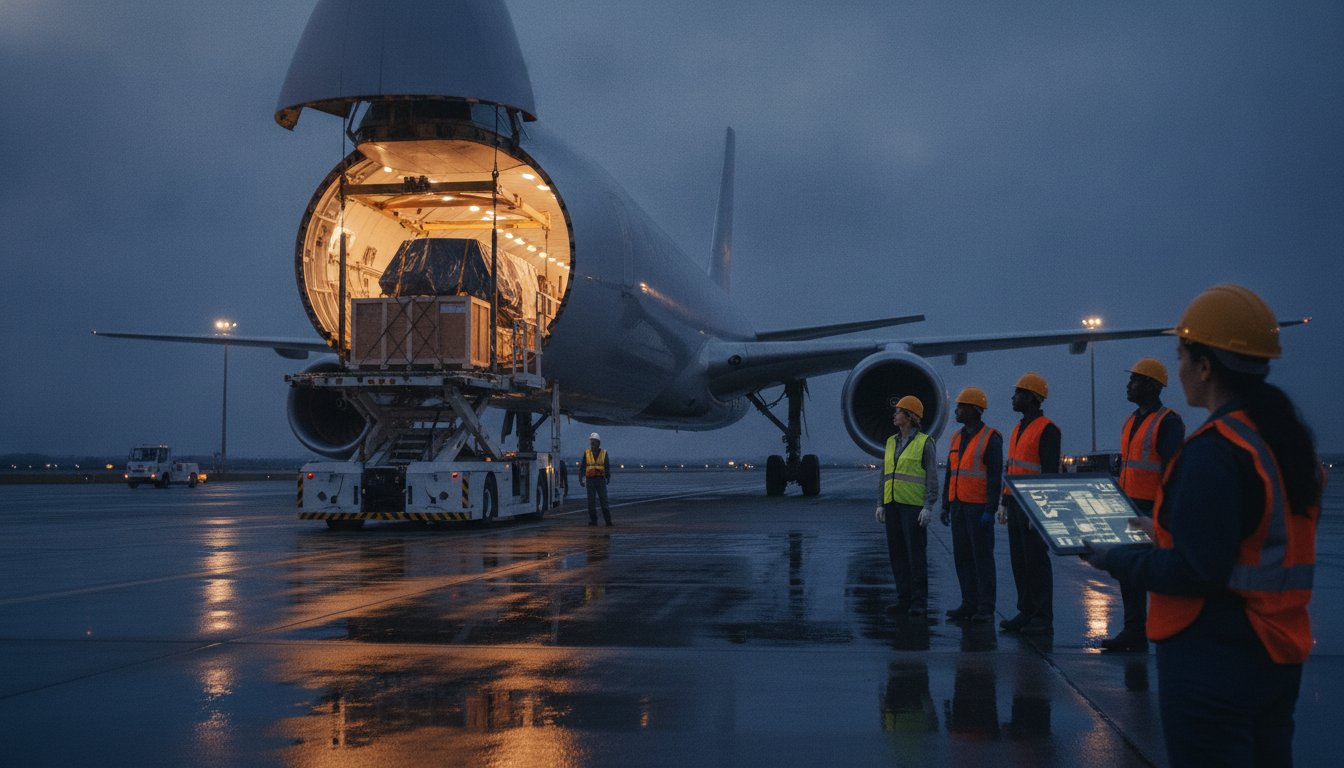
Air charter services for urgent freight (time-critical logistics) give you immediate, dedicated aircraft capacity so you can stop line-down events before they spread. The decision that matters is whether a dedicated charter or scheduled expedited freight costs you less once you add the hourly price of cargo delay to the transport invoice. Secure aircraft that match your payload parameters and flight timeline, and you protect the operational schedule you already committed to your plant and your customers.
Key Takeaways: Air charter services for urgent freight provide dedicated aircraft capacity to prevent production line-down events when scheduled commercial flights cannot meet your deadline.
- Compare your hourly line-down cost against charter rates of $23,000 to $220,000 to determine cost-effectiveness.
- Except when cargo fits commercial freighter doors and scheduled departure times still meet your dock window.
- Select aircraft based on physical door clearances and floor loading limits rather than weight alone.
- Verify the carrier’s air operator certificate and insurance documentation to prevent sudden regulatory groundings.
Match your deadline and cargo size before you pick an air model
Pick the urgent freight model that matches your delivery deadline and cargo size, not the largest aircraft on the ramp. Clients who book an oversized charter when a smaller flight would meet the gate time pay for empty capacity they never use. Align cargo volume with the aircraft category first, and you avoid that over-capacity error.
Three situations we see repeatedly:
- Massive factory moves or full production cells: a full dedicated charter keeps the load together on one timeline.
- Critical small components that cannot miss a shift: a dedicated hand-carry service (on-board courier) rides the passenger network with direct custody.
- High-value freight that still fits commercial freighter doors: scheduled expedited air can meet the window when departure times align with your dock.
Full charters suit large factory shipments; hand-carry protects small mission-critical parts; scheduled express flights bypass standard hubs when your dates are firm but not instantaneous. Deferred air options fit flexible schedules when overnight recovery is enough. You can review air freight shipping services to match cargo dimensions with global transit windows. ICAT Detroit connects you to more than 30,000 airports worldwide so drop-off and recovery stay close to the work. More on this: Air Freight Shipping Services.
Think of dedicated air charter as a tailored taxi compared with a fixed public bus route: you pay for the routing you control, not for the stops you do not need.
Compare charter spend to the real cost of scheduled freight delays
True cost-effectiveness for urgent freight is your line-down cost per hour set beside scheduled belly-cargo rates and dedicated air charter expenses $23–$22,000. Scheduled flights cost less per kilogram $32, yet fixed commercial departure times still expose you to missed connections and plant downtime. Dedicated aircraft remove transit transfers and leave on the schedule your production team sets.
| Transport Option | Transit Speed | Schedule Flexibility | Best Suited For |
|---|---|---|---|
| Scheduled Air Freight | Dependent on commercial flight timetables | Fixed carrier schedules | Standard high-value cargo |
| Dedicated Air Charter | Direct point-to-point delivery | 24/7 custom dispatch | Production-critical loads |
Chartering a heavy-lift freighter such as the Antonov AN-124 gives you immediate capacity when the payload is too large or too sensitive for standard belly space. Booking that dedicated capacity functions as schedule insurance for time-critical supply chains. When ocean delays threaten the calendar, moving the load from ocean and sea freight onto air assets protects the deadlines you already sold internally. For high-volume emergencies, the charter path is often the one that keeps the line running.
Tip: Compare your line-down cost per hour directly against the premium of a dedicated aircraft payload when the piece count, weight, or dimensions rule out standard freighter doors.
Book time-critical air charter in three coordinated steps
Urgent freight can move from first contact to flight departure within hours when assessment, routing, and dispatch run as one sequence. Pre-clearing customs during transit is the step teams skip most often, and it is the step that removes ground delay after landing.
Situation: a Tier 1 automotive supplier had to move a generator without stopping the line. Solution: the oversized shipment was split across two curtain-side trucks, customs was pre-cleared, and progress updates went out every four hours. Result: ground transport cleared the border on time and the customer avoided production line-down costs. That same discipline scales to air charter when the aircraft, permits, and handlers share one plan.
To secure your aircraft, work these steps:
- Needs Assessment: You submit cargo dimensions, weight, and delivery deadlines.
- Aircraft Routing: Logistics specialists select the optimal plane and secure airport slots.
- Dispatch Execution: Ground crews load your cargo while officers finalize flight permits.
Complex dimensions need specialized oversize freight planning so door clearances, floor limits, and route permits are settled before the crew boards. Direct coordination across those three steps protects the shipment every mile.
Confirm insurance and airworthiness before your charter departs
You verify airworthiness and active insurance by reviewing the carrier’s air operator certificate and policy documentation before your urgent freight leaves the ramp. Unverified carriers are a common source of sudden groundings that wipe out time-critical windows. Auditing the charter operator yourself, rather than relying on unverified third-party assurances, is how you keep custody and safety aligned.
According to the FAA Part 135 operations framework from 2026, certified air carriers must comply with strict maintenance and operational standards. Choosing audited operators puts documented controls around goods you cannot replace on short notice. You can also advance diversity commitments through the partnership with 3Li, LLC, a Native American-owned logistics firm certified by the National Minority Supplier Development Council.
When air capacity is not available on your timeline, ground freight shipping remains a controlled alternative for routes that still meet the dock time. Ask for the certificate pack before you release the load.
Fit cargo weight and dimensions to the freighter that can carry them
You match cargo to an aircraft by comparing door clearances, floor loading limits, and total payload capacity before you lock the quote. In live charter operations, physical door dimensions decide the aircraft faster than weight alone. Cargo counts as oversized when its dimensions exceed a standard 40-foot High Cube container, typically wider than 8 feet 6 inches or taller than 9 feet 6 inches.
Small turboprops handle compact urgent freight crates; large freighters take industrial assembly sections that will not break down further. Right-sizing the airframe means you stop paying for hold space your skids never occupy. If you need a precise aircraft fit against drawings or photos, request a personalized quote with dimensions, weight, and the delivery clock you must hit.
Synchronize ground handling, compliance, and customs with the flight
Urgent freight charters only work when ground operations and regulatory steps run on the same clock as the aircraft. Cargo safety starts before the tarmac: custom packaging built to ISPM-15 export standards holds up under air, sea, or ground rules (Incoterms), and untreated wood is an invitation to quarantine.
Your shipment also needs secure floor space before loading and after landing. ICAT Detroit operates a 56,000-square foot warehouse near Detroit’s Metropolitan Airport for inbound and outbound freight, so staging and recovery stay close to the flight. Ground transport has to hand the freight to the aircraft crew on a fixed sequence; gaps in that handoff create the delays charter buyers thought they had bought their way out of.
International crossings need accurate documents at every checkpoint. Specialized freight-forwarding support is what keeps loads from sitting behind airport border blocks when paperwork is incomplete. Compliance failure stops cargo at once, regardless of how fast the airborne leg ran. End-to-end ground handling is how you keep chain-of-custody control from pickup through delivery.
Tip: Ensure wood crates meet ISPM-15 export standards prior to airport staging to prevent immediate customs quarantine.
When dedicated air charter is the wrong choice
A dedicated aircraft is the wrong tool when your urgent freight fits scheduled commercial flights or lower-cost ground networks without missing the production window. Shippers under pressure often default to a full charter out of urgency rather than from a volume or dimension requirement. Booking an entire airframe for a few small crates spends budget that commercial cargo space would have covered on the same deadline.
Small assembly components usually ride commercial routes more efficiently. For smaller parcels that still need direct custody, an on-board courier (hand-carry service) moves through passenger terminals without full airframe cost. When deadlines allow overnight transit, air-ride service trucks can prevent line-down events at a fraction of aviation rates.
Have the team evaluate exact cargo volume against the deadline so you only buy dedicated lift when the load or the clock truly requires it. Request a mode comparison when you are unsure which path protects the bottom line.
Secure international landing rights and permits before takeoff
Landing permits for urgent freight must be in hand before takeoff; overflying foreign airspace without valid authorization can ground the aircraft immediately. Civil aviation authorities often need days to approve international charter permits, so lead time belongs in the booking plan, not as an afterthought.
Another hurdle is non-objection process with local flag carriers: some states grant operating permits only after domestic airlines state they have no commercial objection to the flight. Balancing those rules takes regulatory experience, not a last-minute phone call. Failure to secure proper permits turns directly into line-down cost once the freighter cannot enter or leave.
Access to more than 30,000 airports through a worldwide partner network is how landing permissions get worked in parallel with aircraft routing. Complex flight permits and shipping rules stay on the logistics team so your cargo can land without administrative delay. Put permit work on the critical path the same day you firm the aircraft.
Frequently asked questions
How much does an air charter cost?
Total flight expenditure depends on aircraft positioning, payload dimensions, and flight distance $23–$22,000. You should request a personalized quote to get exact figures for your urgent freight mission.
How fast can urgent air charter be booked?
When cargo data, airport slots, and permits line up, urgent freight can move from initial contact to departure within hours through the needs assessment, aircraft routing, and dispatch sequence. International permit lead times still depend on the states you overfly and the airports you use, so share the full route early.
When should I choose dedicated charter instead of scheduled air freight?
Choose dedicated charter when fixed commercial timetables, transfers, or door limits put your production window at risk, or when the load is too large or too sensitive for standard belly space. Stay on scheduled expedited freight when the piece fits freighter doors and the published departures still meet your dock time after you add connection risk.
Do you only offer full charters?
Full charter flights cover loads that need the entire freighter. When cargo size does not justify a whole airframe, an on-board courier can move smaller critical pieces through passenger terminals while you keep transit cost in proportion to the shipment.
Are charter flights trackable?
Every charter assignment features continuous flight monitoring and complete chain-of-custody compliance from origin pickup to destination touchdown. You receive proactive status updates throughout transit so you keep operational control over high-value cargo while it is in the air.
Secure Your Dedicated Freight Capacity
The same decision you faced at the start still closes the loop: weigh dedicated aircraft capacity against scheduled expedited freight using line-down cost, payload fit, and permit reality, then book only the model that protects the clock. You secure time-critical lift by working with logistics professionals who already run assessment, routing, and dispatch as one plan. Operations Manager Chris Cser and Dan Cser oversee operations so time-sensitive supply chains stay under control.
The team maintains ISPM-15 export standards on packaging paths that need them, which reduces the chance of international customs holds. As a provider certified by the National Minority Supplier Development Council, the company supports shipping programs that require that certification on global routes. SupplyChainBrain recognized this work by including the company on its "100 Great Supply Chain Partners" List.
Contact ICAT Logistics DTW to request a quote for your next urgent move.