

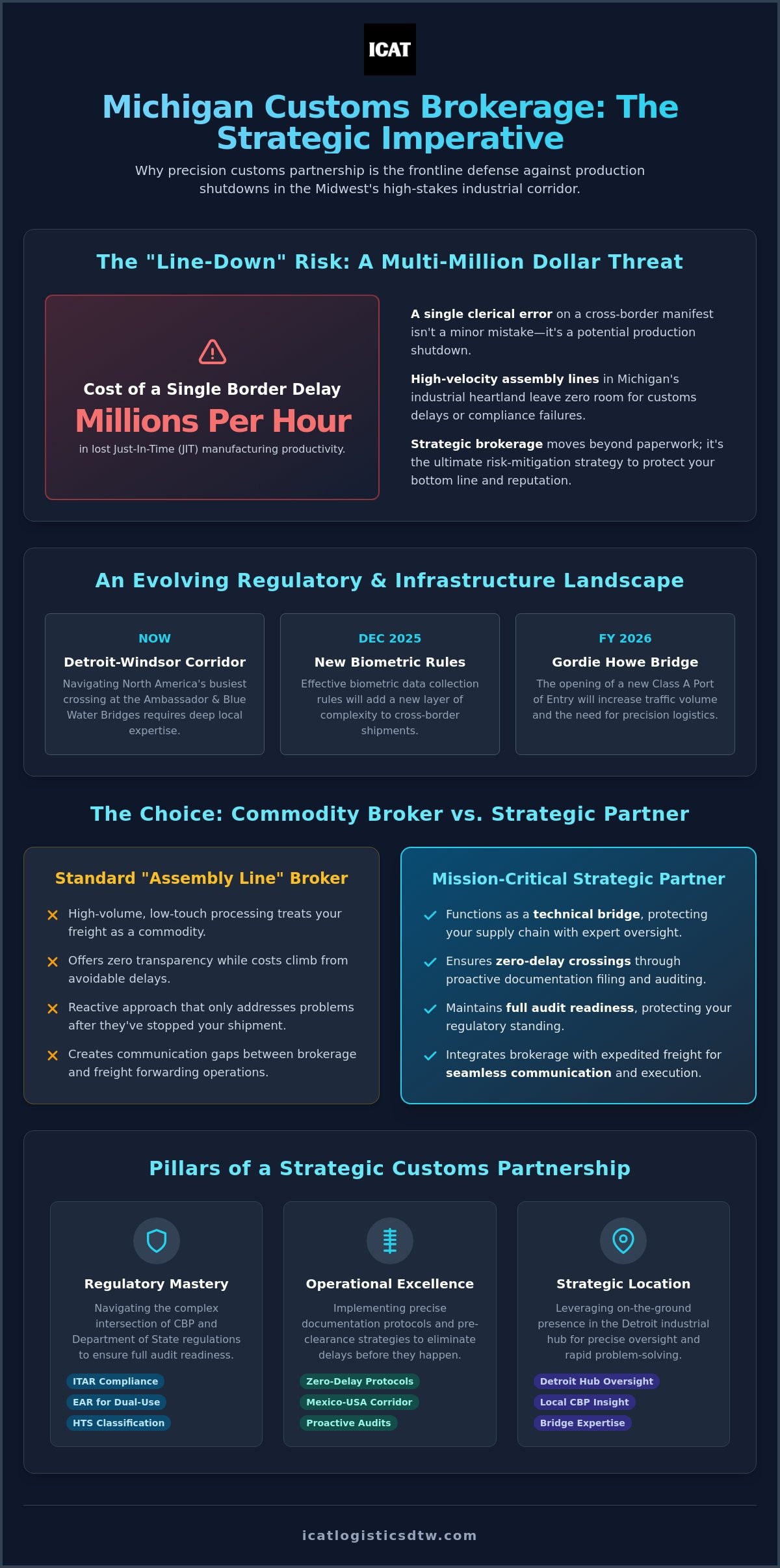
A single clerical error on a cross-border manifest isn’t just a paperwork mistake. It’s a total production shutdown. In the high-stakes industrial corridors of the Midwest, your choice of customs brokerage Michigan determines whether your cargo moves or sits idle at the Detroit-Windsor crossing. With the Gordie Howe International Bridge scheduled to open in fiscal year 2026 as a Class A Port of Entry, the complexity of these trade lanes is only increasing. You can’t afford a partner who treats your high-value freight like a commodity.
You’ve likely felt the frustration of “assembly line” brokers who offer zero transparency while your costs climb due to avoidable delays. It’s a risk that threatens your bottom line and your regulatory standing, especially with shifting ITAR Part 130 requirements and the new biometric data collection rules effective as of December 2025. This guide promises a strategic path forward, showing you how to prioritize regulatory precision without sacrificing speed. We’ll explore the methodologies that ensure zero-delay crossings, full audit readiness, and a seamless integration between your brokerage and freight forwarding operations.
Key Takeaways
- Understand why viewing customs brokerage as a technical bridge rather than a clerical task is essential for protecting Michigan assembly lines from costly shutdowns.
- Master the intersection of CBP and Department of State regulations to maintain full audit readiness and ITAR compliance for defense-related cargo.
- Learn the tactical advantages of integrating your customs brokerage Michigan with expedited freight services to eliminate the communication gaps found in high-volume brokers.
- Discover the specific documentation protocols required to navigate the complex Mexico-to-USA corridor and ensure zero-delay border crossings.
- Identify how a strategically located partner in the Detroit industrial hub provides the precise oversight needed for mission-critical supply chain continuity.
The Strategic Importance of Customs Brokerage in Michigan
In the industrial heart of the Midwest, customs brokerage Michigan represents far more than a regulatory requirement. It functions as the technical bridge connecting global tier-one suppliers to the high-velocity production lines of Detroit and beyond. A Customs broker acts as a specialized intermediary; they ensure that every shipment complies with the complex web of federal laws governing international trade. When cargo is mission-critical, this role shifts from clerical support to a frontline defense against supply chain failure.
Standard brokerage often focuses on high-volume, low-touch processing. This “assembly line” approach is dangerous for Michigan manufacturers. A single misclassification or missing document doesn’t just result in a fine. It halts an entire assembly plant. In 2026, customs brokerage is the ultimate risk-mitigation strategy, ensuring that global regulatory volatility never dictates the speed of local production. Moving beyond mere paperwork, strategic brokerage protects your brand’s reputation and your bottom line by maintaining total operational control.
The ‘Line-Down’ Risk: Why Precision Matters
Just-In-Time (JIT) manufacturing leaves no room for error. A 24-hour border delay at a Port of Entry can trigger a cascading failure across multiple facilities. When time-critical automotive components are stuck, the cost isn’t measured in hundreds of dollars; it’s measured in millions per hour of lost productivity. A strategic partner prioritizes pre-clearing these shipments before they even reach the border. By proactively filing and auditing documentation, expert oversight prevents million-dollar production stoppages that would have otherwise crippled a week’s output.
Michigan’s Gateway: The Ambassador Bridge and Beyond
Michigan occupies a unique trade position, managing the busiest international crossing in North America. Navigating the Detroit-Windsor corridor requires more than general knowledge. It demands an understanding of local infrastructure nuances and the specific operational habits of Customs and Border Protection (CBP) at the Ambassador Bridge and the Blue Water Bridge. Local Michigan expertise is non-negotiable. Without a partner who understands the specific flow of cross-border freight in this region, your cargo is at the mercy of unpredictable inspection queues and infrastructure bottlenecks. Precision at the point of entry is the only way to guarantee continuity.
Regulatory Mastery: Navigating ITAR, EAR, and Trade Compliance
Compliance is a battlefield where the margin for error is zero. For Michigan’s industrial leaders, trade compliance requires managing the complex intersection between Customs and Border Protection (CBP) and the Department of State. While standard shipments face routine scrutiny, mission-critical cargo often falls under the International Traffic in Arms Regulations (ITAR) or Export Administration Regulations (EAR). If you’re moving defense-related articles through the Port of Detroit, your customs brokerage Michigan partner must possess deep technical knowledge to prevent federal violations.
The role of the broker extends far beyond filing entries. They’re the architects of your audit trail. Federal oversight is relentless; a clean record is the only protection against crippling penalties. Managing EAR for dual-use technologies requires identifying items that have both commercial and military applications, ensuring every license is valid and every restriction is met. When the Department of State is involved, the oversight intensifies. You need a partner who understands that regulatory precision is the foundation of production-line continuity.
Defense Logistics: Beyond Standard Customs
Handling defense cargo isn’t a standard logistics task. It demands specialized documentation and rigorous physical security protocols to protect sensitive technical data. Utilizing ITAR compliant logistics Michigan ensures that your high-security shipments move through a chain of custody that meets every federal mandate. Specialized brokers don’t just move boxes; they manage the regulatory risk associated with advanced defense technologies. Partnering with customs and trade compliance experts ensures that your documentation remains bulletproof under federal scrutiny.
HTS Classification and Valuation Accuracy
Precision in Harmonized Tariff Schedule (HTS) classification is a financial necessity. Misclassifying goods leads to immediate seizures, heavy fines, and increased scrutiny on every future shipment. Securing a dedicated customs brokerage Michigan partner allows for a granular review of your entire product catalog to ensure every HTS code is defensible. Beyond classification, strategic valuation ensures you pay the exact duty required by law without overpaying. It’s about operational control and financial exactness. HTS misclassification triggers long-term CBP audits that can drain resources for years. Avoid the “assembly line” trap by demanding a brokerage partner who prioritizes technical excellence over high-volume shortcuts.
Brokerage vs. Strategic Partnership: Choosing Your Ally
Selecting a partner for customs brokerage Michigan isn’t a simple procurement exercise. It’s a decision on who will guard your supply chain’s integrity. Many high-volume brokers operate on an “assembly line” model, treating every entry as a generic transaction. This approach fails when a shipment becomes complex or time-sensitive. Mission-critical shippers require more than a data entry service. They need a strategic ally that acts as an authoritative extension of their own compliance team.
Integration is the primary catalyst for speed. When your brokerage is decoupled from your freight forwarding, communication gaps emerge. These gaps lead to terminal storage fees and production delays. By unifying brokerage with specialized services like air freight Detroit Michigan, you eliminate the friction between clearance and transit. You gain real-time visibility into the clearance process, allowing you to make operational decisions based on hard data rather than optimistic estimates.
A strategic partner anticipates regulatory shifts. They don’t wait for a shipment to be flagged at the border to address a problem. Whether it involves updates to the International Traffic in Arms Regulations (ITAR) or sudden shifts in trade policy, proactive oversight ensures your documentation is bulletproof before the truck leaves the supplier. This foresight transforms compliance from a logistical hurdle into a distinct competitive advantage.
The Dedicated Analyst Advantage
Your business is unique. Your SKU library contains technical nuances that a generic clerk will inevitably overlook. The difference between a data entry clerk and a licensed Customs Broker is the ability to interpret complex trade law, not just fill out forms. A dedicated analyst becomes intimately familiar with your specific products, building a long-term compliance profile that actively reduces “red flags” from CBP. This level of personalized oversight is the only way to maintain a flawless audit record in a high-stakes environment.
Digital Customs: ACE, ISF, and RLF
Modern trade demands digital precision. Leveraging the Automated Commercial Environment (ACE) is essential for streamlining filings and accelerating processing times. For ocean freight, timely Import Security Filings (ISF) are non-negotiable. Missing an ISF deadline triggers automatic fines and holds that can derail an entire project. Remote Location Filing (RLF) provides the ability to clear cargo at any U.S. port from a centralized Michigan hub. This ensures consistency in classification and valuation, providing absolute control over your national import footprint regardless of where the goods land.
Operational Excellence for Michigan Cross-Border Freight
Execution at the border is won or lost long before the truck reaches the gate. In the high-pressure environment of the Detroit-Windsor corridor, operational excellence requires a methodical approach to documentation. Your customs brokerage Michigan partner must ensure every manifest is pre-filed and every duty calculation is verified before the wheels even turn at the supplier’s facility. Waiting for a shipment to reach the Ambassador Bridge or the Detroit-Windsor Tunnel to discover a paperwork error is a recipe for a production-stopping delay.
Managing the Mexico-to-USA corridor introduces additional layers of complexity for Michigan manufacturers. This long-haul route involves multiple jurisdictions and higher security risks that demand elite oversight. C-TPAT certification isn’t just a badge of honor; it’s a functional tool that accelerates border crossings by placing your cargo in low-risk lanes. Even with these safeguards, contingency planning is vital. When a shipment is flagged for a random inspection, an expert broker doesn’t just wait for a status update. They actively manage the communication with CBP to minimize the duration of the hold and keep your supply chain moving.
Optimizing the Canada-Michigan Pipeline
The flow of goods between Ontario and Michigan is the lifeblood of the regional economy. Precision here is non-negotiable. Shippers should utilize tools like the Mission-Critical Ocean Freight Forwarder Checklist to synchronize sea legs with land transport, ensuring that documentation for USMCA compliance is flawless. With the Remote Area Border Crossing (RABC) permit program ending on September 14, 2026, reporting requirements are becoming more centralized, making expert oversight even more critical for those navigating remote entry points accessible from Michigan.
Audit Readiness and Post-Entry Services
Surviving a CBP audit depends on the integrity of your digital records. A strategic partner maintains a comprehensive, organized archive of every transaction, ensuring you’re always ready for federal scrutiny. If errors are discovered post-entry, your broker should utilize Post-Summary Corrections to fix mistakes before they escalate into formal violations. Proactive brokers also identify opportunities for cost recovery through Duty Drawback programs, allowing you to reclaim duties on goods that are subsequently re-exported. For those who demand absolute control over their trade operations, securing a dedicated compliance partner is the only logical step.
ICAT Detroit: Your Mission-Critical Customs Partner
ICAT Detroit stands as the steady, expert hand required for high-pressure logistics. Our strategic location in Taylor, Michigan, offers a decisive tactical advantage for the region’s industrial hubs. We’re positioned at the epicenter of the Detroit automotive and defense corridors, providing immediate oversight for cargo moving through major ports of entry. This proximity allows us to respond with the urgency your mission-critical supply chain demands. We don’t just process entries; we take full ownership of the outcome. In our world, failure isn’t considered a possibility.
The ICAT difference lies in the seamless fusion of elite customs brokerage Michigan with expedited freight shipping Detroit. This integration eliminates the friction points that plague standard logistics models. When every second counts, you can’t afford to have a broker who doesn’t understand the urgency of the freight. We speak the language of the automotive and defense sectors because we operate within them every day. We understand that a single missing document can jeopardize a multi-million dollar contract or stop an assembly plant. We provide the composure and precision needed to navigate these high-stakes scenarios with ease.
One Partner, Total Control
Managing separate providers for brokerage and transport is a risk you don’t need to take. This fragmented approach creates “hand-off” errors where critical technical data or timing requirements are lost in transition. A unified strategy ensures that the team clearing your goods is the same team moving them. This creates a closed-loop system of accountability and absolute reliability. You receive actionable trade intelligence through customized reporting, allowing you to monitor your compliance health and shipment status in real time. Total control means having a single, authoritative partner who manages every moving part with methodical precision and transparency.
Secure Your Michigan Supply Chain Today
Transitioning to a strategic brokerage model is a necessary evolution for industrial leaders who value production-line continuity. It begins with a comprehensive compliance gap analysis. Our experts scrutinize your current SKU library and HTS classifications to identify hidden risks before they result in federal penalties or production stops. Don’t wait for a border crisis to evaluate your logistics partner. Proactive involvement and expert oversight are the only ways to safeguard your brand and your bottom line. Contact ICAT Detroit to safeguard your international shipments and ensure your mission-critical cargo reaches its destination without delay.
Securing Your Competitive Edge in Global Trade
Compliance in international trade isn’t a static goal; it’s an ongoing operational requirement. You’ve seen how precision in HTS classification and ITAR mastery prevents the “line-down” scenarios that cripple production. A strategic partner doesn’t just react to border delays. They eliminate them through proactive filing and methodical oversight. By choosing an elite customs brokerage Michigan partner, you transform regulatory hurdles into a streamlined gateway for your high-value cargo.
ICAT Detroit offers the steady hand of Licensed Customs Brokers and ITAR & EAR compliance experts who take full ownership of your outcomes. Our strategic Taylor, MI location near Detroit Metro Airport ensures we’re positioned exactly where your mission-critical supply chain needs us most. It’s time to move beyond the assembly-line brokers who prioritize volume over accuracy. Secure Your Mission-Critical Supply Chain with ICAT Detroit and gain the absolute reliability your operation demands. You can move forward with confidence, knowing your trade compliance is in expert hands.
Frequently Asked Questions
What is the difference between a freight forwarder and a customs broker in Michigan?
A freight forwarder coordinates the physical transport of goods across borders while a customs broker manages the legal entry of those goods into the U.S. In Michigan, these roles often overlap within a single strategic partner to ensure supply chain continuity. The broker focuses on regulatory compliance, duty payment, and filing through the Automated Commercial Environment. The forwarder handles the logistics of air, sea, or ground movement from supplier to facility.
How do I know if my Michigan business needs an ITAR-compliant broker?
Your business requires an ITAR-compliant broker if you import or export defense-related articles, services, or technical data listed on the United States Munitions List. This is common for Michigan manufacturers serving the aerospace and defense sectors. A specialized broker ensures that every shipment meets Department of State requirements and maintains the rigorous record-keeping necessary to survive a federal audit. Precision in these high-stakes shipments is non-negotiable for maintaining your export privileges.
What are the common causes of customs delays at the Detroit-Windsor border?
Most delays at the Detroit-Windsor border stem from clerical manifest errors or missing documentation for Partner Government Agency (PGA) requirements. Discrepancies between the commercial invoice and the actual cargo trigger immediate holds by Customs and Border Protection. Infrastructure congestion at the Ambassador Bridge can also play a role, but proactive filing through a dedicated customs brokerage Michigan partner significantly reduces these risks by resolving issues before the truck reaches the gate.
Can ICAT Detroit clear my cargo at ports outside of Michigan?
Yes, ICAT Detroit utilizes Remote Location Filing (RLF) to clear cargo at any authorized U.S. port of entry from our Michigan hub. This capability allows for centralized control over your entire national supply chain. You maintain consistent classification and valuation across all shipments, regardless of whether they arrive in Los Angeles, Savannah, or Detroit. This ensures that your compliance profile remains uniform and defensible across all points of entry.
How much does customs brokerage cost for industrial machinery?
The cost of brokerage for industrial machinery depends on the complexity of the HTS classification and the specific regulatory requirements of the shipment. High-value equipment often requires specialized handling and detailed documentation to ensure accurate valuation. Shippers should consult with a licensed broker to evaluate the specific technical requirements of their machinery before the transport begins to ensure a precise quote based on their unique SKU library.
What documents are required for USMCA duty-free treatment?
USMCA duty-free treatment requires a valid Certification of Origin that identifies the goods as qualifying under specific rules of origin. The importer must also provide a detailed commercial invoice and any necessary supporting data to prove the regional value content. Precision in these documents is essential to avoid retroactive duty assessments during a post-entry audit. Your broker ensures that every claim for duty-free status is backed by verifiable technical data.
How does C-TPAT membership benefit Michigan importers?
C-TPAT membership provides Michigan importers with a significant tactical advantage through reduced CBP inspection rates and shorter wait times at the border. Participants are viewed as low-risk partners, which translates to priority processing during times of heightened security or border congestion. This status is vital for maintaining the production-line continuity required in Just-In-Time manufacturing environments where even a minor delay can halt an entire assembly plant.
What should I do if my shipment is held for a CBP intensive exam?
If your shipment is held for an intensive exam, you must immediately coordinate with your broker to provide any additional technical data requested by CBP. The broker acts as your representative, managing the communication with port officials to expedite the release process. While exams are a standard part of border security, having a steady, expert hand to oversee the resolution prevents a temporary hold from becoming a permanent supply chain failure that disrupts your operations.